Careerplanb · July 23, 2026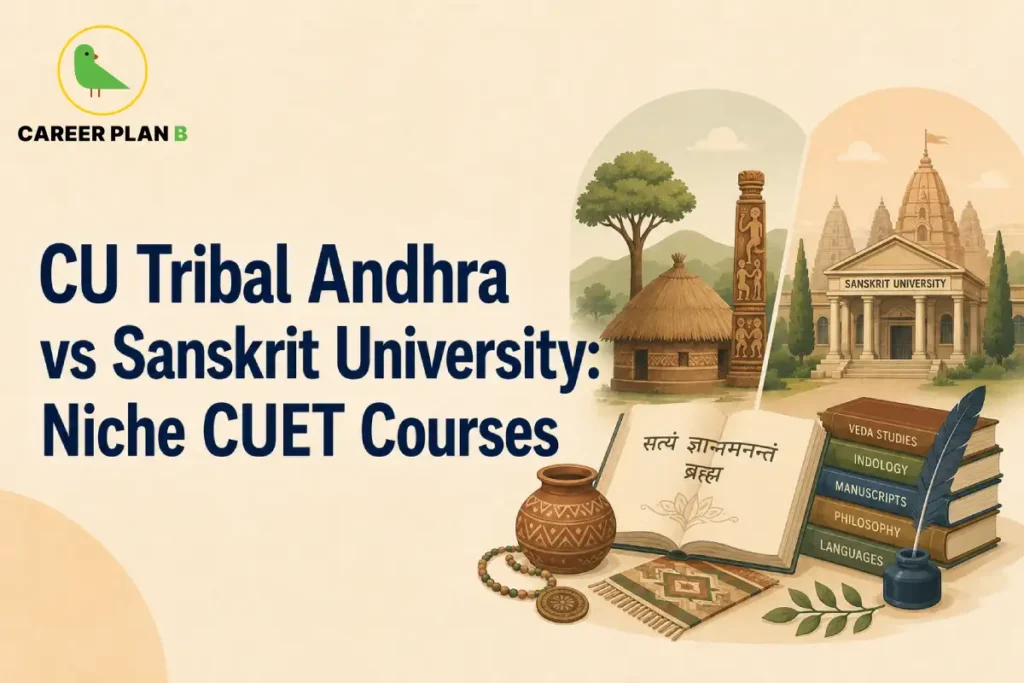
Introduction
Every January, lakhs of Class 12 students sit with a CUET form open on one tab and a hundred doubts open in their head. Engineering, medicine, commerce — the usual suspects get all the attention. But tucked away in the CUET list are niche CUET courses that rarely make it to dinner-table conversations, offered by universities most students have never even heard of.
Two such names are the Central Tribal University of Andhra Pradesh and Central Sanskrit University. They could not be more different on paper, yet both throw open doors to niche CUET courses that reward curiosity over crowd-following. This blog walks you through both, so you can decide if the road less taken is actually the road meant for you.
The Story Behind Two Very Different Universities
Picture a young researcher named Aditi, sitting with her CUET scorecard, unsure whether to follow the herd into a generic BA or explore something that actually excites her. That is the exact fork in the road thousands of students face every year, and it is worth slowing down to understand where each path leads.
Central Tribal University of Andhra Pradesh: Where Culture Meets Classroom
Established in 2019 in Vizianagaram, the Central Tribal University of Andhra Pradesh was built with one clear purpose: giving tribal communities and every curious learner access to quality higher education rooted in identity and culture. It is not just another central university offering the usual BA, BSc, BCom combo. It has quietly built a reputation around programmes that blend science, culture, and community development.
Its Department of Tribal Studies stands out as one of its most distinctive offerings, alongside departments in Biotechnology, Journalism and Mass Communication, and Tourism & Hospitality Management. Admission works entirely through CUET, both at the undergraduate and postgraduate level, followed by a counselling process on the university’s own portal.
Confused about your next steps? Get a personalized roadmap tailored to your career goals.
Central Sanskrit University: Ancient Roots, Modern Doors
Now shift the scene to Central Sanskrit University, one of India’s oldest institutions dedicated to Sanskrit learning, currently accepting students through both CUET and non-CUET routes. This is where niche CUET courses take an entirely different shape. Beyond the expected Shastri and Acharya degree programmes, the university offers something most students never expect from a “Sanskrit university” — a B.A. Hons. in Sanskrit and Civil Services Studies and even an LL.B. (Hons.) in Bhartiya Jurisprudence.
For CUET-based admissions, the university has run Phase-I of its admission process for Shastri, Shastri Pratishtha, B.A. Hons. in Sanskrit & Civil Services Studies, and B.Sc. programmes based on CUET UG results, while postgraduate admissions to programmes like Acharya, MA, and MSc are conducted through CUET PG. Yes, an MSc through a Sanskrit university — that one surprises most people on the first read.
Why Should Students Even Consider Niche CUET Courses?
Isn’t it safer to just pick something popular? That is the question every parent asks, and it deserves an honest answer.
Niche courses exist precisely because the job market has stopped rewarding sameness. A student who studies Tribal Studies understands anthropology, policy, and grassroots development in a way a generic sociology graduate simply doesn’t. A student who studies Sanskrit alongside Civil Services Studies walks into UPSC preparation with a head start most competitors spend years trying to catch up on.
Here’s what makes these programmes worth a second look:
- Lower competition, higher opportunity — fewer applicants means better odds of getting a seat that actually interests you
- Specialised faculty — departments built around one subject tend to attract deeply invested professors
- Government and research pathways — many niche courses feed directly into UPSC, research fellowships, and museum or heritage-sector careers
- Cultural and intellectual depth — a rare kind of education that a mainstream degree simply cannot offer
CTUAP vs Central Sanskrit University: A Side-by-Side Look
| Aspect | Central Tribal University of Andhra Pradesh | Central Sanskrit University |
|---|---|---|
| Established | 2019 | 1970 |
| Core Focus | Tribal culture, science, and social work | Sanskrit, Vedic studies, and jurisprudence |
| Standout Niche Course | Tribal Studies, Tourism & Hospitality | Sanskrit & Civil Services Studies, Bhartiya Jurisprudence LL.B. |
| Admission Mode | CUET UG and CUET PG | CUET UG, CUET PG, and Non-CUET admissions |
| Best Suited For | Students interested in social sciences and community development | Students preparing for UPSC, law, or classical studies |
What Kind of Student Thrives at CTUAP?
Think of a student who has always been fascinated by how communities preserve their identity through generations — their food, their festivals, their oral histories. That student is not going to find their spark in a standard commerce degree. At CTUAP, departments like Tribal Studies and Sociology are built around exactly this kind of curiosity, while newer additions in Computer Science and Biotechnology show the university is not stuck in the past either.
Wondering how the admission actually works? The process is straightforward: qualify CUET, register on the university’s dedicated portal, and go through merit-based counselling rounds.
What Kind of Student Thrives at Central Sanskrit University?
Now imagine a different student — one who loves language, philosophy, and law in equal measure. Someone who wants to read the Vedas in their original form but also dreams of cracking the UPSC exam someday. Central Sanskrit University’s Sanskrit and Civil Services Studies programme was practically built for this student. So was its unusual law programme grounded in Bhartiya Jurisprudence, a niche most law aspirants don’t even know exists until much later in life.
These aren’t backup options. For the right student, they are the fastest route to a career that actually fits.
Making the Choice: A Few Honest Questions to Ask Yourself
Before filling any CUET preference form, students and parents together should sit down and ask a few simple questions.
- Does the student want a career centred on culture and community, or on classical language and law?
- Is the goal a straightforward job, or a longer path involving UPSC, research, or academia?
- How comfortable is the student with a smaller, close-knit university environment?
- Has the family actually visited the official course pages, or is this decision being made on rumours and hearsay?
These four questions alone eliminate most of the confusion that keeps students stuck between generic choices.
How Career Plan B Helps
Career Plan B helps students choose the right niche CUET course through a personalized approach that connects their academic choices with their strengths, interests, and long-term career goals:
- Personalized Career Counselling: Helps students understand their strengths, interests, academic goals, and future aspirations so they can choose the niche CUET course and university that best align with their ambitions.
- Psycheintel & Career Assessment Tests: Provides data-backed insights into aptitude, personality traits, interests, and learning styles, helping students identify specialized academic pathways and career options that best match their natural abilities.
- Admission & Academic Profile Guidance: Supports students in strengthening their academic profile, understanding programme eligibility requirements, interpreting their CUET performance, and planning strategically for university admissions.
- Career Roadmapping: Creates a structured, step-by-step plan that connects course and university selection with skill development, internships, higher education opportunities, and long-term career aspirations, giving students a clear direction throughout their academic journey.
For Latest Information
Frequently Asked Questions
1. Are niche CUET courses recognised the same way as mainstream degrees?
Yes. As long as the university is UGC-recognised, like both CTUAP and Central Sanskrit University are, the degree carries full academic value.
2. Can a science student apply for a niche course like Tribal Studies or Sanskrit programmes?
In most cases, yes. Eligibility depends on the specific CUET domain subjects chosen, not strictly on the stream studied in Class 12.
3. Is Central Sanskrit University only for students who already know Sanskrit?
Not necessarily. Several programmes, including newer interdisciplinary ones, are designed for students with a genuine interest rather than prior fluency.
4. Do niche courses limit future career options?
Not at all. Many actually open doors to UPSC, research, journalism, and policy work that mainstream degrees rarely prepare students for as directly.
5. How is admission to CTUAP different from regular central universities?
The process runs entirely through CUET UG and CUET PG scores, followed by counselling directly through the university’s own admission portal.
Conclusion
Choosing between a tribal studies degree in Vizianagaram and a Sanskrit-meets-law programme in Delhi is not really about picking the “better” university. It’s about picking the version of yourself you want to spend the next three years becoming. Both institutions prove that a meaningful education doesn’t always come from the most talked-about names on the CUET list.
If this blog made you pause and reconsider your own CUET choices, that pause was worth it. Talk to your parents, revisit your interests honestly, and remember that the right course is rarely the loudest one in the room — it’s simply the one that fits.