 Team6 · October 15, 2026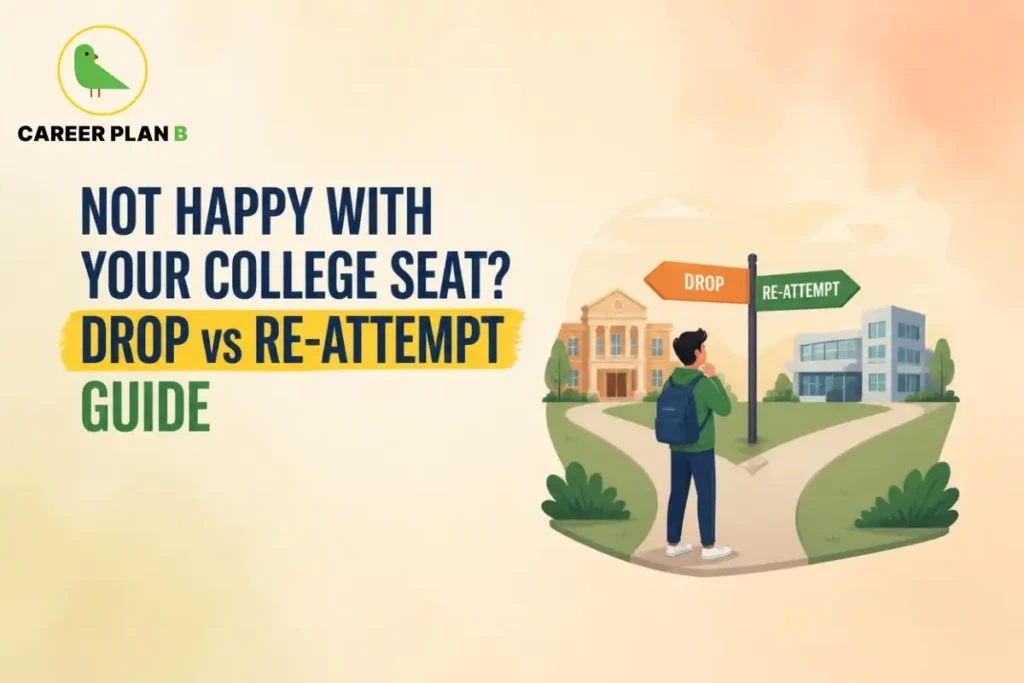
Introduction
You spent months studying, gave up weekends, skipped plans with friends, and sat through CUET 2026 with everything you had. And then the results came. You got a seat but somewhere deep down, it just doesn’t feel right. Maybe it’s the college, maybe it’s the course, or maybe it’s both. That quiet disappointment you’re carrying right now? It’s more valid than you think. Thousands of students every year face this exact crossroads after a drop year after CUET 2026 becomes a real conversation at the dinner table.
The question is — what do you do next? Do you accept the seat and push forward? Do you re-appear for CUET 2027 while staying enrolled? Or do you take a full drop year after CUET 2026 and go all in for a better shot? This guide is not here to scare you or push you in any direction. It’s here to help you think clearly, weigh your options honestly, and make a decision that actually fits your life.
You’re Not Alone — Thousands Feel This Way Every Year
Let’s put this into perspective first, because sometimes when you’re sitting at home feeling stuck, it feels like everyone else has it figured out. They don’t.
In 2024, over 13.48 lakh students registered for CUET UG, according to the National Testing Agency. The number of coveted seats in top central universities — Delhi University, JNU, BHU, Hyderabad Central University is nowhere close to that number. The math simply doesn’t work in everyone’s favour. And that’s not a reflection of how hard you worked. It’s just the reality of a highly competitive exam with limited seats at the top.
A lot of students who don’t get their preferred college or course end up making one of the biggest decisions of their lives in a matter of weeks, often under family pressure, peer comparison, and social media noise. That’s a terrible environment to make a life decision in. So before you do anything, take a breath. You have real options. And each one deserves a fair look.
First, Understand What Your Options Actually Are
When the dust settles after CUET results, you broadly have three paths in front of you. Most students know this but haven’t actually sat down and thought through what each one truly means for them.
Option 1 — Accept the Seat and Make the Best of It
This is the path most families push for, and honestly, it’s not always the wrong one. Joining a college even if it wasn’t your first choice gives you structure, a peer group, exposure to university life, and time to figure out what you actually want from your career.
Many students who initially felt disappointed with their college seat went on to have incredible careers because they used their time there wisely. They participated in fests, built networks, pursued certifications, cracked competitive exams on the side, and discovered interests they never knew they had.
But here’s the catch — this only works if you genuinely engage with where you are. If you spend three years resenting your college instead of growing in it, you’ll come out the other side with a degree and a lot of regret. Ask yourself this honestly: Can I see myself giving this place a real chance?
Option 2 — Re-Appear for CUET 2027 While Staying Enrolled
Yes, this is possible. You can take admission in your allotted seat, attend college, and simultaneously prepare for CUET 2027 to try for a better college or course next year.
If you’re successful, you can take a lateral transfer or simply leave and join the new college. It sounds like the best of both worlds and sometimes it is. But it comes with its own weight. Managing college attendance, assignments, new friendships, and serious CUET preparation all at once is genuinely hard. It requires exceptional time management and a very clear head.
This option works best for students who are disciplined, self-motivated, and whose target college difference is significant enough to justify the effort.
Option 3 — Full Drop Year After CUET 2026 to Re-Attempt in 2027
This is the option that gets the most drama from relatives, neighbours, and sometimes even well-meaning friends. “Ek saal waste ho jayega” is something you’ve probably already heard.
But a drop year after CUET 2026, when planned and executed well, is not a waste. It can be one of the most focused, transformative years of your life if you treat it like one.
The keyword here is if. A drop year without structure, clear goals, and the right support system can quickly become a year of Netflix, anxiety, and regret. The difference between a productive drop year and a wasted one comes down entirely to how seriously you approach it.
Who Should Actually Consider a Drop Year? Be Honest With Yourself
This is the section most guides skip and it’s the most important one. Not every student should drop. And not every student should accept their seat. The right answer depends entirely on your specific situation. Here’s a realistic way to think about it.
A drop year after CUET 2026 might make sense for you if:
- The gap between your current allotted college and your target college is genuinely significant in terms of ranking, course quality, or career outcomes
- You have a very specific course or university in mind and you know why you want it, not just because it sounds prestigious
- You are self-aware enough to know you didn’t prepare as well as you could have for CUET 2026, and you believe with better preparation, your score will meaningfully improve
- Your family is financially and emotionally supportive of this decision
- You have a solid plan for how you will spend the year not just “study harder”
- Your mental health is stable enough to handle a year of uncertainty and social pressure
You should probably not drop if:
- You’re dropping purely because of peer pressure or because a friend got a better college
- You don’t have a clear target or plan and are hoping things will “just work out”
- The difference in college quality is marginal and not worth a full year
- You tend to struggle with self-discipline without external structure like school or coaching
- The emotional and financial cost on your family is significant
There’s no shame in either answer. The smartest thing you can do right now is be ruthlessly honest with yourself about which category you fall into.
The Real Cost of Dropping — It’s Not Just One Year
Let’s talk about what nobody tells you clearly about a drop year.
Emotionally, it can be isolating. Your friends are in college, making memories, posting pictures. You’re at home, studying. Some days will feel purposeful. Other days will feel like you’re falling behind. That emotional rollercoaster is real, and you need to be prepared for it.
Financially, a drop year means a delayed start to your degree, which means a delayed start to your career and earnings. Depending on your family’s situation, this may or may not be a meaningful factor.
Socially, the pressure from family and extended circles can be exhausting. Everyone has an opinion. Everyone has a cousin who dropped and “ruined” their life, or a cousin who dropped and “made it big.” People project their fears and hopes onto your decision, and filtering that noise requires maturity.
Academically, if your CUET 2026 score was low because of genuine preparation gaps — lack of time, weak subjects, poor strategy — a drop year can help you close those gaps meaningfully. But if your score was close to your target and you just missed out, ask yourself whether a full year is necessary or whether a smarter re-attempt strategy while enrolled could work just as well.
None of this is meant to discourage you. It’s meant to make sure you go in with open eyes.
If You Do Drop — Here’s How to Make It Count
So you’ve decided. You’re taking a drop year after CUET 2026 and going all in for CUET 2027. Here’s how you build a year that actually moves the needle.
Start with a proper gap analysis: Don’t just start studying from the beginning. Analyse your CUET 2026 performance subject by subject. Where did you lose marks? Was it speed? Accuracy? Conceptual gaps? Your preparation strategy should be built around your weaknesses, not just your strengths.
Build a realistic daily schedule and stick to it: Treat your drop year like a job. Fixed study hours, fixed breaks, fixed sleep. The biggest enemy of a productive drop year is an unstructured day that bleeds into another unstructured day. Before you know it, three months have passed.
Register for CUET 2027 well in advance: The NTA official website releases CUET UG notifications usually in the early months of the year. Keep an eye on it and don’t miss registration deadlines.
Take mock tests early and often: Don’t wait until you feel “ready” to start attempting mocks. Start early, track your progress, and adjust your strategy based on data, not feelings.
Don’t neglect your mental health: This cannot be overstated. Build on days off. I have hobbies. Talk to people you trust. If anxiety or pressure becomes overwhelming, speak to a counsellor. There is absolutely no strength in suffering silently through a drop year.
Use the year to also explore your career direction: A drop year is not just about CUET. It’s a window to understand yourself better — what subject excites you, what kind of career environment you want, what your actual strengths are beyond exam scores. Don’t waste that.
Have Any Doubts?
Can You Re-Attempt CUET 2027 While Staying Enrolled in College?
Let’s look at this option more closely because it’s underused and often dismissed without real thought.
| Factor | Dropping & Re-Attempting | Staying Enrolled & Re-Attempting | 2026–2027 Strategic Decision Matrix |
|---|---|---|---|
| Focus on CUET prep | High | Moderate | A full drop year provides uncompromised time blocks for deep domain mastery and rigorous mock test simulations. |
| Social life & peer group | Limited | Active | Enrolled students maintain a built-in social buffer, whereas droppers must proactively manage isolation and dopamine hygiene. |
| College experience | Delayed by a year | Continues normally | Weigh the opportunity cost of an academic gap year against the potential career ROI of securing a top-tier central university seat. |
| Risk if CUET 2027 doesn’t improve | High | Lower | Simultaneous enrollment in a backup institution provides a safety net against single-exam variance. |
| Pressure & isolation | High | Moderate | Droppers require structured peer-group sessions and active mental wellness check-ins to prevent burnout. |
| Ideal for | Students with big gaps to cover | Students with small score gaps | Align your choice strictly with your diagnostic audit results from your previous attempt’s score analysis. |
The truth is, staying enrolled while re-attempting suits students who are already close to their target score and just need a sharper, more focused second attempt. If your CUET 2026 score was significantly off from what your target college requires, a full drop year with complete focus may serve you better. Talk to seniors who have done both. Their real experience is worth more than any general advice.
How Career Plan B Helps
Career Plan B helps students make one of the most important post-CUET decisions with clarity, confidence, and a long-term perspective:
- Personalized Career Counselling: Helps students evaluate whether a drop year, a CUET 2027 re-attempt, or an alternative admission pathway is the best fit for their goals, circumstances, and aspirations.
- Psycheintel & Career Assessment Tests: Provides data-backed insights into aptitude, personality traits, interests, learning styles, and academic/career alignment, helping students understand where their true strengths lie.
- Admission & Academic Profile Guidance: Supports students in assessing current admission opportunities, strengthening their academic profile, and planning strategically for future applications if they choose to reattempt.
- Career Roadmapping: Helps students create a structured plan that connects today’s decision with future academic milestones, skill development, higher education opportunities, and career goals.
- End-to-End Guidance: Assists students and families throughout the decision-making process so choices are based on self-awareness, realistic opportunities, and long-term success rather than pressure or uncertainty.
For Latest Information
Frequently Asked Questions
Q1. Can I appear for CUET 2027 if I take admission in a college after CUET 2026?
Yes, you can. CUET does not restrict students who are already enrolled in a college from re-appearing. However, check the specific eligibility criteria on the NTA official website once the CUET 2027 notification is released, as rules can be updated.
Q2. Is a drop year after CUET 2026 looked down upon by colleges or employers?
Not at all. A gap year for academic re-preparation is widely understood and accepted. What matters is how you explain it and what you did during that time. A purposeful drop year with clear outcomes is never a red flag.
Q3. How much can my CUET score realistically improve in one year?
This depends entirely on why your score was what it was. Students who had preparation gaps, weak subjects, or poor exam strategy have seen significant score improvements — sometimes 30 to 50 percentile points with focused re-preparation. Students who were already close to their peak may see smaller jumps.
Q4. What should I do during a drop year besides studying for CUET 2027?
Explore online courses in your area of interest, take up a part-time skill-building programme, read widely, and work on your overall personality and communication. A drop year is not a prison sentence — it’s a year to grow in multiple directions, with CUET preparation as the anchor.
Conclusion
At the end of the day, this decision — drop or re-attempt or simply move forward is yours to make.Yours. And the fact that you’re reading this, thinking carefully rather than reacting impulsively, already says something good about you. A college seat is not the whole story of your life. It’s one chapter.
What matters most is not which path you pick, but how fully you commit to it once you do. Whether you choose to make the most of the seat you have, re-attempt while enrolled, or take a purposeful drop year after CUET 2026 give it everything. Half-hearted decisions made under pressure rarely lead anywhere good. Trust yourself, plan well, and remember that clarity always beats speed when it comes to your future.


