Team6 · July 9, 2026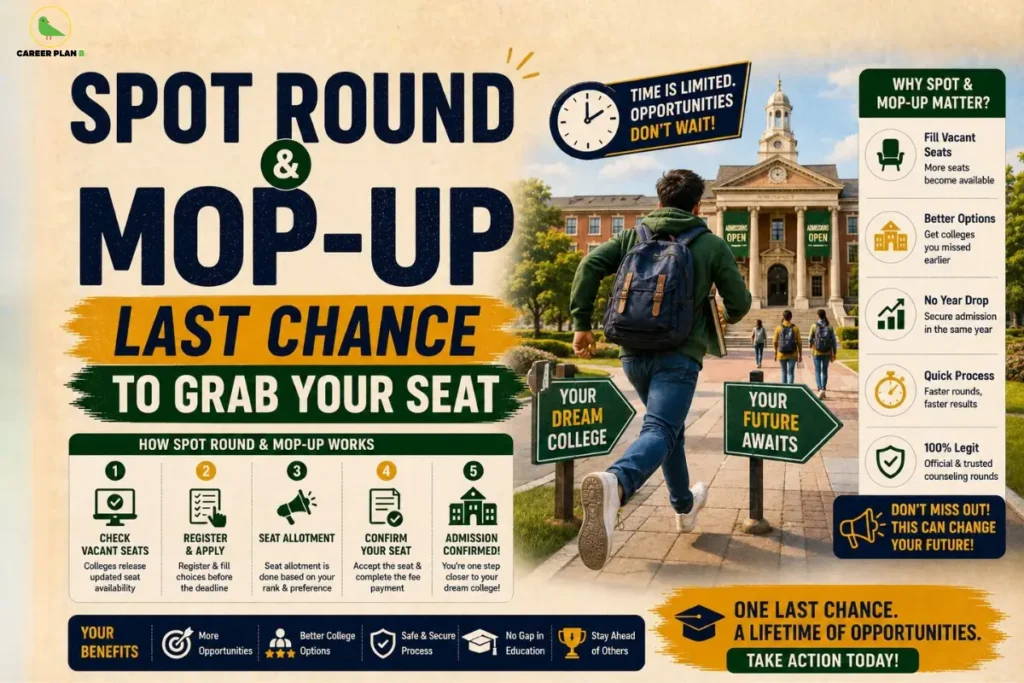
Introduction
You studied for months. You sat through the CUET exam. You waited anxiously for results. And now, even after all of that, you still don’t have a confirmed college seat. If that sounds like your story right now, take a breath because the CUET 2026 spot round might just be the second chance you’ve been waiting for.
Every year, thousands of students either miss out on the regular counselling rounds or end up with a seat they are not happy with. The CUET 2026 spot round and mop-up admissions exist precisely for this reason to fill those leftover vacant seats and give one final window to students who are still searching. This blog walks you through everything you need to know, step by step, so you don’t waste a single day.
What Even Is a Spot Round in CUET Counselling?
Think of the regular counselling rounds as the main race. Most students get their seats during these rounds. But what happens to seats that go unfilled? Universities don’t just leave them empty. They announce a spot round and an additional round of seat allotment specifically to fill those remaining vacancies.
The spot round is conducted after the regular counselling is completed, and it is designed to fill vacant seats that remain unoccupied even after multiple rounds of seat allotment. It is essentially the final option for qualified candidates to get admission to programmes offered by CUET participating universities.
So if you missed the earlier rounds, or if you lost your previously allotted seat due to fee non-payment or document issues this is your window. It is small, it moves fast, and it will not wait.
Spot Round vs. Mop-Up Round — Are They the Same Thing?
Students often use these two terms interchangeably, but they are actually different, and knowing that difference can save you a lot of confusion.
Universities conduct the spot round online through their admission portals and allot the remaining vacant seats to eligible candidates based on merit. In contrast, universities hold the mop-up round as the final admission phase, often in offline mode, after completing the spot round. For example, BHU clearly distinguishes the mop-up round from the spot round and does not allow candidates to upgrade their allotted seats during the mop-up round.
In short: Spot round comes first, mop-up round comes last. Miss either, and the door closes.
Who Is Eligible for the CUET 2026 Spot Round?
This is the part most students skip reading, and then regret. Eligibility for the spot round is not open to everyone — there are specific conditions.
Those who did not participate in the previous CUET counselling rounds but match the eligibility requirements can apply. Those who were assigned a seat but decided to withdraw, or did not confirm their admission, can also apply.
More specifically, you are eligible if:
- You registered for CUET 2026 but did not get a seat in any regular round
- You were allotted a seat but failed to pay the admission fee within the deadline
- Your seat was cancelled or rejected during document verification
- You participated in earlier rounds but are still unplaced
For example, BHU allows candidates to apply for the spot round if they missed the counselling registration, withdrew from the admission process, or lost their allotted seat during document verification. However, candidates who have already accepted and confirmed admission to a programme generally cannot participate in the spot round for another course at the same university.
How Does the CUET Spot Round Process Actually Work?
Here’s the honest truth — the spot round window is short. Universities announce it with very little notice, and the entire process from registration to reporting can happen within a week. This is why being prepared in advance is not optional; it’s necessary.
Here is how the process typically flows:
Step 1 — Watch for the official announcement
Each university announces its spot round separately on its own admission portal. For Delhi University, monitor https://admission.uod.ac.in/ . For BHU, keep an eye on bhu.ac.in and bhucuet.samarth.edu.in. For JNU, check jnuee.jnu.ac.in.
Step 2 — Check the vacant seat matrix
Once the spot round is announced, universities release a vacant seat matrix showing which courses and colleges still have open seats. Study it carefully and match it with your CUET score and eligibility.
Step 3 — Register or log in to your existing portal dashboard
If you are already registered on the CSAS portal and were not admitted to any college at the time of the spot round announcement, you can participate by simply opting for the spot round through your dashboard. New applicants who were never on the portal may need to register fresh by paying an additional non-refundable fee.
Step 4 — Fill and lock your preferences
Choose your college and programme preferences carefully. The order you enter matters: the system allocates seats based on your merit rank and the preference order you set.
Step 5 — Wait for seat allotment
The allotment result is usually declared within a day or two of preference locking.
Step 6 — Accept and report immediately
Once allotted, you must accept the seat and physically report to the college within the given deadline with all required documents. This step has no flexibility. Miss it, and the seat goes to the next candidate.
Have Any Doubts?
Which Central Universities See Vacant Seats in Spot Rounds?
Not every university and course has vacancies in the spot round. Some popular courses at top colleges fill up completely during the first or second regular round. However, based on patterns from previous years, here is a general picture:
| University | Programs with Vacancies |
|---|---|
| Delhi University (DU) | Off-campus/less popular colleges in Humanities & Applied Sciences. |
| Banaras Hindu Univ. (BHU) | Fine Arts, Vocational courses, and specialized B.A. streams. |
| JNU, New Delhi | Certificate/Diploma in niche Foreign Languages & Area Studies. |
| Univ. of Hyderabad (UoH) | Integrated M.Sc courses and specific Social Science electives. |
| Jamia Millia Islamia (JMI) | B.Ed, Language-heavy B.A. programs, and select Arts courses. |
Note: Vacancy patterns change every year based on applications received, merit cutoffs, and withdrawal rates. Always check the official seat matrix released by the university for that specific year.
The Checklist You Need Before the Mop-Up Round Closes
Think of this as your emergency kit. Keep everything ready before the announcement even drops because once it does, you may have only 48 to 72 hours.
- CUET 2026 scorecard (downloaded from cuet.nta.nic.in)
- Class 10 and Class 12 mark sheets (originals + photocopies)
- Category certificate, if applicable — OBC-NCL and EWS certificates must be recent
- Passport-size photographs (at least 6-8 copies)
- Valid government-issued photo ID (Aadhaar, PAN, Voter ID)
- Migration or Transfer Certificate from your school
- CUET-UG application number, and sports or ECA certificates if you are applying under the supernumerary quota
- Net banking, UPI, or debit card ready for fee payment
Also, keep your CSAS portal login credentials (application number and password) saved somewhere accessible. You will need them the moment the spot round opens.
Mistakes That Cost Students Their Seat in the Last Round
These are real mistakes that real students make every single year. Knowing them in advance puts you ahead.
- Waiting to “confirm” before preparing documents — by the time you start collecting papers, the deadline has passed
- Check the admission portal every day because universities do not always send spot round announcements through SMS or email
- Assuming the mop-up round is “just like the spot round” — the mop-up round is typically offline, has no upgradation option, and is far stricter in terms of reporting
- Not opting for the spot round through the dashboard when prompted — the system does not automatically enroll you; you have to actively choose to participate
- Ignoring smaller or less-known colleges — many students fixate on top colleges and miss perfectly good options at other central universities that have seats available
How Career Plan B Helps
Career Plan B helps students navigate CUET 2026 spot rounds with clarity, speed, and confident decision-making:
- Personalized Career Counselling: Helps students evaluate last-minute options, understand realistic college and course fits, and make informed decisions even under time pressure.
- Psycheintel & Career Assessment Tests: Provides data-backed insights into aptitude, personality traits, learning styles, and suitable academic and career pathways to support quick yet informed choices.
- Admission & Academic Profile Guidance: Supports students in assessing available spot round opportunities, organizing documents, and making accurate admission decisions without missing critical steps.
- Career Roadmapping: Helps students connect even spot round admissions with their long-term academic and career direction.
- End-to-End Guidance: Assists students throughout CUET 2026 spot rounds so they don’t just secure a seat, but choose the right course and college aligned with their strengths and future goals.
For Latest Information
Frequently Asked Questions
1. Can I participate in the CUET 2026 spot round if I never registered on the CSAS portal?
Yes, in most cases. New applicants who have not registered on the CSAS portal can register online at ugadmission.uod.ac.in by paying a one-time non-refundable fee of Rs 1,000 in addition to the regular registration charges. However, this varies by university, so check the official portal for the specific university you are targeting.
2. Will my CUET score be considered in the spot round, or is it based on Class 12 marks?
It depends on the university and the specific round. Regular spot rounds are merit-based and use CUET scores. However, the on-the-spot mop-up round at DU, for instance, may consider Class 12 marks for certain categories. Always read the official notice carefully before applying.
3. Is there any upgrade option available in the mop-up round?
BHU’s mop-up round has no seat upgrade option and is a final, one-time allotment. Most universities follow a similar process.
4. What happens if I don’t report after being allotted a seat in the spot round?
Your seat will be cancelled and offered to the next eligible candidate. There is no grace period or second chance within the same round. The seat is gone permanently.
5. Can I apply to more than one university during the spot round?
Yes, since each university conducts its own spot round independently, you can apply to multiple universities simultaneously, as long as you meet the individual eligibility criteria for each. However, once you accept and confirm a seat at one, you should withdraw from others to avoid complications.
Conclusion
The CUET counselling journey is long, and if you have reached the spot round phase without a confirmed seat, it can feel exhausting. But this is not the time to give up—it is the time to stay alert. Every document matters, every deadline counts, and the choices you make on the admission portal can shape your future.
Keep your paperwork ready, log in to official portals every single day, and make decisions based on your long-term goals not just on panic or pressure. A seat secured in the spot round is worth exactly as much as one secured in Round 1. What matters is that you land in the right place, and that you actually show up for it.