Careerplanb · October 30, 2026

Introduction
You filled out that CUET form in a rush. Maybe your friend was choosing Economics, so you did too. Maybe your parents pushed for Mathematics. Maybe you genuinely thought you wanted Science — until you did not. And now, sitting with your scorecard or your admit card in hand, that one thought won’t leave you alone: did I pick the wrong subjects?
CUET subject regret is more common than you think, and it hits harder than people admit. Every year, lakhs of students appear for the Common University Entrance Test with subject combinations they are not fully confident about and then spend weeks wondering if that one decision has closed every door for them. It has not. And this blog is going to show you exactly why, and what you can do right now.
First, Take a Breath — You Are Not the Only One
Let’s be honest for a second. The CUET form comes at a point in your life when you are seventeen or eighteen, barely done with boards, still figuring out what you even like and you are expected to lock in subject combinations that feel like they will define your entire future. That is a lot of pressure for anyone.
According to the National Testing Agency, over 13 lakh students registered for CUET in recent cycles. That is 13 lakh students, most of them navigating the same confusion, the same last-minute choices, the same quiet panic after submission. You are sitting in a very large room of people who feel exactly what you feel right now. The regret is real. But so is the way forward.
Why Does CUET Subject Regret Happen in the First Place?
Understanding why this happened is not about blame. It is about clarity because once you see the root of the problem, the solution becomes a lot easier to find.
Peer Pressure and the “Everyone Is Doing It” Trap
You would be surprised how many subject combinations get chosen simply because a best friend, a cousin, or a classmate picked the same. There is comfort in familiarity. But comfort and compatibility are two very different things. What works brilliantly for your friend’s strengths and interests may sit completely wrong with yours.
No One Really Sat Down With You to Talk About It
Career counselling in India is still catching up. A lot of students fill CUET forms without ever having a single proper conversation about what career they are moving toward, what subjects that career actually requires, or whether their chosen combination even makes sense for the universities they want to apply to. It is not your fault — you were simply not given the map before you started the journey.
The Board Exam Overlap Made Everything Worse
CUET preparation and Class 12 board exams happen almost simultaneously. Your brain was already stretched thin. Subject choices for CUET often became a side decision — something to fill in quickly so you could get back to revision. And quick decisions, made under pressure, rarely reflect what you truly want.
For Personalized Guidance
Can You Actually Change Your CUET Subject Combination?
This is the first practical question most students ask. Let’s walk through it honestly.
What the Official Rules Say
The National Testing Agency does offer a correction window after the CUET application form is submitted. During this period, candidates can make limited edits to their application and in some cases, subject choices can be revised. If you are still within the application or correction phase, go check that portal right now. Do not wait.
When the Correction Window Has Already Closed
Here is where a lot of students assume the story ends. It does not. A closed correction window means you cannot change what you submitted but it does not mean your options are over. It means you need to get smarter about how you use the score you have.
Your CUET Score Is Not Wasted — Here Is Why
Think of your CUET score like a key. You may have thought it only opened one specific door. But there are more doors than you realise and some of them lead to places you might actually love more than your original plan.
Universities and Courses You Have Not Fully Explored
India has over 250 universities currently participating in CUET admissions, including central universities, state universities, and deemed universities. Many of these universities offer programmes that accept a much wider range of subject combinations than students typically research. The University Grants Commission maintains updated lists of participating institutions and it is worth going through them properly, not just scanning the big names.
For example, students who appeared with a Humanities combination are often surprised to find that programmes in Psychology, Social Work, Development Studies, Mass Communication, and Liberal Arts have far more flexibility than they imagined. Similarly, a Commerce student who skipped Mathematics may find strong options in Economics Honours, Business Economics, or Applied Management at universities they had not initially considered.
Interdisciplinary and Emerging Programmes
Some of the most exciting programmes in Indian universities right now are interdisciplinary — they blend subjects rather than demanding a rigid combination. Programmes like B.A. (Hons.) in Economics with Data Science, or integrated Social Sciences degrees, often have flexible entry requirements. Universities like Ashoka University and Shiv Nadar University are known for this kind of flexibility, though admission processes vary.
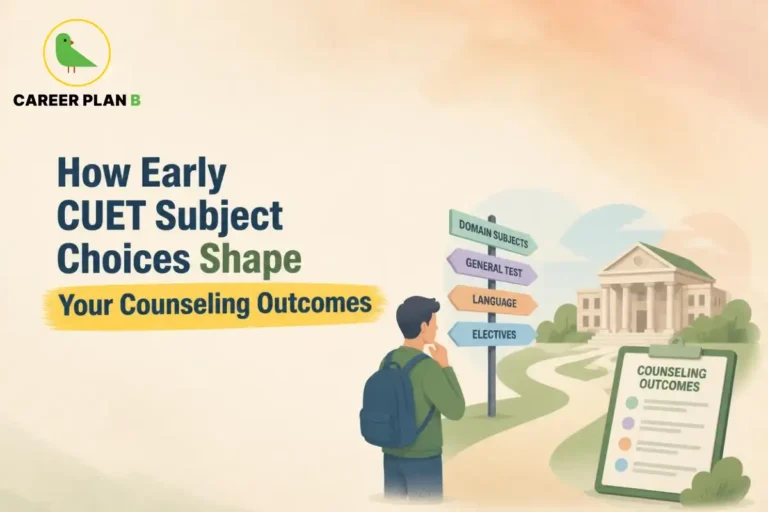
The Domain Subject vs. General Test Balance
CUET scores are made up of both domain-specific papers and the General Test. If your domain subjects feel like a weak spot, a strong General Test score can still make you competitive for a range of programmes. This is something most students overlook entirely when they are deep in regret mode.
Practical Steps to Take Right Now
Stop refreshing your feelings and start moving. Here is a clear, step-by-step action plan.
- List every university and programme you are eligible for based on your current subject combination. Do not filter by prestige yet — just map out the full landscape first using the official CUET participating universities list.
- Read the eligibility criteria carefully on each university’s official admissions page. Many universities list subject combinations as preferred, not mandatory. There is a difference, and it matters.
- Look beyond the obvious: If you appeared with PCB but are not keen on MBBS, explore Environmental Science, Nutrition, Biotechnology, or Psychology — all fields where biology is a strong foundation and CUET scores can be applied.
- Talk to someone who knows the landscape: Not just a friend or a relative who went through admissions five years ago. The system has changed significantly. Get counseling from someone current.
- Do not rule out state entrance exams and other parallel paths: CUET is not the only route to a good undergraduate programme. Many strong state universities and private institutions run their own admissions. Your Class 12 marks still hold weight in a number of them.
- Start building your application profile now: Essays, extracurriculars, and personal statements matter enormously for several universities. Do not spend all your energy on regret when you could be building something strong.
Real Talk — What If Your Dream College Is Still Possible?
Here is something worth sitting with. Sometimes the subject combination you regret is actually not as big a barrier as you think — the real issue is that you have not researched your dream college’s actual requirements thoroughly enough.
A student once came in certain that she had destroyed her chances of studying Psychology at Delhi University because she had not taken the relevant domain subjects. When she actually read Delhi University’s admissions criteria carefully, she realised her combination was still eligible for a related programme and she got in.
The lesson is not that everything always works out. It is that panic narrows your vision. When you are upset, you stop reading carefully. You assume the worst. You close tabs before you find the information you need. The reality is often less catastrophic than the story your anxiety is telling you.
Slow down. Read the actual eligibility documents. And then decide what is and is not possible based on facts, not fear.
How Career Plan B Helps
Career Plan B helps students navigate CUET subject-related uncertainty by focusing on informed decisions and long-term academic planning:
- Personalized Career Counselling: Helps students evaluate their current situation, understand their strengths and interests, and explore practical academic options based on their goals.
- Psycheintel & Career Assessment Tests: Provides data-backed insights into aptitude, personality traits, interests, and learning styles, helping students identify academic pathways and career options that best match their natural abilities.
- Admission & Academic Profile Guidance: Supports students in understanding university eligibility requirements, strengthening their academic profile, and evaluating the opportunities available based on their subject choices.
- Academic Pathway Planning: Helps students assess how their current CUET subjects align with different courses and universities while identifying realistic alternatives where appropriate.
- Career Roadmapping: Creates a structured, step-by-step plan that connects present academic decisions with future university admissions, skill development, and long-term career aspirations, giving students a clear direction moving forward.
- End-to-End Guidance: Assists students throughout the planning and admission journey so every academic decision is informed, intentional, and aligned with their future ambitions.
For Latest Information
Frequently Asked Questions
1. What if my CUET subject combination does not match any course I want?
It may feel that way, but it is rarely entirely true. Many programmes have broader eligibility than students realise. Research thoroughly using official university websites, and consider speaking with a counsellor who can help you map your score to actual options.
2. Is it possible to get into a good university with a subject combination I am not confident about?
Absolutely. Your domain subjects are one part of your CUET score — the General Test also carries significant weight for many programmes. Additionally, your Class 12 percentage still factors into admissions at many universities.
3. What courses can I explore if I regret choosing Humanities for CUET?
Humanities opens doors to Psychology, Sociology, Political Science, Economics, Mass Communication, Law, Education, Social Work, Development Studies, and several interdisciplinary Liberal Arts programmes — many of which are growing rapidly in India’s higher education space.
4. Should I consider reappearing for CUET next year? This depends entirely on your situation — your financial circumstances, the gap year’s impact on your mental health, and whether there are genuinely no suitable options this year. It is a big decision and should be made after proper counselling, not out of panic.
5. My parents are upset about my subject choices. How do I handle that conversation?
Start with facts, not feelings. Show them a researched list of the programmes you are still eligible for, the universities that accept your combination, and a clear plan going forward. A calm, prepared conversation is far more effective than an emotional one.
Conclusion
CUET subject regret is painful but it is not a full stop. It is, at most, a comma. The students who come out of this situation well are not the ones who made perfect choices from the start. They are the ones who stopped spiralling, started researching, and made smart decisions with the options actually in front of them.
Your CUET journey is one chapter, not the whole book. Whatever combination you submit, there is a path forward and the first step is simply choosing to look for it with clear eyes, good information, and the right people in your corner.