Team4 · July 26, 2026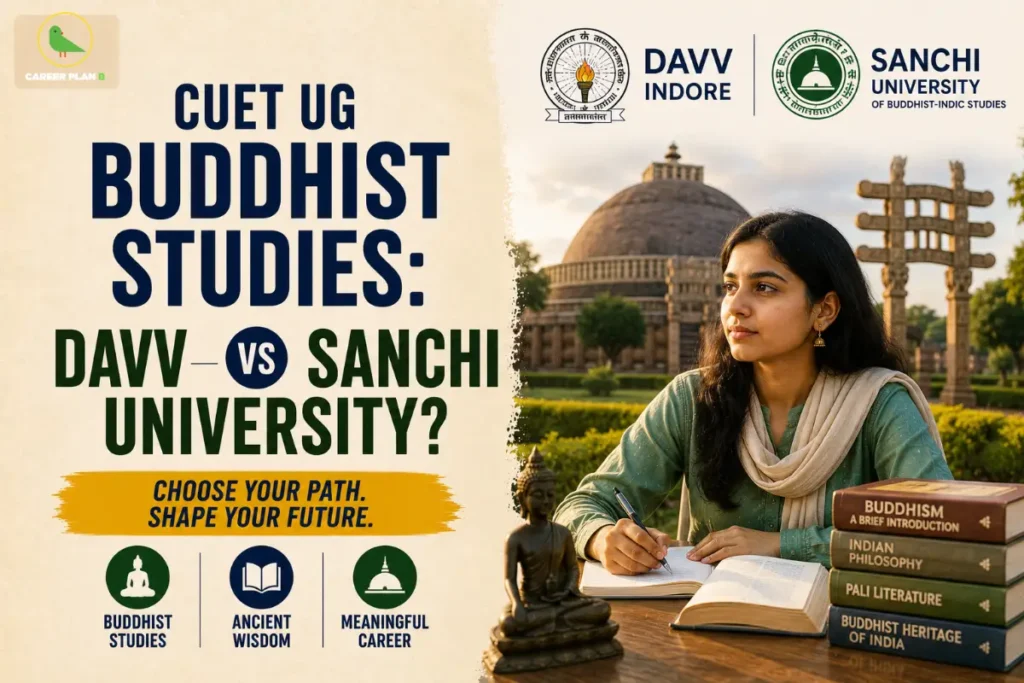
Introduction
It was 11 pm when Ananya messaged her school group. She had just cleared CUET and was staring at her preference list, unsure whether to type DAVV or Sanchi University first. Her interest in Buddhist Studies had started with a random documentary, but now it felt like a real decision with real consequences.
If you are searching for CUET UG Buddhist Studies options right now, you are probably in the same spot. Two names keep showing up. Both sound promising. But CUET UG Buddhist Studies isn’t a single, identical course sitting on two campuses, and knowing the difference early can save you months of confusion later.
The Quiet Confusion Every CUET Aspirant Faces
Every year, thousands of students clear CUET UG and open the counselling portal expecting clarity. Instead, they get a long list of participating universities, each with its own courses, cutoffs, and rules. Somewhere in that list sits Devi Ahilya Vishwavidyalaya, popularly known as DAVV, and Sanchi University of Buddhist-Indic Studies.
Both names are linked to Buddhist Studies. But they were built for different purposes, and a student who doesn’t know this can end up applying to the wrong one entirely. So let’s slow down and actually understand what each university offers, before you lock a choice you can’t easily undo.
DAVV Indore: A Wide Door With a Buddhist Studies Room Inside
Think of DAVV as a large university campus where Buddhist philosophy is one wing among many, not the whole building. Established in 1964, Devi Ahilya Vishwavidyalaya is one of the oldest state universities in Madhya Pradesh, and it runs its undergraduate admissions through CUET UG.
What DAVV Actually Offers UG Students
DAVV admits students into general undergraduate programmes like BA, B.Com, and B.Sc through CUET UG scores. If Buddhist thought interests you, it usually enters your degree through History, Sanskrit, Philosophy, or allied humanities electives rather than as a standalone “Buddhist Studies” major at the bachelor’s level. That’s an important nuance most students miss while filling their CUET UG Buddhist Studies preferences.
How CUET UG Counselling Works Here
The process is fairly standard for university-level counselling. You register on the university’s admission portal, submit your CUET UG scorecard, and go through merit based rounds before seat allotment. For exact eligibility, subject combinations, and current counselling schedules, it’s worth checking the official DAVV website directly, since these details are updated closer to each admission cycle.
For Personalized Guidance
Sanchi University: Built Entirely Around Buddhist Thought
Now picture the opposite kind of institution. Sanchi University of Buddhist-Indic Studies wasn’t built as a general university that happens to teach Buddhism. It was created specifically to revive Sanchi’s historical identity as a centre of Buddhist learning, right next to the UNESCO World Heritage stupas that inspired its name.
Why It Exists and What It Specialises In
Here, Buddhist and Indic traditions aren’t a side elective. They are the core of the institution. The university runs specialised postgraduate programmes such as MA in Buddhist Studies, MA in Yogic Science, and MA in Chinese Language, built around research and dialogue between Buddhist and broader Indic knowledge systems.
The Truth About UG Seats Here
This is where students often get caught off guard. Sanchi University’s admission notices largely centre on PG programmes through CUET PG, with UG level offerings mostly limited to diploma and certificate courses rather than a full CUET UG Buddhist Studies bachelor’s degree. If your goal is a specialised Buddhist Studies path, Sanchi is often better suited once you’re heading into postgraduate study, not necessarily right after Class 12. You can verify current UG and PG intake details on the official Sanchi University website before making assumptions.
DAVV vs Sanchi: A Side-by-Side Look
Sometimes a table says what three paragraphs can’t.
| Aspect | DAVV Indore | Sanchi University |
|---|---|---|
| Admission level for CUET | Strong UG intake via CUET UG | Mainly PG intake via CUET PG |
| Focus on Buddhist Studies | Elective within broader humanities | Core specialisation across programmes |
| Best suited for | Students wanting a general degree with Buddhist-related electives | Students planning specialised study after their bachelor’s |
| Campus character | Large, multi-faculty university | Focused, heritage-linked institution near the Sanchi Stupas |
| Ideal entry point | Right after Class 12 | Often after completing a UG degree |
So, Which One Should You Actually Pick?
Here’s a fair question to ask yourself. Are you looking for a broad undergraduate degree that lets you explore Buddhist philosophy alongside other subjects, or are you already certain you want to build a focused career in Buddhist and Indic studies?
If it’s the first, DAVV through CUET UG probably fits your timeline better right now. If it’s the second, Sanchi University might become your destination later, once you’ve completed a bachelor’s degree and are ready to specialise through CUET PG. There’s no universally right answer here. There’s only the answer that matches where you are and where you want to end up in the next five years.
Ananya, by the way, chose DAVV for her BA, with plans to apply to Sanchi for her master’s. It wasn’t a compromise. It was a sequence that made sense once she saw the full picture.
How Career Plan B Helps
Career Plan B helps students navigate university and course selection through a personalized approach that connects their academic choices with their strengths, interests, and long-term career goals:
- Personalized Career Counselling: Helps students understand their strengths, interests, academic goals, and future aspirations so they can choose the university and course that best align with their ambitions.
- Psycheintel & Career Assessment Tests: Provides data-backed insights into aptitude, personality traits, interests, and learning styles, helping students identify academic pathways and career options that best match their natural abilities.
- Admission & Academic Profile Guidance: Supports students in strengthening their academic profile, understanding programme eligibility requirements, interpreting admission criteria, and planning strategically for university applications.
- University & Course Alignment: Helps students compare universities and courses based on curriculum, academic fit, learning environment, career opportunities, eligibility requirements, and long-term goals, ensuring every decision supports their future aspirations.
- Career Roadmapping: Creates a structured, step-by-step plan that connects university and course selection with skill development, higher education opportunities, and long-term career aspirations, giving students a clear direction throughout their academic journey.
- End-to-End Guidance: Assists students throughout the planning and admission process so every academic decision is informed, intentional, and aligned with their future ambitions.
For Latest Information
Frequently Asked Questions
1. Can I pursue a full Buddhist Studies degree at the UG level through CUET?
Not always as a standalone major. Institutions like DAVV offer Buddhist-related content through electives in broader UG degrees, while dedicated Buddhist Studies programmes are more common at the postgraduate level.
2. Does Sanchi University accept CUET UG scores?
Sanchi University’s prominent CUET-based admissions are largely at the PG level. Its UG offerings are limited, so always confirm the current year’s intake on its official website before applying.
3. Is DAVV a good option if I’m serious about Buddhist Studies long term?
Yes, as a starting point. You can build a strong humanities foundation at DAVV and then move to a specialised institution like Sanchi University for postgraduate study.
4. How do I apply to DAVV through CUET UG?
You need to register on DAVV’s official admission portal, submit your CUET UG scorecard, and participate in the counselling rounds as per the schedule published by the university.
5. Is Sanchi University only for Buddhist Studies?
No. It also offers programmes in Yogic Science, Chinese Language, Indian Painting, and other Indic disciplines, all connected by a shared focus on Indic knowledge traditions.
Conclusion
Choosing between DAVV and Sanchi University isn’t really about picking the “better” university. It’s about understanding what each one is actually built for and where you currently stand in your academic journey. One offers breadth right after school, the other offers depth once you’re ready to specialise.
If you take one thing away from this, let it be this. Don’t chase a name because it sounds impressive on a form. Chase the path that fits your goals, your timeline, and the kind of student you actually are. That decision, made with clarity instead of pressure, is the one you won’t regret in three years.