Careerplanb · July 13, 2026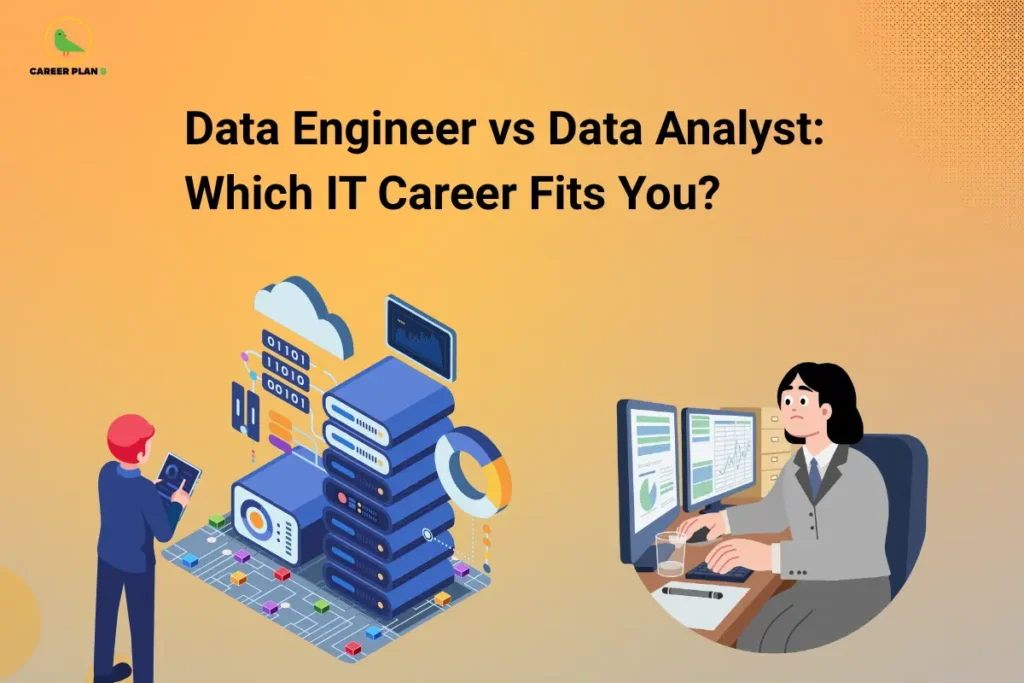
Introduction
Every time a company launches a new product, adjusts its pricing, or predicts customer behaviour, it is relying on data. But behind that data-driven decision, two very different professionals are at work, one building the systems that make data available, and another interpreting what that data actually means. The debate between data engineer vs data analyst is one of the most common dilemmas faced by IT graduates and career changers today.
As IT careers in data continue to grow at an extraordinary pace, understanding which role suits your strengths, interests, and long-term goals has never been more important. This blog breaks down what each role involves, how they differ in skills and responsibilities, what the salary landscape looks like, and how to decide which path is the right one for you.
What Does a Data Engineer Actually Do?
A data engineer is the architect and builder of an organisation’s data infrastructure. Their primary responsibility is to design, build, and maintain the pipelines that collect, transform, and deliver data from various sources to storage systems like data warehouses or data lakes. Without a data engineer, raw data would remain scattered, inaccessible, and unusable. They work extensively with tools such as Apache Spark, Apache Kafka, Apache Airflow, and cloud platforms like AWS, Google Cloud, and Microsoft Azure. Their day-to-day work is deeply technical writing code, optimising database performance, managing ETL (Extract, Transform, Load) workflows, and ensuring that data flows reliably across systems. Data engineering is fundamentally a backend, infrastructure-heavy role, making it an excellent fit for IT professionals who enjoy building systems rather than interpreting them.
What Does a Data Analyst Actually Do?
A data analyst sits on the opposite side of the data journey. While data engineers build the roads, data analysts drive on them to find meaningful destinations. Their core responsibility is to examine structured datasets, identify patterns and trends, and translate those findings into actionable business insights. They work with tools like Microsoft Excel, SQL, Power BI, and Tableau to create dashboards, generate reports, and present data stories to decision-makers. A data analyst needs to understand the business context deeply knowing not just what the numbers say, but why they matter and what action should follow. It is a role that blends analytical thinking with communication skills, making it ideal for professionals who are curious about business problems and enjoy storytelling through data.
Data Engineer vs Data Analyst: Key Differences
While both roles sit under the broad umbrella of big data and analytics, they serve fundamentally different purposes within an organisation. Here is a quick comparison:
| Parameter | Data Engineer | Data Analyst |
|---|---|---|
| Primary Focus | Building data pipelines and infrastructure | Analysing data and generating insights |
| Core Tools | Apache Spark, Kafka, Airflow, Cloud Platforms | SQL, Excel, Tableau, Power BI |
| Key Skills | Python, Scala, ETL, cloud architecture | SQL, statistics, data visualisation |
| Certifications | Google Cloud Data Engineer, AWS Data Engineer | Google Data Analytics, Power BI Associate |
| Avg. India Salary | ₹11,20,000 per year | ₹6,63,000 per year |
| Career Path | Junior Engineer → Senior → Data Architect | Analyst → Senior Analyst → Analytics Manager |
Both roles are indispensable. A data analyst cannot function without clean, well-structured data and that is precisely what a data engineer provides. Together, they form the backbone of any data-driven organisation.
For Personalized Guidance
What Skills Do You Need for Each Role?
Skills for a Data Engineer
A data engineering career demands strong programming proficiency, particularly in Python and SQL for data roles, along with knowledge of distributed computing frameworks and cloud infrastructure. Data engineers must be comfortable designing schemas, optimising query performance, and building fault-tolerant pipelines that handle large volumes of data reliably. Understanding of version control systems, containerisation tools like Docker, and workflow orchestration platforms is increasingly expected by employers. Problem-solving under pressure and a systems-thinking mindset are equally important, as data engineers are often responsible for infrastructure that the entire organisation depends on.
Skills for a Data Analyst
Data analyst skills centre on the ability to query, clean, and visualise data in a way that tells a clear story. Proficiency in SQL is non-negotiable, while familiarity with Python or R adds significant value as analysts tackle more complex datasets. Strong skills in data visualisation tools like Power BI or Tableau are essential for communicating insights to non-technical stakeholders. Beyond technical tools, a good data analyst needs business acumen and the ability to frame the right questions and connect data findings to real organisational outcomes. Clear written and verbal communication is a skill that separates average analysts from exceptional ones.
Certifications and Learning Paths
For those pursuing a data engineering career, cloud certifications are the most valued credentials in the industry. Google Cloud’s Professional Data Engineer certification is one of the most recognised globally, and full details are available at the official Google Cloud page: https://cloud.google.com/learn/certification/data-engineer. AWS also offers the AWS Certified Data Engineer – Associate, accessible at: https://aws.amazon.com/certification/.
For aspiring data analysts, the Google Data Analytics Professional Certificate offers a well-structured entry point, available through Google’s official career training platform at: https://grow.google/certificates/data-analytics/. Microsoft’s Power BI Data Analyst Associate certification is equally valuable and can be explored at: https://learn.microsoft.com/en-us/credentials/certifications/power-bi-data-analyst/. Both pathways have strong employer recognition across India and globally.
Salary and Career Growth in India and Globally
Both roles offer strong and growing compensation in India’s data-driven job market. According to Glassdoor, the average salary for a data engineer in India is approximately ₹11,20,000 per year, with top earners reporting up to ₹23,41,200 annually. For data analysts, Glassdoor reports a median total pay of ₹6,63,000 per year in India, with senior data analysts earning a median of ₹15 LPA.
The global outlook for both roles is equally encouraging. According to the U.S. Bureau of Labor Statistics, employment of operations research analysts, a category closely aligned with data analysis, is projected to grow 21 percent from 2024 to 2034, much faster than the average for all occupations. Full projections are available at: https://www.bls.gov/ooh/math/operations-research-analysts.htm. In terms of career trajectory, both roles offer a clear path from entry level to senior positions, with data engineers often progressing toward data architecture and data analysts moving into analytics management or data science.
How to Choose the Right Path for You
The simplest way to decide is to ask yourself one honest question: do you want to build the engine, or drive it? If you enjoy writing code, designing systems, and solving infrastructure problems, data engineering is likely your natural fit. If you are drawn to business questions, enjoy translating numbers into narratives, and find satisfaction in influencing decisions, data analysis is where you will thrive. Neither path is easier or harder; they simply require different strengths. The good news is that both are in high demand, both offer strong career progression, and both sit at the heart of how modern organisations operate.
How Career Plan B Helps
Whether you are leaning toward a data engineering career or exploring data analyst skills, choosing the right direction matters. Career Plan B helps you make that choice with confidence through personalised career counselling, psychometric assessments, and structured career roadmapping. Their tools help identify which data career path aligns with your strengths, interests, and long-term professional goals so you move forward with clarity.
Get In Touch With Us
Frequently Asked Questions
1. Can a data analyst transition into data engineering?
Yes, many analysts make this transition. Since both roles require strong SQL skills, analysts who build on their knowledge with Python, cloud platforms, and pipeline tools can move into data engineering with focused effort over six to twelve months.
2. Which role is better for freshers entering IT careers in data?
Data analysis is generally more accessible for freshers, as the technical bar for entry is lower. Data engineering tends to require stronger programming foundations, making it a better fit for those with a computer science or IT background.
3. Do both roles require knowledge of SQL and Python?
SQL is essential for both roles. Python is increasingly important in both, though data engineers use it more heavily for pipeline development, while analysts use it primarily for data manipulation and basic modelling.
4. Which role has better long-term growth prospects?
Both offer excellent growth. Data engineers tend to earn higher salaries at senior levels due to the technical complexity of their work. Data analysts have a broader set of roles to transition into, including data science, business intelligence, and product analytics.
5. Is a master’s degree necessary for either role in India?
No. While a relevant degree helps, both roles are largely skills and certification-driven. Many professionals enter these fields through online certifications, bootcamps, and portfolio projects without a postgraduate degree.
Conclusion
The choice between a data engineer and a data analyst is not about which role is more prestigious it is about which one genuinely excites you. One builds the infrastructure that powers data-driven organisations. The other turns that data into the insights those organisations act on. Both are critical, both are growing, and both offer rewarding IT careers in data for those willing to invest in the right skills. Take stock of your strengths, explore the certifications that match your path, and step into the data career that feels most like you.
Not sure which data role suits you best? Visit Career Plan B today and get personalized guidance to map your ideal career path.