Deepti · September 24, 2026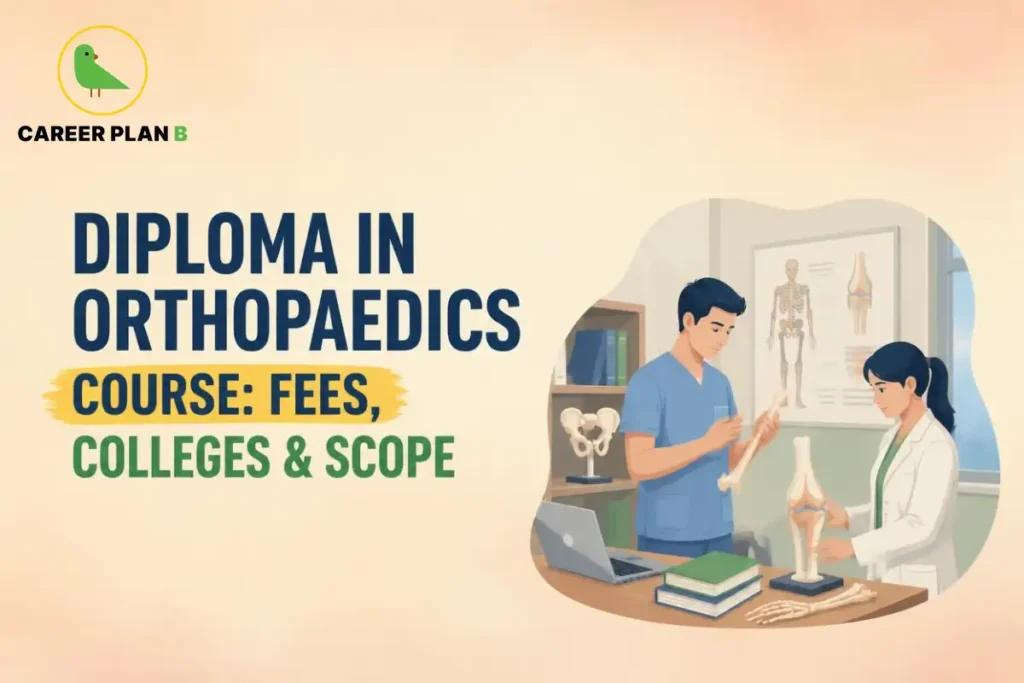
A postgraduate diploma can offer MBBS graduates a focused route into orthopaedic training. The Diploma in Orthopaedics Course, commonly called D Ortho, covers musculoskeletal conditions, trauma care, clinical assessment and orthopaedic management. The course usually runs for two years after MBBS. A major 2026 update matters for new aspirants: the National Medical Commission has stated that 2026–27 is the last academic year for admission to postgraduate diploma courses as institutions move towards conversion of diploma seats into corresponding MD/MS seats.
What Is D Ortho?
D Ortho means Diploma in Orthopaedics. It is a postgraduate medical qualification for doctors who have completed MBBS.
The course focuses on the bones, joints, muscles, ligaments, spine and other parts of the musculoskeletal system. Training also covers trauma and emergency management.
The NMC’s postgraduate framework aims to develop specialty-specific clinical competence, scientific skills, ethical practice and the ability to manage patients at appropriate levels of healthcare. The NMC also publishes postgraduate curriculum resources for Diploma in Orthopaedics.
A typical D Ortho course includes:
- Orthopaedic trauma
- Fractures and dislocations
- Bone and joint disorders
- Paediatric orthopaedics
- Spine and peripheral nerve conditions
- Sports injuries
- Orthopaedic imaging
- Rehabilitation
- Basic operative and emergency care
D Ortho Eligibility After MBBS
The D Ortho Eligibility route starts with an MBBS qualification.
Candidates generally need to meet the applicable postgraduate medical admission requirements, including recognised MBBS qualification, registration and completion of the prescribed internship within the notified deadline. The exact eligibility conditions for each admission cycle come from the NEET-PG information bulletin and counselling authority.
For Diploma in Orthopaedics NEET PG 2026, candidates should check the latest NBEMS bulletin before completing the counselling process. NBEMS maintains the official NEET-PG portal with the examination bulletin, application information and results.
Candidates should avoid relying on old eligibility rules because postgraduate medical regulations and counselling conditions can change.
D Ortho Admission After MBBS: Is NEET PG Required?
D Ortho Admission After MBBS follows the postgraduate medical admission framework.
NEET-PG serves as the common entrance route for MD, MS and postgraduate diploma admissions. MCC conducts counselling for 50% All India Quota postgraduate medical seats, while applicable state authorities conduct state-level counselling.
The usual process looks like this:
- Complete MBBS and the required internship.
- Meet registration and NEET-PG eligibility conditions.
- Appear for NEET-PG.
- Receive the NEET-PG rank and score.
- Register for MCC or the relevant state counselling.
- Check the available D Ortho seats.
- Fill choices according to preference and eligibility.
- Complete allotment, document verification and college admission.
Candidates can also use Career Plan B’s NEET PG Counselling Process guide to understand registration, choice filling, allotment and reporting.
Diploma in Orthopaedics NEET PG 2026 Update
NBEMS scheduled NEET-PG 2026 for 30 August 2026. The board later conducted a re-examination for affected candidates at specified centres. The official internship completion cut-off listed for NEET-PG 2026 is 30 September 2026.
The admission cycle also carries an important regulatory change. NMC’s notice dated 22 June 2026 states that 2026–27 will be the last academic year for admission to postgraduate diploma courses. Medical colleges that intend to convert diploma courses into corresponding MD/MS courses must follow the NMC process.
D Ortho Course Duration
The D Ortho Course Duration is two years after MBBS under the postgraduate diploma structure. The programme combines academic teaching with supervised clinical training. NMC postgraduate regulations govern the broader framework for postgraduate medical education.
During these two years, residents can receive exposure to:
- Outpatient orthopaedic care
- Inpatient management
- Trauma and emergency cases
- Fracture assessment
- Clinical examination
- Imaging interpretation
- Case discussions
- Procedural and operative assistance
- Rehabilitation planning
Clinical exposure can differ between institutions, so students should review the department, attached hospital and patient workload before choosing a seat.
For Personalized Guidance
D Ortho Syllabus: What Do You Study?
The D Ortho Syllabus combines basic science, pathology, trauma and clinical orthopaedics.
Major areas include:
| Area | Topics covered |
|---|---|
| Basic sciences | Anatomy, physiology and musculoskeletal foundations |
| Trauma | Fractures, dislocations, wound and trauma management |
| Orthopaedic diseases | Degenerative, inflammatory and infectious conditions |
| Paediatric orthopaedics | Developmental and childhood disorders |
| Spine | Spine disorders and related conditions |
| Sports medicine | Sports injuries and rehabilitation |
| Imaging | Radiology and investigation of orthopaedic conditions |
| Rehabilitation | Functional recovery and rehabilitation principles |
| Operative care | Operative orthopaedics and surgical assistance |
The NMC’s published Diploma in Orthopaedics curriculum includes areas such as basic sciences, general principles of surgery and traumatology, orthopaedic diseases, fracture healing, radiology, paediatric orthopaedics, spine disorders, rehabilitation and operative orthopaedics.
D Ortho Fees in India
There is no single D Ortho Fees in India for every medical college. Government, private and self-financing institutions can follow different fee structures.
An official example comes from the Tamil Nadu government’s 2024–25 postgraduate prospectus. It listed ₹20,000 per year as tuition fee for PG Diploma courses in government institutions. Self-financing institutions follow separately prescribed fee structures. This figure should not be treated as a national 2026 fee.
Students should check the latest official notification for:
- Tuition fee
- University fee
- Examination fee
- Hostel charges
- Security deposit
- Other institutional charges
- Bond or service conditions
PSG Institute of Medical Sciences & Research, for example, officially lists Diploma in Orthopaedics among its postgraduate diploma programmes and maintains a dedicated fee-information section for postgraduate courses.
D Ortho Colleges in India
The number of D Ortho seats can change when NMC changes recognition, permissions, seat capacity or course structures.
Recent official NMC records have included institutions such as:
| Institution | State | Official record |
|---|---|---|
| BRD Medical College, Gorakhpur | Uttar Pradesh | NMC’s 2025–26 seat matrix lists 3 Diploma in Orthopaedics seats |
| Rajah Muthiah Medical College, Annamalainagar | Tamil Nadu | NMC’s 2025–26 seat matrix lists 3 Diploma in Orthopaedics seats |
| LLRM Medical College, Meerut | Uttar Pradesh | NMC records list 3 Diploma in Orthopaedics seats |
| PSG Institute of Medical Sciences & Research, Coimbatore | Tamil Nadu | The institute officially lists Diploma in Orthopaedics among PG diploma programmes |
| Govt. Medical College, Kolkata | West Bengal | NMC admission records show D Ortho admissions |
Students should verify the current seat matrix before choice filling through the NMC College and Course Search and the relevant counselling portal. NMC provides tools to search recognised and permitted medical courses and institutions.
Diploma in Orthopaedics Government Colleges
Government colleges can offer D Ortho seats, but availability does not remain fixed across admission years.
BRD Medical College, Gorakhpur and Rajah Muthiah Medical College are examples appearing in recent NMC seat records.
Check three details before selecting a government D Ortho seat:
Recognition: Confirm the current course status with NMC.
Seat availability: Check the latest counselling-year seat matrix.
Fee and bond: Check the latest state or college notification.
D Ortho Cutoff:What Rank Do You Need?
There is no single D Ortho cutoff for India.
The closing rank can change according to:
- College
- Category
- Quota
- State
- Counselling round
- Number of available seats
- Candidate preferences
A NEET-PG qualifying percentile and a college-specific closing rank represent different things. Candidates should compare the last allotted rank for the exact college, category, quota and round.
MCC handles 50% AIQ postgraduate medical counselling. State authorities handle their applicable state counselling.
For the latest counselling process, candidates can also refer to Career Plan B’s AIQ NEET PG Counselling guide.
D Ortho Career and Scope After MBBS
The D Ortho Career path can involve hospital-based orthopaedic services, trauma care, outpatient practice and roles that accept the qualification under applicable recruitment rules.
Potential career areas include:
- Orthopaedic clinical services
- Trauma care
- Hospital medical officer roles
- Musculoskeletal outpatient care
- Rehabilitation-linked clinical services
- Teaching and academic roles where qualification rules permit
- Further postgraduate training
The qualification can build a focused foundation in musculoskeletal care. Job titles and eligibility for specialist or teaching posts depend on current regulatory and employer requirements.
What Can You Study After D Ortho?
A major pathway often missed in course guides is Post Diploma DNB in Orthopaedics.
NBEMS officially lists DORTHO as an eligible feeder qualification for DNB (Post Diploma) Orthopaedics. Admission to Post Diploma DNB courses uses the DNB-PDCET ranking examination and subsequent NBEMS counselling.
NBEMS also conducted DNB Post Diploma Orthopaedics counselling for the 2026 admission session and published 2026 Post Diploma DNB seat information.
This pathway gives D Ortho graduates another recognised postgraduate training option to investigate after completing the diploma.
How Career Plan B Helps
Career Plan B can help MBBS graduates understand postgraduate pathways through Personalized Career Counselling, PsycheIntel and Career Assessment Tests, Admission and Academic Profile Guidance, and Career Roadmapping.
The guidance can help candidates compare course structures, understand counselling requirements, shortlist relevant options and plan their next academic move.
Get In Touch With Us
Frequently Asked Questions
Q1. What is the D Ortho Course Duration after MBBS?
The D Ortho Course Duration is two years under the postgraduate diploma structure.
Q2. What is the D Ortho Eligibility After MBBS?
Candidates need a recognised MBBS qualification and must meet the applicable registration, internship and NEET-PG requirements.
Q3. What is the D Ortho Admission After MBBS process?
Candidates generally qualify through NEET-PG and then participate in MCC or applicable state counselling for available PG diploma seats.
Q4. What are the D Ortho Fees in India?
D Ortho Fees in India vary by institution and state. Candidates should use the latest official college or counselling fee notification.
Q5. Which are the Diploma in Orthopaedics Government Colleges?
Recent NMC records include government institutions such as BRD Medical College, Gorakhpur and Rajah Muthiah Medical College. Candidates must verify the current admission-year seat matrix.
Q6. What is the Diploma in Orthopaedics Scope After MBBS?
The Diploma in Orthopaedics Scope After MBBS includes orthopaedic clinical services, trauma care, hospital roles and further training such as Post Diploma DNB Orthopaedics, subject to applicable rules.
Conclusion
The Diploma in Orthopaedics Course gives MBBS graduates focused postgraduate training in orthopaedics through a two-year diploma route. Eligibility, NEET-PG admission, college recognition, fees, clinical exposure and future training plans all matter when evaluating a seat.
The 2026–27 admission cycle carries extra importance because NMC has identified it as the last academic year for PG diploma admissions.
Check the latest NMC, NBEMS and counselling notifications before making your D Ortho choices. Explore Career Plan B for personalised postgraduate admission guidance and career roadmapping.