Careerplanb · August 18, 2026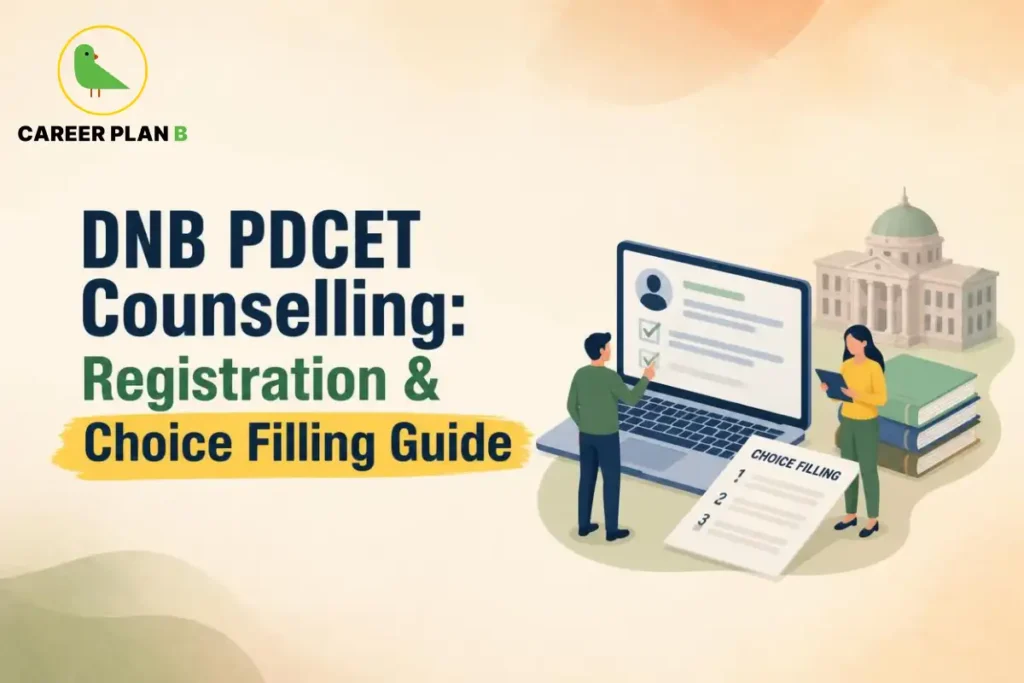
Introduction
You cleared DNB PDCET. Now what?
Every year, hundreds of doctors qualify the Diplomate of National Board Post Diploma Centralised Entrance Test (DNB PDCET) and then get stuck on the same question: how does the counselling actually work? The official NBEMS portal is functional but not exactly beginner-friendly, and one missed deadline can cost you a seat.
This guide walks you through the entire DNB PDCET counselling journey from checking your eligibility to registering on the portal, filling and locking your choices, understanding how the Centralized Allotment Processing System (CAPS) works, and finally, getting your seat allotted. We’ll also flag what’s confirmed and what’s still pending for DNB PDCET counselling 2026, so you know exactly where things stand.
What Is DNB PDCET Counselling?
DNB PDCET counselling is the centralised process run by the National Board of Examinations in Medical Sciences (NBEMS) to admit doctors into Post Diploma DNB broad specialty courses. It covers admission to approximately 2,494 spread across nearly 900+ NBEMS-accredited hospitals in India, across 16 broad specialties. (source: seat matrix on this page to get complete list of seat availability in each college and speciality.)
Unlike a walk-in interview, this is a fully merit-based, online system. Your rank in the DNB PDCET exam decides everything which hospitals you can realistically get, and which specialties are within reach.
DNB PDCET Counselling Eligibility
Before you even think about registration, check that you meet these basic requirements:
- You must have qualified DNB PDCET with a valid merit rank.
- You must hold a recognised Postgraduate Diploma in the same broad specialty, with your final diploma result declared by the cutoff date set in that year’s Information Bulletin (usually end of January).
- You need a valid, permanent registration certificate from the National Medical Commission (NMC) or a State Medical Council.
- If you’re currently enrolled in another MD, MS, or DNB programme, you can only join a new DNB seat after formally resigning from the current one.
If any of these boxes are unchecked, NBEMS can disqualify your candidature even after a seat has been allotted. So this isn’t a step to skim.
DNB PDCET Registration Process
This is where most candidates get their first taste of the DNB PDCET counselling registration workflow and where small mistakes cause the biggest headaches later.
How to Register for DNB PDCET Counselling
- Go to the official counselling portal i.e., counseling.nbe.edu.in not any third-party site claiming to offer registration.
- Create your candidate account using your name, email ID, and phone number to receive login credentials.
- Log in and fill your personal, address, and academic details carefully. Double-check spellings against your official documents — mismatches cause verification delays later.
- Pay the counselling registration fee. In recent cycles this has been ₹2,500, paid online through the portal.
- Submit and download your confirmation for your records.
One detail that trips people up: registration for DNB PDCET counselling typically happens only once, before Round 1. You don’t need to re-register for Round 2 or the mop-up round unless you missed the first round entirely.
Documents Required for DNB PDCET Counselling Registration
Keep scanned copies of these ready before you start:
- Postgraduate Diploma pass certificate (or provisional certificate) in your feeder specialty
- Permanent NMC/State Medical Council registration certificate
- Proof that you passed your PG diploma final exam by the required date
- NMC website screenshot confirming your diploma’s recognition
- Matriculation or Class 10 certificate as date-of-birth proof
- Category certificate (SC/ST/OBC/EWS/PwBD), if applicable, from a competent authority
- A valid government photo ID
Missing even one document at the verification stage can hold up your admission, so it’s worth organising this folder before counselling opens rather than scrambling once your rank letter arrives.
Have Any Doubts?
DNB PDCET Choice Filling Process
Once you’re registered, the real strategy begins: choice filling.
Steps to Fill and Lock Choices
This is the part of DNB PDCET counselling where your preferences actually matter as much as your rank:
- Log in to your counselling account once the choice-filling window opens.
- Browse the indicative seat matrix — the live list of available hospitals and specialties, uploaded on the portal at the start of each round.
- Select and arrange your preferred hospital-specialty combinations in order of priority. List everything you’d genuinely accept, not just your top pick — a shorter list only limits your own chances.
- Use the “Lock and Confirm” option before the deadline. If you skip this step, whatever choices you last saved are automatically treated as final, so don’t assume an unlocked list is safe.
A candidate who registers but never submits choices, or doesn’t pay the fee in time, is simply removed from that round. There’s no manual override for missed deadlines.
DNB PDCET Counselling Process: How CAPS Rounds Work
NBEMS runs DNB PDCET counselling through its Centralized Allotment Processing System (CAPS) — a rank-and-preference-based algorithm, not a manual seat-by-seat decision.
Round-Wise Structure
The DNB Post Diploma counselling process typically runs across four rounds:
- Round 1 — Online. First allotment based on rank and locked choices.
- Round 2 — Online. Candidates who didn’t get a seat, or want to upgrade, participate again.
- Mop-Up Round — Online. Held only if seats remain vacant after Round 2.
- Final Round — Usually conducted offline, for any seats still unfilled.
If you’re allotted a seat in Round 1 but hope for something better, you have a choice: freeze it (accept and lock it permanently) or leave it floating for upgrade in the next round. If you float and get upgraded, you must accept the new allotment — there’s no reverting.
DNB PDCET Seat Allotment Process
Once choices are locked and a round closes, CAPS matches ranks against preferences and seat availability to generate allotment results. Here’s what happens next:
- Check your allotment result on the portal.
- If allotted, deposit the one-year course fee to freeze your seat — in the most recent 2026 cycle, this was ₹1,25,000/- (Excludes payment gateway charges), though this figure is confirmed fresh each admission year, so always verify the current amount on the official portal.
- Report to the allotted institute in person with your original documents for verification.
- Only after document verification is your admission finalised.
Skipping the fee deadline or the physical reporting step forfeits the seat, no exceptions are made for late submissions.
DNB PDCET Counselling 2026: Where Things Stand
For the 2026 admission cycle, the DNB PDCET exam was held on April 12, 2026, with results declared May 14, 2026, and individual scorecards available from May 22, 2026.
As of the latest official notices, NBEMS had begun counselling registration in early July 2026, with round-wise dates (choice filling, allotment, fee payment) being released progressively on the counselling portal rather than all at once. Because these dates shift slightly each cycle, always cross-check the live schedule on counseling.nbe.edu.in rather than relying on last year’s calendar.
How Career Plan B Helps
Choosing the right DNB specialty and hospital preference isn’t just about rank; it’s about long-term career fit.
Career Plan B offers personalised career counselling for medical postgraduates, using the PsycheIntel Career Assessment to map your strengths against specialty options.
Our team also guides you through admission and academic profile review, helping you build a realistic, well-ordered choice list instead of guessing under pressure.
Get In Touch With Us
Frequently Asked Questions
- How do I register for DNB PDCET counselling?
Visit counseling.nbe.edu.in, create your candidate account with your name, email, and phone number, fill in your personal and academic details, and pay the counselling registration fee (₹2,500/-). Registration is generally a one-time step before Round 1.
- What is the DNB PDCET counselling process and eligibility?
You need a qualifying DNB PDCET rank, a completed PG diploma in the relevant feeder specialty, and valid NMC or State Medical Council registration. The process itself covers registration, choice filling, CAPS-based allotment across multiple rounds, fee payment, and document verification.
- How many rounds does DNB PDCET counselling and registration have?
Typically four: Round 1, Round 2, a Mop-Up round (only if seats remain vacant), and a final offline round. Registration usually happens only once, before Round 1.
- What is the DNB PDCET seat allotment process?
After choices are locked, the CAPS algorithm matches candidate rank, preferences, and seat availability to generate results. Allotted candidates must pay the course fee to freeze the seat and report in person for document verification.
- What happens if I don’t lock my choices or pay the fee on time?
If you don’t use “Lock and Confirm,” your last-saved choices are treated as final automatically. If you don’t pay the counselling fee or course fee within the deadline, you’re excluded from that round with no manual extension.
- Is the DNB Post Diploma counselling process the same every year?
The overall structure from registration, choice filling, CAPS rounds, allotment, fee payment, verification stays consistent. However, exact dates, fee amounts, and the seat matrix change each year, so always check the current year’s Information Bulletin.
Conclusion
DNB PDCET counselling isn’t complicated once you know the sequence: check eligibility, register early, keep your documents ready, fill and lock your choices thoughtfully, and track each round’s deadline closely. The candidates who lose seats are rarely the ones who scored lower; they’re the ones who missed a fee deadline or forgot to lock their choices.
If you’ve cleared DNB PDCET, don’t leave your next steps to guesswork. Get your document checklist ready today, and if you’d like help thinking through your specialty and hospital preferences strategically, Career Plan B’s counselling team is here to help.