Team Career Plan B · August 24, 2026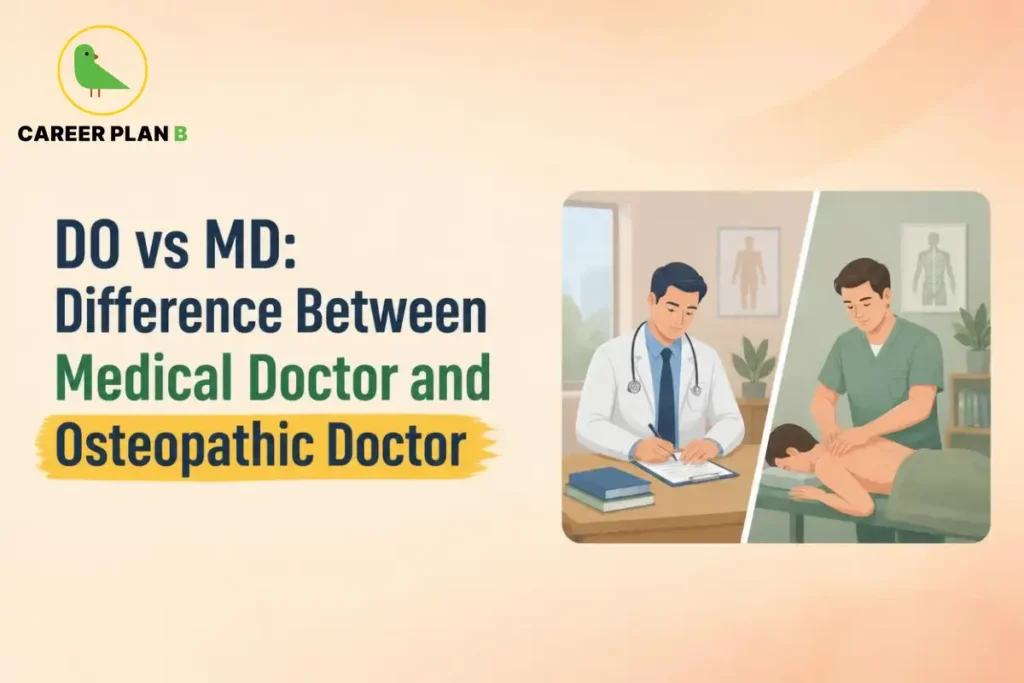
Introduction
Understanding the complete DO vs MD comparison is essential for aspiring students, patients, and healthcare professionals navigating modern clinical training. Both pathways train fully licensed physicians who are authorized to prescribe medications, perform complex surgeries, and direct patient care across all medical specialties.
However, key distinctions exist in their underlying philosophy, specialized clinical coursework, and historical training frameworks. Examining the exact difference between md and do helps candidates make informed decisions about their clinical education and long-term career goals.
Evaluating the core difference between a DO and MD doctor clarifies how daily clinical practice, hands-on diagnostics, and patient interactions unfold. Both degrees represent rigorous doctoral qualifications that grant full legal practice rights worldwide.
What Does DO and MD Stand For? Philosophy & Definitions
Demystifying degree acronyms is the first step toward understanding how both training frameworks operate.
Aspirants frequently ask, what does do and md stand for in contemporary healthcare? MD stands for Doctor of Medicine, while DO stands for Doctor of Osteopathic Medicine.
Doctor of Medicine (MD) and Allopathic Training
A medical doctor holding an MD degree practices allopathic medicine, which centers on diagnosing diseases and applying evidence-based pharmacological or surgical treatments. Historically referred to as allopathic doctors, MD physicians utilize targeted interventions to neutralize symptoms and cure underlying pathologies.
Understanding the difference between do & md approaches reveals that MD training focuses heavily on specialized clinical diagnostics and organ-system pathology. MD postgraduates represent the majority of practicing physicians in tertiary care networks and surgical units.
Doctor of Osteopathic Medicine (DO) and Osteopathic Philosophy
An osteopathic doctor holding a DO degree practices osteopathic medicine, which emphasizes a holistic approach to patient care. This philosophy views the human body as an interconnected system where structure and function directly influence overall wellness.
Evaluating the difference between do and dr clarifies that a DO is a fully licensed physician, not a non-physician doctorate holder. Practitioners complete extensive training in osteopathic manipulative medicine to evaluate neuromuscular alignment during patient examinations.
Furthermore, DO students master the osteopathic manipulative technique (OMT), utilizing hands-on physical manipulation to alleviate pain and improve structural mobility. Understanding the difference between md and do degrees highlights how OMT adds an extra hands-on dimension to osteopathic clinical care.
| Medical Career Step | MD Pathway | DO Pathway |
|---|---|---|
| Step 1: Undergraduate Education | Bachelor’s degree + pre-med prerequisites | Bachelor’s degree + pre-med prerequisites |
| Step 2: Medical School | 4-year Doctor of Medicine (MD) program | 4-year Doctor of Osteopathic Medicine (DO) program |
| Step 3: Licensing Exams | USMLE Steps 1, 2 CK & 3 | COMLEX-USA Levels 1, 2-CE & 3 |
| Step 4: Residency Training | ACGME-accredited residency | ACGME-accredited residency |
| Step 5: Residency Duration | 3–7 years, depending on specialty | 3–7 years, depending on specialty |
| Step 6: Career Options | Primary care, surgery, emergency medicine, and subspecialties | Primary care, surgery, emergency medicine, and subspecialties |
| Step 7: Medical Practice | Licensed physician practice in accordance with state requirements | Licensed physician practice in accordance with state requirements |
Educational Roadmap: Medical School & Curriculum Comparison
Comparing the difference between md or do academic tracks demonstrates that both require four years of intensive medical school education.
During the first two years, both MD and DO students complete identical foundational coursework in anatomy, biochemistry, pharmacology, pathology, and physiology. In the final two years, both groups complete core clinical rotations in internal medicine, general surgery, pediatrics, obstetrics, and psychiatry.
However, evaluating the difference between medical doctor and doctor of osteopathy curricula reveals that DO students complete over 200 additional hours of dedicated OMT instruction. This specialized coursework focuses on biomechanics, spinal alignment, and physical diagnosis.
Analyzing the difference between osteopathic doctor and medical doctor clinical schedules confirms that both complete rigorous hospital clerkships. Candidate credentials across both tracks align with public health standards monitored under the U.S. Department of Health and Human Services (HHS).
Licensing Exam Requirements: USMLE vs COMLEX
Navigating the difference between DO, MD examination rules is crucial for securing state medical licensure and residency placement.
MD students take the United States Medical Licensing Examination (licensing exam series: USMLE Step 1, Step 2 CK, and Step 3). Candidates can verify testing parameters directly on the official USMLE Portal.
Conversely, DO students take the Comprehensive Osteopathic Medical Licensing Examination (COMLEX-USA Level 1, Level 2 CE, and Level 3). Candidates can review testing frameworks on the official National Board of Osteopathic Medical Examiners (NBOME) portal.
Many DO students also take the USMLE alongside COMLEX to maximize their competitive standing for specialized residency programs. Comparing the do degree vs md examination workload demonstrates that DO candidates frequently manage dual testing requirements.
When evaluating degree designations like MD, DO, or even comparing physician paths like MD versus OD (Doctor of Optometry), verifying official licensing exam validity ensures total regulatory compliance. International candidates tracking global equivalency standards can also monitor public notices published by the National Medical Commission (NMC).
For Personalized Guidance
Residency Matching, Practice Scope & Career Opportunities
The DO vs MD career comparison shows that both degrees lead to comprehensive physician training and broad practice opportunities in the United States. MD and DO graduates can pursue residency training across a wide range of specialties, including internal medicine, pediatrics, surgery, emergency medicine, anesthesiology, and many subspecialties.
Following the ACGME single accreditation system, MD and DO graduates enter the same accredited residency system and compete for residency positions through the same overall framework. Residency programs generally last 3–7 years, depending on the specialty and training pathway.
DO graduates have traditionally had a stronger presence in primary care fields, including family medicine, internal medicine, and pediatrics. However, DO physicians also pursue competitive specialties such as orthopedic surgery, emergency medicine, anesthesiology, and other surgical and medical subspecialties.
From a practice-scope perspective, both MD and DO physicians can obtain medical licenses, prescribe medications, perform procedures, admit patients, and hold hospital privileges when they meet applicable state and institutional requirements. Both can also pursue board certification and advanced fellowship training.
The main MD vs DO difference is therefore the educational approach. MD programs generally follow a conventional allopathic medical curriculum, while DO programs include additional training in osteopathic principles and Osteopathic Manipulative Medicine (OMM/OMT) alongside standard medical education.
For students deciding between MD or DO, factors such as curriculum, medical school environment, residency opportunities, specialty interests, location, and personal career goals are more important than assuming one degree automatically provides a broader scope of practice.
For Personalized Guidance
Head-to-Head Comparison Matrix: DO vs MD
The following matrix contrasts key operational parameters across both doctoral medical qualifications.
| Operational Parameter | Doctor of Medicine (MD) | Doctor of Osteopathic Medicine (DO) | Strategic Perspective |
|---|---|---|---|
| Primary Philosophy | Allopathic medical education with disease-focused diagnostic and treatment approach | Osteopathic medical education emphasizing whole-person care and structural health | Both are evidence-based medical degrees |
| Medical School Duration | 4 Years Full-Time | 4 Years Full-Time | Comparable foundational medical education |
| Hands-On Physical Training | Standard physical examination and clinical techniques | Additional training in Osteopathic Manipulative Medicine (OMM/OMT) | DO curriculum includes specialized hands-on techniques |
| Primary Licensing Exam | USMLE Step 1, Step 2 CK & Step 3 | COMLEX-USA Level 1, Level 2-CE & Level 3 | DO students may also take USMLE exams depending on residency goals |
| National Residency Match | ACGME Residency Match | ACGME Residency Match | MD and DO graduates compete within the same residency accreditation system |
| Practice Distribution | Broad representation across primary care, surgery and subspecialties | Strong representation in primary care and family medicine, with access to all specialties | Both can pursue any medical specialty after residency |
| Legal Practice Rights | Full physician practice rights across the U.S. | Full physician practice rights across the U.S. | Both have equivalent physician licensing rights when state requirements are met |
(Source: Operational parameters compiled in alignment with official notices published by the U.S. Department of Health and Human Services).
How Career Plan B Helps
Evaluating pre-med educational pathways, selecting medical school options, and planning healthcare career roadmaps requires strategic guidance. Career Plan B supports medical aspirants through:
- Personalised Career Counselling: Evaluating your academic standings, MCAT targets, and degree preferences across MD and DO medical school pathways.
- Psycheintel & Career Assessments: Scientific evaluations confirming whether high-volume surgical tracks, holistic primary care, or diagnostic specialties fit your natural strengths best.
- Customized Admission Guidance: Support navigating medical school application portals, personal statement drafting, and interview preparation.
- Career Roadmapping: Strategic planning extending beyond medical school graduation toward residency matching, fellowship selection, and global licensing.
Get In Touch With Us
Frequently Asked Questions
Q1. What is the main DO vs MD difference in daily medical practice?
The primary difference lies in philosophy and hands-on training, as DO physicians receive extra instruction in osteopathic manipulative medicine (OMT) to treat structural issues.
Q2. Are DO doctors fully licensed medical doctors in the United States?
Yes, DO doctors are fully licensed physicians who possess identical legal practice rights, surgery privileges, and prescription authority as MD physicians.
Q3. Which licensing exam do MD and DO students take during medical school?
MD students take the USMLE licensing exam series, whereas DO students take the COMLEX series, though many DO students also take the USMLE for competitive residency matching.
Q4. Do MD and DO graduates participate in the same residency match program?
Yes, both MD and DO graduates compete in the single unified ACGME National Resident Matching Program for hospital residency positions.
Q5. Where can candidates verify official public health standards for medical degrees?
Official health service updates and public standards can be verified directly on the U.S. Department of Health and Human Services Portal.
Conclusion
Analyzing operational frameworks proves why evaluating degree pathways early is essential for every medical aspirant. Securing your target medical school seat requires understanding curriculum nuances, preparing for licensing exams, and maintaining strong academic performance.
Remember that reviewing official updates on public health portals protects your candidature throughout the admission process. Choosing between an MD and a DO degree allows you to align your medical education with your personal healthcare philosophy.
Developing a clear academic preparation strategy ensures a confident transition into medical school and residency training. Connect with Career Plan B today to build a personalized medical career roadmap tailored to your long-term goals.