Team6 · July 15, 2026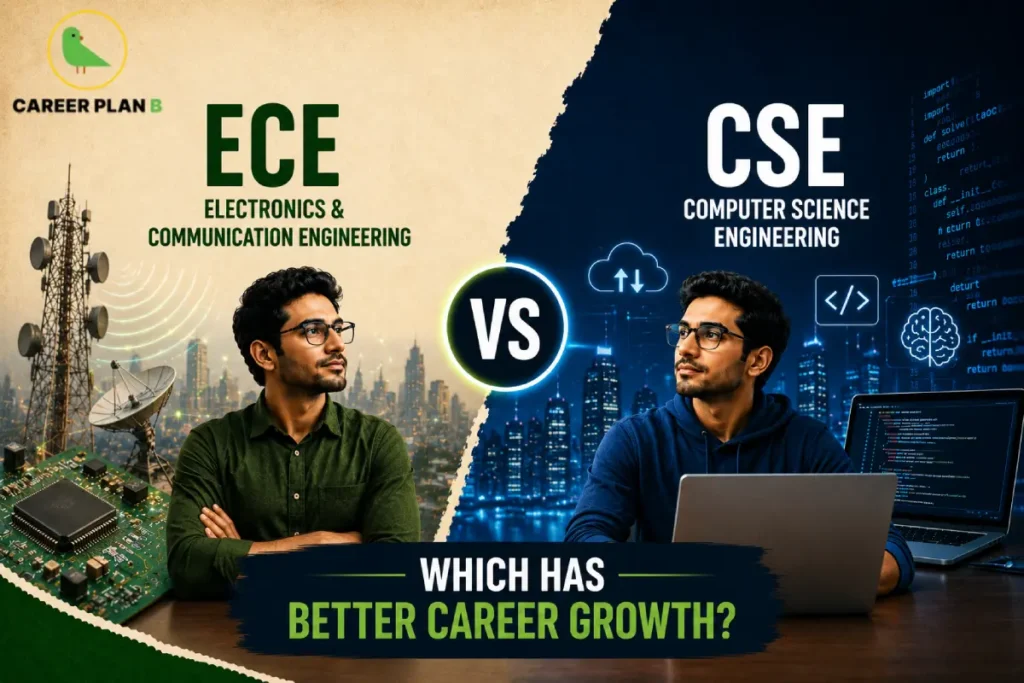
Introduction
Every year, thousands of engineering aspirants in India face the same question staring back at them from their college application form: ECE or CSE?
Both branches are prestigious, both lead to strong careers, and both attract some of the brightest minds in the country. Yet they are fundamentally different in what they teach, where they lead, and what kind of thinker they reward. The confusion is completely understandable, especially when you see ECE graduates landing software jobs and CSE graduates working on hardware-driven AI systems.
ECE vs CSE is one of the most searched engineering comparisons in India, and for good reason. According to the All India Council for Technical Education (AICTE), India produces approximately 1.5 million engineers every year. In a market that competitive, choosing the right branch is not just about interest; it is about strategy.
In this blog, we will break down the real differences between ECE and CSE across career growth, salary, scope, skills, and government job opportunities so you can make a choice you will be confident about for years to come.
What Is ECE?
ECE stands for Electronics and Communication Engineering. It is a branch that sits at the intersection of electronics, communication systems, and computing hardware.
Core Focus Areas of ECE
- VLSI design and semiconductor engineering
- Embedded systems and firmware development
- Signal and image processing
- Communication systems: 4G, 5G, satellite
- Analog and digital circuit design
- Internet of Things (IoT) hardware
ECE graduates typically work in industries like telecommunications, semiconductors, defence, aerospace, consumer electronics, and automotive systems. If you are someone who enjoys understanding how devices work at a fundamental hardware level, ECE is built for you.
What Is CSE?
CSE stands for Computer Science and Engineering. It is the branch focused on software, algorithms, data, and computing systems – the backbone of the modern digital economy.
Core Focus Areas of CSE
- Data structures, algorithms, and system design
- Artificial intelligence and machine learning
- Cloud computing and DevOps
- Cybersecurity and data privacy
- Web and mobile application development
- Database management and big data
CSE graduates work across IT services, product companies, startups, fintech, edtech, and increasingly in AI-first organisations. If you love building software, solving logic problems, and working with data, CSE is your natural home.
ECE vs CSE – Core Differences at a Glance
Here is a structured comparison to help you see exactly where electronics vs computer science diverge:
| Parameter | ECE | CSE |
|---|---|---|
| Primary Focus | Hardware, communication, electronics | Software, algorithms, data systems |
| Core Subjects | VLSI, signals, embedded systems, circuits | DSA, OS, AI/ML, databases, networking |
| Programming Depth | Moderate C, Embedded C, Python | High Python, Java, C++, DSA |
| Hardware Involvement | High | Low to Moderate |
| Key Industries | Telecom, semiconductor, defence, EV | IT, product companies, fintech, AI |
| Higher Studies | M.Tech ECE, MS abroad, GATE EC | M.Tech CSE, MBA, MS abroad, GATE CS |
| Government Jobs | ISRO, DRDO, BEL, BSNL, ESE | SSC, UPSC, PSU IT roles, GATE CS |
This engineering stream comparison makes it clear that both branches are strong; they simply serve different career ecosystems.
ECE vs CSE Salary – Who Earns More?
Let us look at the numbers, because ECE vs CSE salary is one of the most asked questions by students and parents alike.
ECE Salaries in India and Globally
| Experience Level | India (LPA) | Global (USD/year) |
|---|---|---|
| Entry Level (0–2 years) | ₹3.5 – ₹6.5 LPA | $55,000 – $75,000 |
| Mid Level (3–5 years) | ₹7 – ₹14 LPA | $80,000 – $110,000 |
| Senior Level (6+ years) | ₹15 – ₹28 LPA | $115,000 – $160,000 |
CSE Salary in India and Globally
| Experience Level | India (LPA) | Global (USD/year) |
|---|---|---|
| Entry Level (0–2 years) | ₹4.5 – ₹8 LPA | $65,000 – $90,000 |
| Mid-level (3–5 years) | ₹9 – ₹18 LPA | $95,000 – $130,000 |
| Senior Level (6+ years) | ₹18 – ₹40 LPA | $130,000 – $200,000 |
What Do These Numbers Tell Us?
CSE tends to offer higher starting salaries, particularly in software product companies and tech startups. However, ECE graduates who specialise in high-demand domains like VLSI, semiconductor design, or 5G communication can command exceptionally competitive packages, especially in global markets.
For the latest industry salary benchmarks, NASSCOM publishes annual technology talent reports that provide reliable, India-specific compensation data across engineering roles.
Career Scope – Which Branch Opens More Doors?
Beyond salary, ECE career growth and CSE job opportunities each follow distinct trajectories shaped by industry demand.
ECE Career Growth
ECE is experiencing a genuine renaissance in India, driven by:
- The Production Linked Incentive (PLI) Scheme for Electronics Manufacturing by MeitY, which is boosting domestic semiconductor and hardware production significantly
- India’s rapidly growing Electric Vehicle (EV) sector, which demands firmware and embedded systems engineers
- The nationwide 5G rollout creating thousands of communication engineering roles
- Government recruitment through organisations like ISRO, DRDO, and BEL (Bharat Electronics Limited)
- Global semiconductor companies setting up design centres in India, creating high-value chip design roles
CSE Job Opportunities
CSE continues to dominate in terms of sheer volume of opportunities, powered by:
- India’s IT industry, valued at over $250 billion, as reported by NASSCOM
- Explosive growth in AI, machine learning, and data science roles across every sector
- Rising demand for cybersecurity professionals as digital infrastructure expands
- A thriving startup ecosystem backed by strong venture capital investment
- Global product companies like Google, Microsoft, Amazon, and Meta actively hiring from Indian campuses
Verdict on Scope
As a best engineering branch in India, CSE currently offers wider immediate job opportunities across more industries. ECE, however, offers deeper specialisation value and is gaining significant momentum through semiconductor, EV, and defence sector growth. Both are strong; the question is whether you want breadth or depth in your career path.
What Skills Do You Need?
Understanding the skill requirements helps you assess honestly which branch suits your learning style and natural strengths.
ECE Core Skills
- Embedded C and Assembly programming
- VLSI design and semiconductor fundamentals
- Signal processing and communication systems
- PCB design and circuit debugging
- Hardware-software integration
- Knowledge of communication protocols SPI, I2C, UART, 5G standards
CSE Core Skills
- Data structures and algorithms: the foundation of every software interview
- Programming proficiency in Python, Java, or C++
- Understanding of operating systems, databases, and computer networks
- AI and machine learning fundamentals
- Cloud computing platforms: AWS, Azure, Google Cloud
- Cybersecurity basics and secure coding practices
Overlapping Skills Where ECE and CSE Meet
- C programming fundamentals
- Mathematics: discrete math, probability, linear algebra
- IoT development where hardware and software converge
- Problem-solving and analytical thinking
- Basic networking and communication protocols
This overlap is exactly why many ECE graduates successfully transition into software roles and why CSE graduates increasingly work on AI-powered hardware systems. The two branches are more connected than most students realise.
Have Any Doubts?
Higher Studies and Government Jobs
A tech career after engineering often involves either higher studies or government sector entry, and both branches offer strong options here.
ECE Higher Studies and Government Pathways
- GATE EC Gateway to M.Tech admissions at IITs and NITs, and PSU jobs at organisations like BHEL, BSNL, and DRDO
- MS Abroad Strong options in semiconductor design, communications, and embedded systems at US and European universities
- UPSC Engineering Services Exam (ESE) ECE is one of the four streams under UPSC ESE, offering prestigious government engineering roles
- Direct Recruitment ISRO, DRDO, and BEL regularly recruit ECE graduates through dedicated examinations
CSE Higher Studies and Government Pathways
- GATE CS Opens M.Tech seats at IITs and NITs, plus PSU IT roles
- MS Abroad Extremely popular for AI, machine learning, and systems research at top global universities
- MBA Many CSE graduates pursue management roles in tech companies post B.Tech
- Government IT Roles SSC, state PSC, and central government departments increasingly recruit CSE graduates for digital infrastructure projects
For GATE preparation and examination details, visit the official GATE portal.
Which Should You Choose – ECE or CSE?
Here is the most honest answer anyone can give you: the best branch is the one that genuinely excites you.
Choose ECE if you:
- Are fascinated by how electronic devices and communication systems work
- Enjoy working with hardware, circuits, and embedded systems
- Want to work in core engineering domains like semiconductors, aerospace, or telecom
- Are interested in government sector roles at ISRO, DRDO, or defence organisations
- Want deep, specialised expertise that is hard to replicate
Choose CSE if you:
- Love coding, problem-solving, and building software products
- Are drawn to AI, machine learning, data science, or cybersecurity
- Want access to the widest possible job market immediately after graduation
- Are aiming for top product companies or a startup career
- Want flexibility to work across multiple industries throughout your career
If you are still unsure after reading this, which is completely valid, then the problem is not a lack of information. It is a lack of self-awareness about your own strengths and interests. And that is something structured career guidance can genuinely solve.
How Career Plan B Helps
Choosing between ECE and CSE is one of the most important decisions you will make as an engineering aspirant, and it deserves more than a coin toss or peer pressure. Career Plan B gives you the tools and guidance to make this choice with real confidence:
- PsycheIntel Career Assessment Tests Scientifically designed assessments that identify whether your aptitude, personality, and interests align more with hardware-focused ECE pathways or software-driven CSE careers, giving you a data-backed direction
- Personalised Career Counselling One-on-one sessions with career experts who understand the nuances of the ECE vs CSE landscape across industries, salaries, and long-term growth trajectories
- Career Roadmapping A customised, step-by-step plan that outlines the exact subjects, certifications, projects, and internships you should focus on tailored specifically to your chosen branch and career goals
- Admission & Academic Profile Guidance Expert support in identifying the right colleges, specialisations, and entrance exam strategies to maximise your profile for either ECE or CSE admission
Do not leave one of the most important career decisions of your life to guesswork. Visit Career Plan B and get the clarity you deserve.
For Latest Information
Frequently Asked Questions (FAQs)
Q1. Can an ECE graduate get a software job?
Yes, absolutely. Many ECE graduates successfully transition into software roles by building strong programming and data structure skills. Companies like TCS, Infosys, Wipro, and even product companies hire ECE graduates for software positions, provided they demonstrate coding proficiency during placement drives.
Q2. Is CSE harder than ECE?
Both branches have their own challenges. CSE demands strong logical and mathematical thinking, particularly in algorithms and system design. ECE requires comfort with both hardware and software concepts simultaneously. Difficulty is largely subjective and depends on where your natural strengths lie.
Q3. Which branch is better for government jobs in India?
Both branches have strong government job pathways. ECE graduates can appear for UPSC ESE and join organisations like ISRO, DRDO, and BEL. CSE graduates have access to government IT roles, GATE CS-based PSU recruitment, and state government technical positions. ECE traditionally has a slight edge in core government engineering roles.
Q4. Which is better for studying abroad after B.Tech?
Both branches offer excellent MS opportunities abroad. CSE is more popular for AI, ML, and software engineering programmes at US universities. ECE is highly valued for semiconductor, communications, and hardware engineering research, particularly in the US, Germany, and Japan.
Q5. What is the future of ECE in India given the semiconductor boom?
The future is very strong. India’s PLI Scheme for Electronics and the government’s push to establish domestic semiconductor fabrication are creating thousands of high-value ECE roles. Companies like Micron, Samsung, and Applied Materials are already expanding their India presence, making ECE an increasingly lucrative best engineering branch India choice.
Conclusion
The ECE vs CSE debate does not have a single right answer; it has your answer, shaped by your interests, strengths, and long-term vision.
CSE opens the widest doors fastest, particularly in software, AI, and the booming Indian IT industry. ECE offers deeper specialization, strong government job pathways and is gaining powerful momentum through India’s semiconductor, EV, and 5G growth story.
Both are genuinely future-proof. Both can lead to extraordinary careers. The difference lies entirely in which one you will wake up every morning excited to learn and build with.Choose based on who you are, not just where the jobs are today.
Start with self-awareness. Start with the right guidance. Visit Career Plan B to discover which tech career after engineering is truly built for you because the best career decisions are always the informed ones.