Careerplanb · August 3, 2026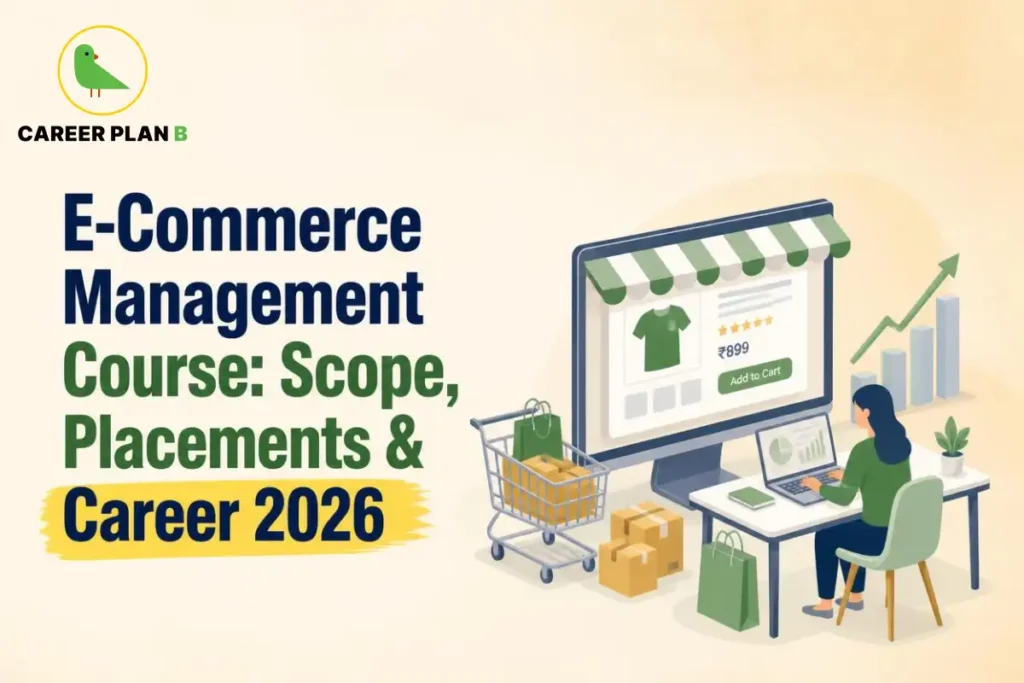
Introduction
Here’s a number that surprises almost every student researching this field. More than half of all e-commerce jobs in India come from logistics alone, not marketing, not design, not the glamorous parts everyone assumes. This single fact is exactly why an E-Commerce Management Course deserves a much closer look than most students give it before writing off the field as “just digital marketing.”
So what does this course actually train you for, and where genuinely does the money sit? This guide breaks down real eligibility, placement data, and honest salary numbers behind an E-Commerce Management Course in 2026. By the end, this field will look considerably bigger than a single Instagram ad campaign.
Why Is E-Commerce Management Genuinely Booming Right Now?
India’s e-commerce market was valued at roughly one hundred forty-seven billion dollars in 2024 and is projected to reach four hundred fifty billion dollars by 2030, growing at over thirty-one percent annually. Consequently, this scale of growth genuinely demands trained professionals across marketing, logistics, analytics, and operations simultaneously, not just one narrow specialisation.
Furthermore, the Indian e-commerce market base is expected to reach nearly five to six hundred million users by 2030, positioning India as the second-largest e-commerce market globally. Therefore, students entering this field today are genuinely positioning themselves inside one of the fastest-growing sectors in the entire Indian economy.
Is This Just Another Name for Digital Marketing?
Not at all, and this is genuinely the biggest misconception students carry into this decision. E-commerce management covers digital marketing, e-commerce platforms, consumer behaviour, web analytics, supply chain management, and online retailing together. Therefore, it is a considerably broader, more operationally focused field than digital marketing alone.
For Personalized Guidance
E-Commerce Management Courses After 12th: What Are Your Options?
Several genuinely distinct pathways exist at different depths and durations. Here is a simple breakdown of the main routes available straight after Class 12.
| Course Type | Duration | Best Suited For |
|---|---|---|
| Diploma in E-Commerce | 1 year (2 semesters) | Students seeking a quick, focused entry into online retail and e-commerce operations |
| BBA in Logistics, Retailing & E-Commerce | 3 years | Students looking for comprehensive training in retail, logistics, supply chain, and e-commerce |
| PGDM in E-Commerce Management | 11 months to 2 years | Graduates seeking a focused and faster postgraduate specialisation in e-commerce |
| MBA in E-Commerce Management | 2 years | Students aiming for long-term leadership roles in digital business, brand management, and e-commerce strategy |
Notably, over seventy colleges across India now offer specialised e-commerce programmes, reflecting genuinely strong institutional investment in this field. Therefore, students have considerably more credible options today than even a few years ago.
What Eligibility Do You Actually Need?
Most undergraduate-level programmes, including the BBA in Logistics, Retailing and E-Commerce, require completion of 10+2 with a minimum of fifty percent aggregate marks, including at least fifty percent in English specifically. Meanwhile, postgraduate routes like the MBA typically require a bachelor’s degree with a similar fifty percent aggregate, alongside entrance exams such as CAT, XAT, or CMAT.
What Does the Curriculum Actually Cover?
Strong programmes build several genuinely distinct, practical skill areas rather than social media theory alone. Understanding this breadth helps you evaluate course quality.
- Digital Marketing and Consumer Behaviour – understanding how and why customers buy online
- E-Commerce Platforms and Web Analytics – managing online storefronts and tracking performance data
- Supply Chain and Logistics Management – coordinating warehousing, inventory, and delivery operations
- Retailing and Online Sales Management – structuring pricing, promotions, and customer experience
- Cyber Law and Digital Security – understanding IT Act provisions and cyber security issues in e-commerce
Notably, this genuinely operational depth is exactly why logistics alone generates more than half of all e-commerce management jobs. Therefore, students who specifically build strength in supply chain and operations coursework often find considerably more entry-level opportunity than marketing-focused peers alone.
Career in E-Commerce Management: What Roles Can You Actually Pursue?
This field offers genuinely diverse roles, extending well beyond running a brand’s social media alone. Depending on your specific interests, several distinct directions exist.
- E-Commerce Logistics Manager – overseeing warehousing, order fulfilment, and delivery operations
- Supply Chain Manager – managing the full flow from procurement to final delivery
- Digital Marketing and Brand Manager – driving customer acquisition and online brand presence
- Web Analytics Specialist – tracking and optimising online performance data
- Inventory or Warehouse Operations Manager – ensuring stock accuracy and efficient distribution centre operations
Which Companies Actually Recruit for These Roles?
Top recruiters genuinely include Amazon, Flipkart, Myntra, Paytm, and eBay, alongside countless smaller online retailers and logistics partners. Consequently, opportunities extend well beyond the largest platforms into third-party logistics providers and niche digital retail startups as well.
What Salary Can You Actually Expect?
Compensation genuinely varies based on role, specialisation, and city. However, current data offers a realistic picture across both entry-level and management-track positions.
How Does Salary Actually Grow With Experience?
Entry-level roles like logistics coordinator or warehouse supervisor typically serve as the starting point before progressing into logistics manager or supply chain analyst positions. Meanwhile, MBA-level e-commerce management professionals genuinely earn considerably more, with average salaries ranging broadly depending on role and location, and senior positions like Head of Logistics or Director of Supply Chain commanding significantly stronger packages.
Does City Location Actually Matter for Pay?
Yes, genuinely so. Salaries are typically higher in major cities like Bengaluru, Mumbai, and Delhi, particularly for professionals working with global e-commerce firms. Therefore, location genuinely factors into realistic salary expectations alongside role and experience.
How Should You Actually Choose the Right Course?
Not every e-commerce programme delivers equal depth. Therefore, evaluate your options using these practical criteria before enrolling.
- Check for genuine logistics and supply chain coverage, since this area alone genuinely drives the majority of hiring
- Verify industry recruiter tie-ups, prioritising institutes with genuine connections to major e-commerce and logistics companies
- Compare practical exposure, favouring programmes with internships or live project work over theory-heavy curricula alone
- Consider relevant certifications, such as Google Analytics or Certified Supply Chain Professional, to strengthen your profile further
A Word of Caution Before You Enrol
Always verify a course provider’s genuine placement record and industry connections before committing significant fees. Additionally, remember that operational roles in logistics and supply chain genuinely offer faster, more accessible entry than purely marketing-focused positions for fresh graduates.
How Career Plan B Helps
Deciding whether an E-Commerce Management Course genuinely fits your strengths takes more than enjoying online shopping alone.This is where Career Plan B can help by offering:
- Personalised Career Counselling: Provides expert guidance based on individual interests, skills, and career goals, helping you judge whether e-commerce management genuinely fits your strengths.
- Psychometric & Career Assessment Tests: Identifies strengths, personality traits, and suitable career opportunities, useful for confirming genuine aptitude for operations versus marketing-focused roles.
- Career Roadmapping: Creates a clear step-by-step plan to achieve academic and professional goals, including which e-commerce specialisation to pursue.
- Admission & Academic Profile Guidance: Helps in selecting the right courses and colleges and improving academic profiles, so your course choice is genuinely outcome-driven.
Get In Touch With Us
Frequently Asked Questions
1. What is the eligibility for an E-Commerce Management Course after 12th?
Most undergraduate programmes require completion of 10+2 with a minimum of fifty percent aggregate marks, including at least fifty percent specifically in English.
2. Is e-commerce management the same as digital marketing?
No, it is considerably broader, covering supply chain, logistics, web analytics, and retail operations alongside digital marketing, not just marketing alone.
3. Which companies hire e-commerce management graduates?
Top recruiters include Amazon, Flipkart, Myntra, Paytm, and eBay, alongside smaller online retailers and third-party logistics providers.
4. Why does logistics generate so many jobs in this field?
Logistics and supply chain management genuinely form the operational backbone of e-commerce, generating more than half of all jobs in the sector.
5. Do I need an MBA to build a strong career in e-commerce management?
Not necessarily. A BBA or diploma can start your career, though an MBA genuinely accelerates progression into senior management and leadership roles.
Conclusion
E-commerce management is genuinely far bigger than running a brand’s Instagram page, spanning logistics, supply chain, analytics, and retail strategy across a market racing toward four hundred fifty billion dollars by 2030. For students who understand this operational depth, this field offers real, diverse, and genuinely well-paying opportunity across India’s fastest-growing sector.
If you are still weighing whether this field suits your strengths, thoughtful guidance can bring real clarity before you commit years of study. The right specialisation, chosen deliberately, can position you exactly where India’s digital economy needs talent most. Talk to a Career Plan B counsellor today to see if e-commerce management is the right path for you.