Team6 · July 15, 2026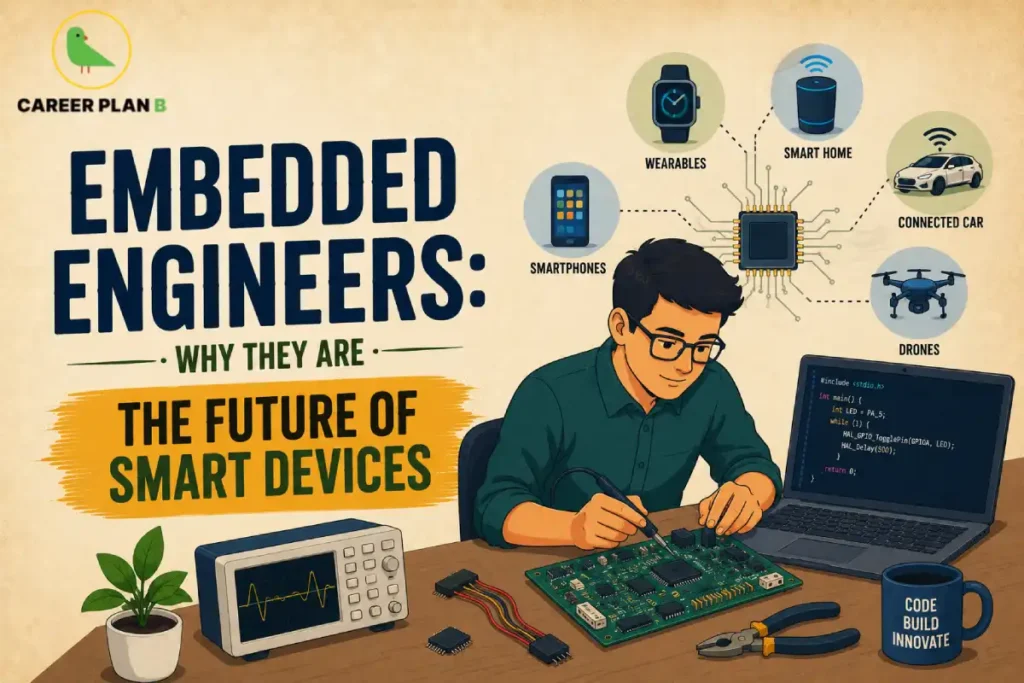
Introduction
Think about the last time you used a smartwatch, adjusted your home thermostat from your phone, or rode in a car with automatic braking. Every single one of those experiences was made possible by embedded engineers, the professionals who design and build the intelligent systems hidden inside modern technology.
We live in a world that is rapidly filling with smart devices. From connected refrigerators to wearable health monitors and autonomous vehicles, the demand for technology that thinks, responds, and adapts is growing faster than ever before. And at the centre of all of it are embedded engineers, quietly powering the future of smart devices one line of firmware at a time.
If you are a student or early-career professional exploring your options, a career in embedded systems could be one of the most future-proof decisions you make. This blog will walk you through what embedded engineers do, why their role is becoming increasingly critical, what skills and qualifications you need, and what career opportunities await you in this exciting field.
What Do Embedded Engineers Actually Do?
An embedded systems engineer designs, develops, and tests the software and hardware that powers dedicated computing systems built to perform specific functions within a larger device or machine.
Unlike general-purpose computers, embedded systems are optimized for a single task: controlling a car’s braking system, managing a medical device’s sensor readings, or regulating the temperature inside an industrial machine.
On a daily basis, an embedded engineer might:
- Write and optimize firmware in C or C++
- Integrate microcontrollers and processors with sensors and actuators
- Test real-time performance under strict timing and memory constraints
- Debug hardware-software interface issues
- Collaborate with hardware engineers to design circuit boards and system architecture
Industries that rely heavily on embedded engineers include automotive, aerospace, consumer electronics, healthcare, industrial automation, and telecommunications.
Why Smart Devices Cannot Exist Without Embedded Systems
Every piece of smart device technology you interact with daily is powered by an embedded system. This is not an exaggeration; it is a technical reality.
Consider these examples:
- Smartphones use embedded processors to manage everything from camera autofocus to power consumption
- Electric Vehicles (EVs) rely on embedded systems for battery management, motor control, and driver assistance features
- Pacemakers use embedded software to monitor and regulate heart rhythms in real time
- Smart meters in homes use embedded systems to track and transmit energy usage data
- Industrial robots depend on embedded controllers for precise, repeatable movements
The reason embedded software development is so critical is that these systems must perform reliably, often in real time, with very limited processing power and memory. There is no room for error, and that is exactly what makes embedded engineers so valuable.
The Explosive Growth of IoT and What It Means for Embedded Engineers
The Internet of Things (IoT), the network of connected smart devices, is one of the fastest-growing sectors in the global technology industry. Every connected device in the IoT ecosystem requires an embedded system at its core.
According to the U.S. Bureau of Labour Statistics, employment in electrical and electronics engineering, a field closely tied to embedded systems, is expected to grow steadily, driven by advancements in telecommunications, automation, and smart infrastructure.
The IEEE (Institute of Electrical and Electronics Engineers), the world’s largest technical professional organization, regularly publishes research and standards related to embedded systems and IoT development, reflecting how central this field is to modern engineering. For students in India, the All India Council for Technical Education (AICTE) provides official guidance on engineering programmes, including those focused on embedded and IoT technologies.
What does this growth mean for you? It means that the demand for IoT engineer careers and embedded systems professionals is only going to rise. Companies across every sector are building smarter, more connected products, and they need qualified engineers to build them.
Have Any Doubts?
Skills Every Embedded Systems Engineer Must Have
Building a successful embedded systems career requires a very specific combination of technical depth and practical problem-solving ability. Here is what you need to develop:
Technical Skills:
- Programming Languages: C and C++ are the foundation of embedded development. Python is increasingly used for scripting and testing.
- Real-Time Operating Systems (RTOS): Understanding FreeRTOS, Zephyr, or VxWorks is essential for managing time-critical tasks
- Microcontrollers and Processors: Hands-on experience with ARM Cortex, AVR, PIC, or ESP32 platforms
- Communication Protocols: UART, SPI, I2C, CAN, and Ethernet are used to connect components within embedded systems
- Hardware Interfaces: Reading schematics, working with oscilloscopes, logic analyzers, and JTAG debuggers
- FPGA Programming: Field Programmable Gate Arrays are increasingly used in high-performance embedded applications
Soft Skills:
- Precision and attention to detail embedded bugs can cause serious hardware failures
- Patience for long debugging cycles
- Strong cross-disciplinary communication with hardware and software teams
Career Paths and Salary as a Firmware Engineer or Embedded Developer
One of the most compelling reasons to pursue a career in embedded systems is the variety of roles available and the strong salary potential across industries.
| Role | Industry | Avg. Salary (India) | Avg. Salary (Global) |
|---|---|---|---|
| Embedded Software Engineer | Consumer Electronics, Automotive | ₹5–14 LPA | $80,000–$120,000/year |
| Firmware Engineer | IoT, Telecom, Defense | ₹6–16 LPA | $85,000–$130,000/year |
| IoT Developer | Smart Home, Healthcare | ₹5–13 LPA | $75,000–$115,000/year |
| Embedded Systems Architect | Aerospace, Industrial | ₹12–28 LPA | $110,000–$160,000/year |
| RTOS Developer | Automotive, Defense | ₹8–18 LPA | $90,000–$135,000/year |
For India-specific career and education data, students can refer to the National Board of Accreditation (NBA) under AICTE, which accredits engineering programmes across the country.
For free, high-quality courses on embedded systems and microcontroller programming taught by IIT faculty, NPTEL is an excellent official resource.
Challenges You Should Know Before Entering This Field
Like any engineering discipline, a career in embedded systems comes with its share of real challenges. Being aware of them early helps you prepare better.
- Debugging is uniquely difficult. Unlike software bugs that show up in a log file, embedded bugs can be caused by hardware timing issues, power fluctuations, or signal interference, making them much harder to trace.
- Memory and power constraints are strict. Embedded systems often run on microcontrollers with kilobytes of RAM, not gigabytes. Writing efficient, lean code is a critical skill that takes time to develop.
- The hardware-software boundary is complex. An embedded systems engineer must understand both worlds, electronics and programming, simultaneously. This dual expertise is what makes the role challenging and also highly valued.
- Rapid hardware evolution. New microcontrollers, communication standards, and IoT protocols emerge frequently. Staying current through continuous learning is a professional necessity.
How Career Plan B Helps
Deciding whether a career in embedded systems is the right fit for you can feel overwhelming, especially with so many engineering specializations to choose from. That is where Career Plan B comes in.
At Career Plan B, you can access PsycheIntel Career Assessment Tests that evaluate your technical aptitude, analytical thinking, and problem-solving abilities – key traits for embedded engineers. Their Career Roadmapping service helps you chart a clear path from your current education to your first embedded systems role. If you are planning to pursue a specialized engineering degree or a master’s programme focused on IoT or embedded software development, their admission and academic profile guidance ensures your application stands out.
Career Plan B gives you expert, personalized support so you do not have to navigate this career path alone.
For Latest Information
Frequently Asked Questions (FAQs)
1. What does an embedded engineer do?
An embedded engineer designs, programs, and tests the software and hardware inside dedicated computing systems from smartwatches to automotive control units.
2. Is embedded systems a good career choice right now?
Absolutely. With the global expansion of IoT, EVs, smart manufacturing, and medical devices, the demand for embedded systems engineers is at an all-time high and growing steadily.
3. What programming language is most important for embedded development?
C is the most widely used language in embedded software development due to its efficiency and low-level hardware control. C++ is also commonly used for more complex applications.
4. How is embedded engineering different from software engineering?
Software engineers typically build applications for general-purpose computers. Embedded engineers write code that runs directly on hardware, often in real time, with strict resource constraints.
5. Which industries hire embedded engineers the most?
Automotive, consumer electronics, healthcare, aerospace and defence, telecommunications, and industrial automation are the top sectors offering IoT engineering careers and embedded roles.
6. Do I need a degree to become an embedded engineer?
A bachelor’s degree in electronics, electrical engineering, or computer science is typically required. Practical project experience and certifications can strengthen your profile significantly.
Conclusion
The world is getting smarter, and embedded engineers are the ones making it happen. From the chip inside your fitness tracker to the systems managing an entire smart city’s power grid, embedded engineering sits at the intersection of innovation and real-world impact.
This is not just a job with strong salary prospects. It is a career where your work genuinely shapes how people live, move, and connect with the world around them.
If you are ready to explore whether this path is right for you, visit Career Plan B for personalized career counselling, assessment tests, and expert guidance tailored to your goals.
The smartest devices in the world run on embedded systems, and the best embedded engineers are the ones who start preparing today