Team Career Plan B · July 10, 2026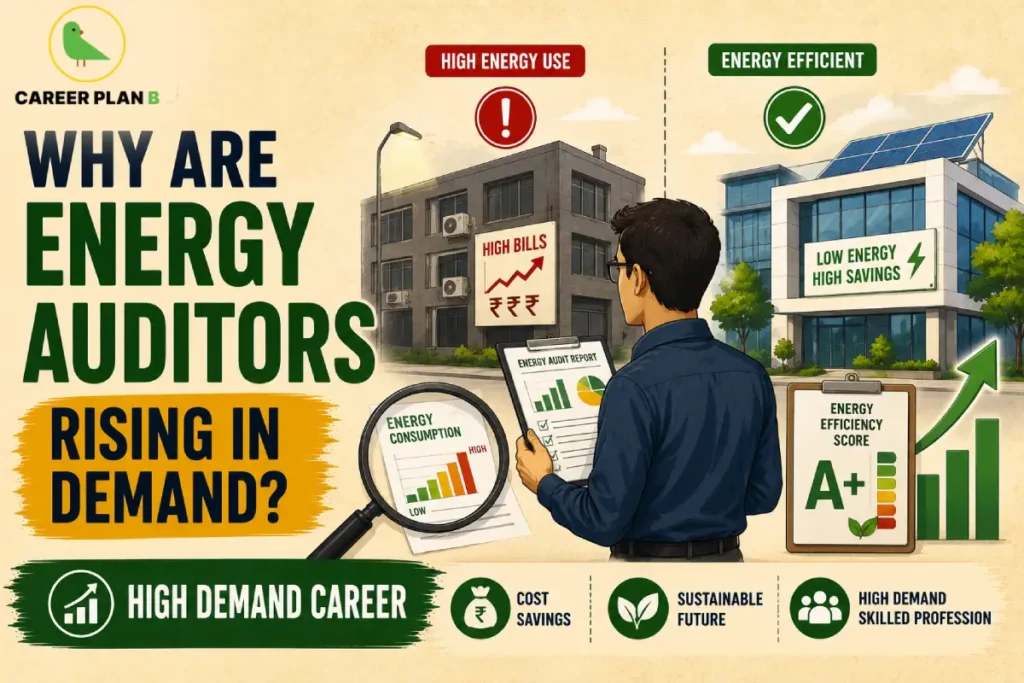
Introduction
India is one of the world’s largest energy consumers and one of its biggest energy wasters. Industries, commercial buildings, hospitals, hotels, and government facilities collectively lose thousands of crores worth of energy every year through inefficiency, outdated equipment, and poor energy management practices.
Now imagine a professional who walks into a factory, analyses every unit of electricity being consumed, identifies exactly where energy is being lost, and recommends changes that can cut the facility’s energy bill by 20 to 40 per cent while also reducing its carbon footprint. That professional is an energy auditor.
India has committed to achieving net zero carbon emissions by 2070 and has set an interim target of reducing the emissions intensity of its GDP by 45% by 2030, goals enshrined in India’s Nationally Determined Contributions (NDCs) submitted under the Paris Agreement. Achieving these targets are impossible without dramatically improving energy efficiency across every sector of the economy. And that is precisely why the demand for energy auditors in India is rising faster than most people in the engineering world realise.
The Bureau of Energy Efficiency (BEE) under the Ministry of Power, Government of India estimates that India’s energy efficiency market represents an investment opportunity of over ₹14 lakh crore, and every rupee of that opportunity needs trained energy professionals to unlock it.
This blog covers everything you need to know about energy auditors, from what they do and how to become one to career scope, BEE certification, top recruiters, salary, and the skills that define success in this growing field.
Who Is an Energy Auditor and What Do They Do?
An energy auditor is a trained professional who systematically examines an organisation’s energy consumption across its equipment, processes, and systems to identify opportunities for reducing energy use, cutting costs, and improving overall energy efficiency.
Think of an energy auditor as a doctor for buildings and industrial facilities. Just as a doctor diagnoses health problems and prescribes treatment, an energy auditor diagnoses energy inefficiencies and recommends corrective measures.
Two key designations in India’s energy audit ecosystem:
- BEE Certified Energy Auditor (EA): The highest professional qualification for energy auditing in India, authorised to conduct detailed energy audits of large industrial and commercial facilities. Certification is governed by the Bureau of Energy Efficiency (BEE).
- BEE Certified Energy Manager (EM): A complementary qualification focused on energy management within an organisation mandatory for Designated Consumers (DCs) under India’s Energy Conservation Act.
Industries where energy auditors work:
- Heavy industries: steel, cement, aluminium, fertilisers, textile mills
- Commercial buildings: offices, hotels, hospitals, malls, data centres
- Power utilities and distribution companies
- Government buildings and public sector undertakings
- Renewable energy installations and smart grid projects
- Infrastructure: airports, metro rail, seaports
What Does an Energy Auditor Actually Do on the Job?
Understanding energy auditor roles and responsibilities in practical detail is essential before you commit to this career because it is far more hands-on and analytical than most people expect.
Core responsibilities include:
- Conducting walkthroughs and preliminary energy audits to identify quick energy-saving opportunities
- Performing detailed energy audits collecting comprehensive data on energy consumption, equipment performance, and operational patterns
- Analysing energy bills, load profiles, and production data to establish energy performance baselines
- Recommending energy conservation measures (ECMs) with detailed cost-benefit analysis and payback period calculations
- Preparing energy audit reports that meet BEE and regulatory standards
- Monitoring and verifying the implementation of recommended energy-saving measures
- Supporting organisations in complying with Perform Achieve and Trade (PAT) Scheme targets set by BEE
Types of energy audits:
- Preliminary Audit: A quick assessment to identify obvious inefficiencies and estimate potential savings
- Detailed Audit: A comprehensive, data-intensive investigation of all energy systems the most common type for industrial clients
- Investment-Grade Audit: The most rigorous level used to justify large capital investments in energy efficiency upgrades
Key instruments and tools used:
- Power analysers measure electrical load, power factor, and harmonics
- Thermal imaging cameras detect heat losses in building envelopes, electrical panels, and industrial equipment
- Flow meters and pressure gauges measure fluid and compressed air systems
- Lux meters assess lighting efficiency levels
- Combustion analysers evaluate boiler and furnace efficiency
- Energy simulation software eQUEST, EnergyPlus for building energy modelling
Why Are Energy Auditors Rising in Demand in India?
The demand for energy auditors in India is being driven by a powerful combination of government policy, rising energy costs, and growing corporate sustainability commitments all converging at the same time.
1. The PAT Scheme: A Regulatory Mandate for Energy Efficiency
The Perform Achieve and Trade (PAT) Scheme is India’s most ambitious industrial energy efficiency programme. Implemented by BEE under the Ministry of Power, PAT covers over 1,000 large industries called Designated Consumers (DCs) across sectors like steel, cement, aluminium, fertilisers, and power plants. These industries are legally mandated to achieve specific energy consumption reduction targets, and they cannot do so without qualified energy auditors and managers. Each PAT cycle creates direct demand for BEE-certified professionals across all covered industries.
2. India’s Net Zero 2070 Commitment
India’s climate commitments under the Paris Agreement overseen by the Ministry of Environment, Forest and Climate Change (MoEFCC) include achieving net zero emissions by 2070 and reducing GDP emissions intensity by 45% by 2030. Energy efficiency is the single most cost-effective lever for meeting these targets, and energy auditors are the professionals who deliver it on the ground.
3. The Energy Conservation (Amendment) Act 2022
The Energy Conservation (Amendment) Act 2022, available at Ministry of Power significantly expanded the scope of India’s energy efficiency framework. It introduced carbon trading mechanisms, mandatory energy conservation standards for buildings, and extended BEE’s mandate to include green hydrogen and new industrial sectors. This expansion directly creates new roles for energy auditors across previously uncovered industries and building types.
4. Rising Energy Costs for Industries
With electricity tariffs rising consistently across India, every percentage point of energy efficiency translates directly into cost savings for businesses. This economic reality is driving industries, even those not covered by PAT, to voluntarily invest in energy audits. The energy efficiency career opportunities this creates extend well beyond regulated industries into the broader commercial and services sector.
5. Green Building and ESG Compliance
India’s green building movement, led by rating systems like IGBC (Indian Green Building Council) and GRIHA (Green Rating for Integrated Habitat Assessment) under the Ministry of New and Renewable Energy (MNRE) requires energy performance certification for buildings. Additionally, growing ESG (Environmental, Social, and Governance) reporting requirements from SEBI for listed companies are creating demand for energy auditors who can quantify and verify energy performance data.
BEE Certified Energy Auditor: What You Need to Know
The BEE-certified energy auditor qualification is the gold standard for energy audit professionals in India, and understanding the certification process is central to how to become an energy auditor in this country.
What is BEE Certification? The Bureau of Energy Efficiency (BEE) under the Ministry of Power administers India’s national energy auditor and energy manager certification examinations. The certification is mandated under the Energy Conservation Act 2001 and is the primary professional credential for energy audit work in India.
Two certifications offered by BEE:
- Certified Energy Auditor (EA): Authorises the holder to conduct energy audits of large industrial and commercial facilities. Considered the more prestigious and technically demanding of the two certifications.
- Certified Energy Manager (CEM): Focuses on energy management within organisations; mandatory for energy managers appointed by designated consumers under the Energy Conservation Act.
Eligibility criteria for the EA exam:
- A degree in Engineering or Architecture with at least 5 years of relevant work experience, OR
- A diploma in Engineering with at least 7 years of relevant work experience
Exam structure: The BEE EA examination consists of four papers covering general aspects of Energy Management, energy efficiency in electrical utilities, energy efficiency in thermal utilities, and a sector-specific paper (candidates choose their industry sector). Full details, exam schedules, and study materials are available at the official BEE India website.
Career Scope for Energy Auditors in India and Globally
The energy auditor career scope in India is broader and more sustainable than most engineering graduates realise, and it is growing in multiple directions simultaneously.
Designated Consumers: A Guaranteed Market: India currently has over 1,000 officially designated large energy consumers under the PAT Scheme, each legally required to employ a BEE-certified energy manager and periodically conduct energy audits. As the scope of the Energy Conservation Act expands to cover more industries, this number will grow. Every single designated consumer represents a direct employment or consulting opportunity for certified energy auditors.
Green Buildings: A Booming Sector – India has the second largest green building footprint in the world by registered area, and it is growing rapidly. IGBC- and GRIHA-rated building projects require energy performance assessments, creating sustained demand for energy auditors with building energy expertise. Details on GRIHA are available at GRIHA Council.
ESG and Corporate Sustainability: SEBI’s Business Responsibility and Sustainability Reporting (BRSR) framework mandating sustainability disclosures from top listed companies is creating a new wave of demand for energy auditors who can support corporate ESG reporting and carbon footprint quantification.
Global Opportunities: The energy efficiency career opportunities extend well beyond India. Countries in the Middle East, particularly the UAE, Saudi Arabia, and Qatar, have mandatory energy audit programmes for large buildings and industries. Europe’s Energy Efficiency Directive requires regular energy audits for large enterprises across EU member states. In Southeast Asia, Singapore, Malaysia, and Thailand are also scaling up energy audit requirements. Indian energy auditors with BEE certification and international experience are in strong demand across all these geographies.
Top Recruiters for Energy Auditors in India
The energy audit jobs and salaries in India are available across government institutions, large private corporations, consultancies, and a growing ecosystem of energy service companies (ESCOs).
Government and Public Sector Recruiters
- Bureau of Energy Efficiency (BEE) The apex government body for energy efficiency in India. BEE directly employs energy professionals and coordinates the national energy audit ecosystem. It also empanels certified energy auditors for government-sponsored audit programmes.
- Energy Efficiency Services Limited (EESL) A joint venture of major PSUs under the Ministry of Power, EESL implements large-scale energy efficiency programmes across industries, government buildings, and municipalities. It is one of the most active government employers of energy auditors and managers in India.
- NTPC Limited India’s largest power generator, employs energy managers and auditors to optimise energy performance across its generation fleet and corporate facilities.
- Power Grid Corporation of India (PGCIL) employs energy efficiency professionals for transmission loss reduction and energy management across its national grid infrastructure.
- State DISCOMs and electricity boards: State distribution companies across India are increasingly deploying energy auditors for demand-side management programmes and loss reduction initiatives.
Private Sector Recruiters
- Siemens India works extensively on industrial energy management and building automation systems, actively recruiting energy auditors for client project delivery.
- Schneider Electric India One of the most active private-sector employers of energy efficiency professionals, offering roles in energy management systems, building automation, and industrial energy optimisation.
- L&T Energy and L&T Construction recruit energy auditors for large infrastructure and industrial projects requiring energy performance certification.
- Tata Consulting Engineers and Tata Power work across power and infrastructure projects with dedicated energy efficiency teams.
Consulting and ESCO Sector
- KPMG, Deloitte, and EY India All have growing sustainability and energy advisory practices that employ BEE-certified energy auditors for ESG consulting and energy performance projects.
- Ernst & Young (EY) and PwC India Recruit energy auditors for sustainability reporting, carbon accounting, and energy efficiency consulting.
- ESCOs (Energy Service Companies) A growing sector in India, ESCOs finance and implement energy efficiency projects for industrial and commercial clients on a performance-contract basis. They are among the most active employers of field energy auditors in the country. A list of empanelled ESCOs is available at BEE ESCO Portal.
Energy Auditor: Salary and Job Roles
Here is a realistic breakdown of energy audit jobs and salary in India across different roles and experience levels:
| Job Role | Fresher Salary | Experienced (3–5 Years) |
|---|---|---|
| Energy Auditor (Industry) | ₹4 – ₹7 LPA | ₹10 – ₹20 LPA |
| Energy Manager (Designated Consumer) | ₹5 – ₹8 LPA | ₹12 – ₹22 LPA |
| Green Building Consultant | ₹4.5 – ₹7.5 LPA | ₹10 – ₹20 LPA |
| ESG Energy Consultant | ₹5 – ₹9 LPA | ₹12 – ₹25 LPA |
| ESCO Project Engineer | ₹4.5 – ₹7 LPA | ₹10 – ₹18 LPA |
| Government / PSU Energy Manager | ₹50,000 – ₹70,000 per month | ₹80,000 – ₹1.2 lakh per month |
| Freelance Energy Auditor | ₹500 – ₹2,000 per audit day | ₹3,000 – ₹10,000 per audit day |
BEE-certified energy auditors working as independent consultants or through ESCOs can earn significantly above the salaried benchmarks, especially as they build a portfolio of industrial clients and develop sector-specific expertise. ESG consulting roles at Big 4 firms command some of the highest salaries in the energy efficiency space.
Have Any Doubts?
Skills Every Energy Auditor Must Have
Building the right skill set for energy efficiency career opportunities requires a deliberate combination of technical knowledge, analytical ability, and practical field experience.
Technical skills that are essential:
- Power Systems and Electrical Engineering A fundamental understanding of motors, transformers, lighting systems, HVAC, and compressed air systems the most common energy-consuming equipment in industrial audits
- Thermodynamics and Thermal Systems knowledge of boilers, furnaces, heat exchangers, and steam systems critical for auditing thermal energy consumption in process industries
- Data Analysis and Energy Modelling: ability to analyse energy consumption data, build load profiles, and use energy simulation tools like eQUEST and EnergyPlus
- Power Quality Analysis: measuring and interpreting power factor, harmonics, and demand patterns using power analysers
- Building Energy Systems’ understanding of HVAC design, building envelope performance, and lighting systems for commercial energy audits
Key certifications that strengthen your profile:
- BEE Certified Energy Auditor / Energy Manager: the primary professional credential details at BEE India
- LEED Accredited Professional (LEED AP) for green building energy consulting roles
- GRIHA Evaluator Certification for Indian green building rating projects details at GRIHA Council
- IGBC Accredited Professional for IGBC-rated building projects
- NPTEL courses on Energy Engineering, Power Systems, and Renewable Energy from IITs available at NPTEL
- ISO 50001 Internal Auditor for energy management system audit roles in industrial organisations
Soft skills that define career success:
- Analytical thinking: the ability to look at complex energy data and identify patterns, anomalies, and opportunities
- Report Writing energy audit reports are detailed, technical documents that must be clear, accurate, and actionable
- Client Communication presenting energy audit findings and recommendations to facility managers and senior executives requires clear, persuasive communication
- Attention to Detail: Missing a significant energy consumer during a site survey can invalidate an entire audit
Practical experience tips:
- Participate in Smart India Hackathon energy efficiency challenges at SIH Official
- Pursue internships at ESCOs, EESL, or BEE-empanelled energy audit firms during your engineering programme
- Conduct energy audits of your college campus or hostels as final-year projects – practical experience that is highly valued by recruiters
How Career Plan B Helps
The path to becoming a BEE-certified energy auditor involves more than just passing an examination; it requires the right engineering foundation, the right specialisation, and a career strategy aligned with where India’s energy efficiency sector is heading. Career Plan B helps engineering students and graduates navigate this journey through psychometric and career assessment tests that identify your aptitude for analytical and field-based roles, career roadmapping sessions that build a step-by-step plan from your current qualification to your target role, and personalised career counselling from experts who understand the energy and sustainability sector. Whether you are targeting BEE certification, an ESCO career, or an ESG consulting role at a top firm, Career Plan B ensures your journey into energy efficiency career opportunities is purposeful, structured, and built for long-term success.
For Latest Information
Frequently Asked Questions (FAQs)
Q1. Is energy auditing a good career choice for engineering graduates in India?
Absolutely. With India’s mandatory energy efficiency regulations, net zero commitments, green building boom, and growing ESG compliance requirements, the demand for qualified energy auditors is strong, sustained, and growing across multiple sectors. It is a career that offers both excellent professional growth and the genuine satisfaction of contributing to India’s sustainability goals.
Q2. Which engineering background is best suited for becoming an energy auditor?
Electrical engineering (EEE), mechanical engineering, and chemical engineering graduates are the most naturally suited for energy auditing careers, as the role involves auditing electrical systems, thermal processes, and mechanical equipment. However, graduates from other engineering disciplines can also pursue BEE certification with the right preparation and work experience.
Q3. What is the difference between a BEE energy auditor and a BEE energy manager?
A BEE-certified energy auditor is authorised to conduct independent energy audits of large industrial and commercial facilities. A BEE Certified Energy Manager is primarily an in-house professional responsible for managing energy. Large designated consumers under India’s Energy Conservation Act are legally required to appoint a BEE-certified energy manager. Full details on both certifications are available at BEE India.
Q4. Can energy auditors work as independent consultants in India?
Yes, and it is one of the most financially rewarding ways to build a career in this field. BEE empanels certified energy auditors for government-sponsored audit programmes, and private industries actively hire independent auditors for PAT compliance and voluntary energy audits.
Q5. Are there global opportunities for Indian energy auditors?
Yes, significantly. The UAE, Saudi Arabia, and Qatar have mandatory building energy audit programmes. The European Union’s Energy Efficiency Directive requires regular audits for large enterprises. Singapore and Malaysia are scaling up energy audit regulations.
Conclusion
India cannot meet its climate commitments, reduce its industrial energy bills, or build a sustainable economy without dramatically improving energy efficiency and energy auditors are the professionals who make that improvement happen, one facility at a time.
The demand for energy auditors in India is not a short-term trend driven by a single policy. It is a structural, long-term shift driven by climate commitments; mandatory regulations; rising energy costs; green building standards; and corporate ESG requirements, forces that are only going to intensify over the coming decade.
For engineering graduates who enjoy analytical work, want to make a tangible environmental contribution, and are looking for a career with both strong job security and excellent earning potential, energy auditing offers one of the most compelling professional paths in India’s evolving energy sector.
But getting there requires the right preparation, the right certification, the right skills, and a career plan built around where this industry is heading. Visit Career Plan B today and take the first step toward an energy auditor career that is as efficient, purposeful, and impactful as the work you will one day do.