Team6 · July 20, 2026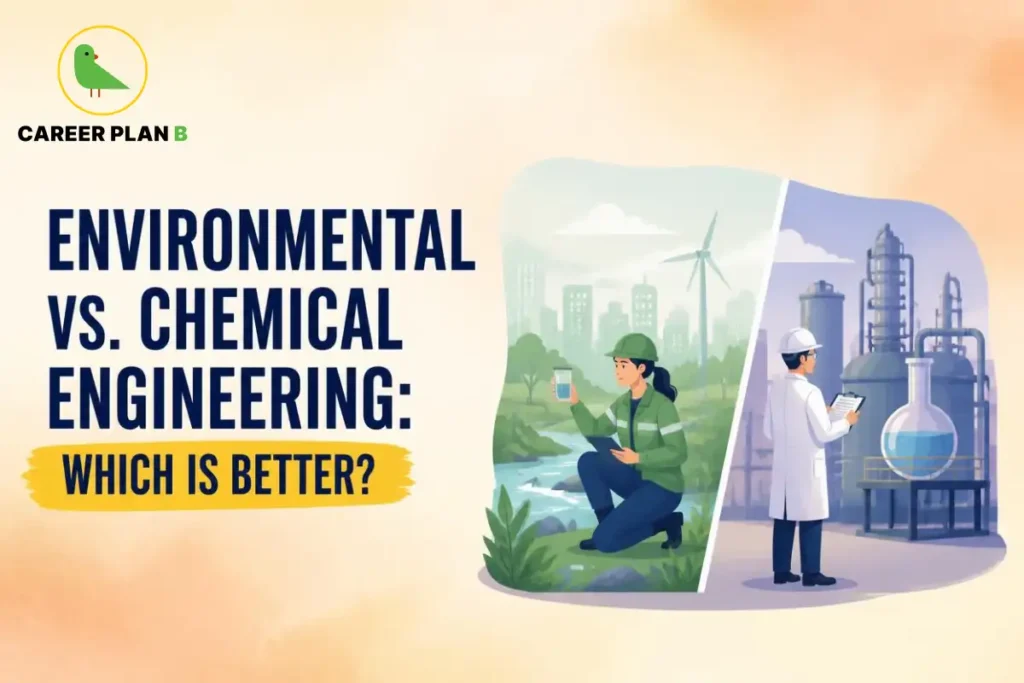
Introduction
Choosing between engineering branches after Class 12 often comes down to one question: environmental vs chemical engineering, which is better? Both fields share common fundamentals, including chemistry, process design, and strong problem-solving skills. However, they lead to very different careers and day-to-day responsibilities.
Many students choose one branch simply because it sounds more technical or because someone they know recommended it. In reality, each field offers unique opportunities, work environments, and career paths. Understanding these differences is essential before making a decision.This blog compares environmental and chemical engineering in detail. It explores their core differences, career scope, salary, required skills, and future opportunities. The goal is to help you choose the branch that best matches your interests and long-term career goals.
What’s the Core Difference Between These Two Fields?
Chemical engineering focuses on designing processes that convert raw materials into valuable products: fuels, pharmaceuticals, plastics, fertilizers, and more. It’s rooted in thermodynamics, fluid mechanics, and reaction engineering. Environmental engineering, meanwhile, centres on protecting the environment through pollution control, waste management, water treatment, and regulatory compliance. There’s real overlap between the two, since many chemical engineering programs even offer environmental engineering as a specialization, and chemical engineers in sectors like petrochemicals now spend significant time on emissions control and environmental compliance as part of their core job. Still, the primary focus differs: one is about producing things efficiently, and the other is about protecting ecosystems and public health from the side effects of that production.
Which One Actually Suits You Better?
So, how do you decide between the two? Start by asking yourself what excites you more. Do you enjoy designing and optimizing processes that transform raw materials into useful products? Or are you more interested in solving pollution, waste management, and environmental compliance challenges?
If you enjoy chemical reactions, industrial processes, and large-scale manufacturing systems, a chemical engineering career may be the better fit. If you’re more interested in sustainability, environmental regulations, and solving issues related to waste or water systems, an environmental engineering career is likely to suit you better.
Neither field is inherently better than the other. The right choice depends on your interests, strengths, and the type of technical problems you want to solve throughout your career.
Have Any Doubts?
Career Scope: Where Each Field Leads
Chemical engineering offers a considerably broader industrial base, with strong demand across petrochemicals, pharmaceuticals, oil and gas, fertilizers, and food processing. Major government recruiters include PSUs like IOCL, ONGC, HPCL, BARC, and DRDO, alongside private giants like Reliance Industries and Tata Chemicals. Environmental engineering, while a narrower field numerically, has steady government demand through the Central Pollution Control Board, State Pollution Control Boards, and PSUs needing dedicated compliance expertise. Both fields are increasingly intersecting too, since chemical engineers working in petrochemicals are now tasked with developing cleaner extraction methods and carbon capture technologies to meet environmental regulations, which blurs the line between petrochemical engineering jobs and pure environmental compliance work.
Salary Comparison: Environmental vs Chemical Engineering
| Career Stage | Chemical Eng. Salary (India) | Environmental Eng. Salary (India) |
|---|---|---|
| Entry-Level | INR 3.5 – 6 lakh | INR 4.5 – 7 lakh |
| Mid-Level | INR 8 – 15 lakh | INR 8 – 18 lakh |
| Senior-Level | INR 20 – 25+ lakh | INR 15 – 30+ lakh |
Interestingly, average salaries in both fields land in a similar range at the entry level, though chemical engineering shows a wider spread depending on the sector; petrochemical and specialized roles like chip manufacturing or renewable energy can command notably higher starting packages than core manufacturing roles. For both fields, the Graduate Aptitude Test in Engineering (GATE) remains a key gateway into stable PSU roles. You can check official exam details and eligibility through the GATE official website, maintained by the IIT hosting the exam that year.
Skills and Certifications That Boost Either Path
For a chemical engineering career, proficiency in process simulation software like Aspen Plus and MATLAB, along with strong knowledge of safety norms, significantly boosts starting offers and long-term growth. For an environmental engineering career, credentials like LEED green building certification, GIS mapping skills, and sustainability reporting frameworks like GRI tend to open doors to specialized consulting and compliance roles. Both fields increasingly reward professionals who go beyond core coursework and build applied, industry-relevant skills through internships and certifications, rather than relying purely on their degree.
How Career Plan B Helps
Career Plan B helps students and professionals make informed career decisions through personalized guidance, assessments, and structured planning.
- Personalized Career Counselling: Provides expert guidance based on individual interests, skills, and career goals.
- Psychometric & Career Assessment Tests: Identify strengths, personality traits, and suitable career opportunities.
- Career Roadmapping: Creates a clear step-by-step plan to achieve academic and professional goals.
- Admission & Academic Profile Guidance: Helps in selecting the right courses and colleges and improving academic profiles.
Get In Touch With Us
Frequently Asked Questions
1. Which is better, environmental or chemical engineering?
Neither is objectively better. Chemical engineering offers broader industrial scope, while environmental engineering suits those drawn to sustainability and regulatory work.
2. Can chemical engineers work as environmental engineers?
Yes, especially those who specialize in environmental engineering during their degree or gain experience in compliance and emissions control roles.
3. Which field pays more at the entry level?
Both fields have similar entry-level ranges, though chemical engineering shows wider variation depending on the specific sector, such as petrochemicals or pharmaceuticals.
4. Which field has better government job opportunities?
Both offer strong government scope chemical engineers through PSUs like IOCL and ONGC and environmental engineers through pollution control boards.
5. Is environmental engineering a specialization within chemical engineering?
At some institutes, yes, it’s offered as a specialization track, though it also exists as a fully independent engineering discipline at most universities.
Conclusion
Deciding between environmental vs chemical engineering: which is better depends on the kind of problems you want to solve. Chemical engineering focuses on designing efficient industrial processes, while environmental engineering is centred on protecting the environment through sustainable practices and regulatory compliance.
Both fields offer strong opportunities in the government and private sectors in India. They also provide competitive long-term salary growth and promising career prospects. As environmental compliance becomes more important, the overlap between these two disciplines continues to increase.Instead of choosing a branch based on prestige or popularity, take time to understand your interests and strengths. If you’re still unsure, a Career Plan B counsellor can help you compare both career paths and choose the one that best matches your goals.
If you’re still unsure which path fits you best, a conversation with a Career Plan B counsellor can help you weigh your interests and aptitude clearly before you finalize your entrance exam choices.