Team6 · July 22, 2026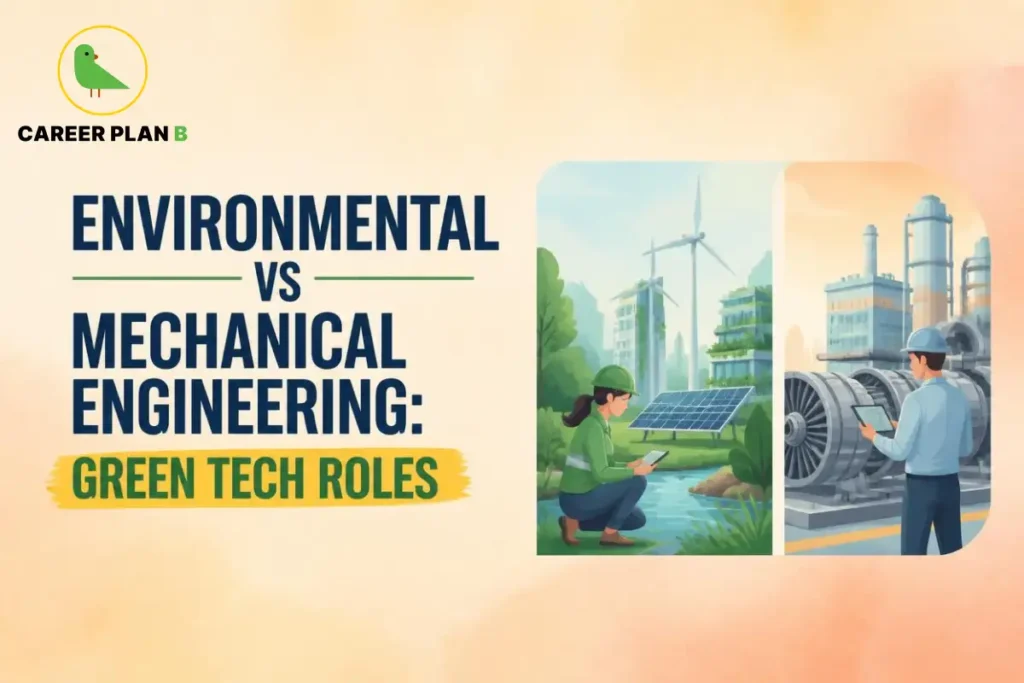
Introduction
Green tech hiring pulls from more engineering disciplines than people often expect, and two of the biggest contributors are environmental and mechanical engineering. The environmental vs mechanical engineering green tech roles comparison comes up a lot among students trying to figure out which path actually leads to the clean technology work they’re interested in. Both fields genuinely matter here, but they approach sustainability from very different technical angles.
Understanding those differences can save you a lot of time when deciding where to focus your studies or your job search. Let’s break down what each field actually contributes.
What Does Environmental Engineering Contribute to Green Tech?
Environmental engineering tends to focus on systems: pollution control, water and waste management, and regulatory compliance. In government settings, this work often involves reviewing environmental impact, enforcing pollution standards, or managing large-scale infrastructure projects (EPA Occupations). Most environmental engineering careers in green tech revolve around ensuring that new technologies and industrial processes actually reduce environmental harm, rather than designing the physical hardware itself.
What Does Mechanical Engineering Contribute to Green Tech?
Mechanical engineering, by contrast, tends to focus on the physical hardware behind clean technology: wind turbines, HVAC systems, electric vehicle components, and energy-efficient machinery. According to the U.S. Bureau of Labour Statistics, mechanical engineers held about 293,100 jobs in 2024, with employment projected to grow 9% through 2034, notably faster than the average across all occupations (BLS Mechanical Engineers). Much of this growth ties directly into sustainable mechanical engineering work, since designing and refining the physical systems behind renewable energy and efficient machinery is fundamentally a mechanical engineering task. Mechanical engineering careers in this space often involve hands-on design, testing, and iteration on hardware in a way that’s quite different from environmental engineering’s more systems-and-compliance-focused approach.
Where the Two Overlap in Renewable Energy
Renewable energy is really where these two fields end up working side by side. The U.S. Department of Energy’s Wind Energy Technologies Office funds research aimed at improving turbine performance, reducing costs, and addressing environmental and siting concerns tied to wind energy deployment (DOE Wind Energy Technologies Office). This is a clear example of renewable energy engineering roles requiring both disciplines at once: mechanical engineers designing and optimizing the turbines themselves and environmental engineers addressing the broader environmental and regulatory considerations around where and how those turbines get deployed. As renewables continue expanding, with the sector reaching roughly 30% of total U.S. electricity generation in early 2026 according to the U.S. Energy Information Administration (EIA), this kind of collaboration between the two fields is only becoming more common.
Key Differences in Education, Skills, and Tools
Despite working together on shared projects, the day-to-day training and tools involved look quite different between these two fields.
| Aspect | Environmental Engineering | Mechanical Engineering |
|---|---|---|
| Core Focus | Pollution control, compliance, large-scale systems | Physical hardware, mechanical design, energy systems |
| Typical Projects | Environmental impact assessments, water/waste systems | Turbine design, HVAC systems, EV components |
| Common Employers | Government agencies, consulting firms, utilities | Manufacturing companies, energy technology firms |
| Median Wage (BLS, 2024) | Environmental engineers, broadly stable growth | $102,320, with 9% growth projected through 2034 |
This kind of split helps explain why someone drawn to hands-on mechanical design might lean toward mechanical engineering, while someone interested in systems, compliance, and environmental impact might lean toward environmental.
Have Any Doubts?
Which Green Tech Path Fits You Best?
Both paths lead to genuine green tech engineering jobs, just through different technical routes. If you’re drawn to designing and building the physical hardware behind clean energy, from EV components supported by the DOE’s Vehicle Technologies Office to wind turbine systems (DOE Vehicle Technologies Office), mechanical engineering is likely the better fit. If you’re more interested in the systems-level thinking behind pollution control, compliance, and large infrastructure projects, environmental engineering probably makes more sense. This kind of engineering sustainability comparison ultimately comes down to whether you’d rather build the hardware or manage the systems and standards around it, and both paths lead to meaningful clean technology careers.
How Career Plan B Helps
Career Plan B helps students choose the right green technology engineering path through personalized guidance, assessments, and career planning.
Personalized Career Counselling: Helps identify whether environmental or mechanical engineering aligns with your interests and career goals.
Psychometric & Career Assessment Tests: Evaluate skills, strengths, and preferences to suggest suitable career opportunities.
Career Roadmapping: Provides a structured plan for education, skill development, and future career growth.
Admission & Academic Profile Guidance: Supports students in selecting the right courses, colleges, and specialization options.
Get In Touch With Us
Frequently Asked Questions
1. Which field has more green tech job openings, environmental or mechanical engineering?
Mechanical engineering shows slightly faster projected growth overall, but both fields have strong, steady demand within green tech specifically.
2. Do mechanical engineers need extra training to work in renewable energy?
Not necessarily, though specialized coursework or experience in renewable systems can help when entering this niche.
3. Is one degree considered more “sustainability-focused” than the other?
Environmental engineering is more directly tied to sustainability by design, though mechanical engineering increasingly incorporates sustainability through renewable energy hardware work.
4. Can environmental and mechanical engineers work on the same green tech projects?
Yes, and it’s common, particularly in renewable energy, where both technical hardware design and environmental compliance are needed together.
5. Which field pays more in clean technology roles?
Pay varies by employer and specialization, though mechanical engineers currently show a slightly higher median wage overall according to BLS data.
Conclusion
The environmental vs mechanical engineering green tech roles comparison really comes down to hardware versus systems. Mechanical engineers build and refine the physical technology behind clean energy, while environmental engineers manage the broader systems, compliance, and impact considerations around it. Both are essential to how green technology actually gets built and deployed responsibly.
If you’re still weighing which path fits your interests and strengths, Career Plan B can help you explore both directions and build a realistic plan to get there. Whichever you choose, you’ll be stepping into work that’s genuinely shaping the future of clean technology.