Team Career Plan B · August 13, 2026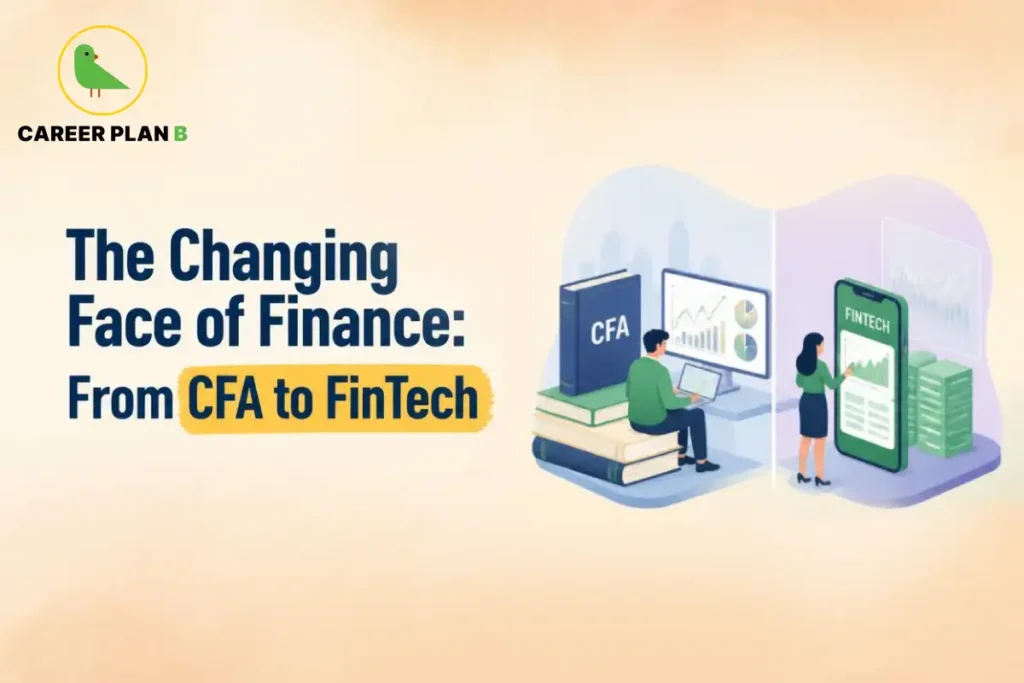
Introduction
Finance used to mean a fairly predictable set of choices. You did a commerce degree, maybe an MBA, perhaps a CFA charter. Then you aimed for a bank, a broking firm, or an asset manager. That path still exists, and still works in finance careers. But it’s no longer the only serious option. For a growing number of students, it isn’t even the first one they consider.
Alongside it, a genuinely new industry has taken shape. Digital payments, lending platforms, and neobanks have turned “fintech” from a buzzword into a real, fast-hiring sector. It now has its own job titles and career ladders. Someone graduating today could build credit-scoring models at a lending startup. Or they could just as easily analyse equities at a traditional asset manager.
This guide covers the changing face of finance in India, from the CFA and NISM route to the fintech path. It looks at what each route actually involves. It also covers how they increasingly overlap, and how to choose between them, or combine both.
Why Finance Careers Look Different in 2026
Two forces are reshaping finance careers at the same time, and they’re pulling in complementary, not opposite, directions.
On one side, India’s digital payments infrastructure has scaled dramatically. UPI alone processed 23.2 billion transactions worth ₹29.9 lakh crore in May 2026, a record month, according to NPCI. For the full FY 2025-26, UPI processed over 241 billion transactions worth more than ₹314 lakh crore. This isn’t a niche trend anymore. It’s the backbone of how India moves money.
On the other hand, traditional finance credentials haven’t become irrelevant. They’ve adapted. As of amendments effective 25 November 2025, SEBI’s Research Analyst and Investment Adviser regulations now formally accept a CFA Charter. It counts as an alternative to a graduate degree, alongside the still-mandatory NISM certification. Regulation is evolving alongside the industry, not standing still against it.
The Traditional Path: CFA, NISM, and SEBI Registration
The CFA Charter remains one of the most recognised credentials in investment analysis and portfolio management, globally and in India. It’s rigorous, and expensive. Total exam fees across all three levels run roughly ₹3.3 to ₹4.3 lakh, per CFA Institute’s fee structure.
What often surprises people is that the CFA doesn’t replace India’s regulatory certifications. If you want to work as a SEBI-registered Investment Adviser, you still need NISM certification. Specifically, that means NISM-Series-X-A and X-B, even with a CFA Charter. NISM was established by SEBI in 2006. It sets mandatory certification requirements for roles like mutual fund distributors and research analysts.
In practice, the CFA and NISM aren’t competing credentials. The CFA builds deep analytical skills. NISM certifies you to legally operate within India’s specific regulatory framework. Most serious finance professionals in India end up holding some combination of both.
The New Path: FinTech Careers
FinTech in India has moved well past its early “digital wallet” phase. It now spans payments, digital lending, neobanking, insurtech, and wealth-tech, each with distinct roles and skill demands.
India’s fintech workforce is estimated at over 2.2 lakh professionals. It’s growing around 15% annually, per NASSCOM’s 2025 Fintech Employment Outlook. Roles here range from product managers and data scientists to compliance specialists. Most need both finance and technology understanding, not just one.
Companies in this space increasingly look for hybrid profiles. Someone who understands lending regulation, and can also work with a data pipeline, is more valuable than either specialist working alone.
Where the Two Paths Actually Overlap
The more useful way to think about this isn’t “CFA versus fintech.” It’s where the two increasingly need each other.
- Compliance and regtech: fintech lending platforms operate under RBI’s digital lending directions, and increasingly hire people who understand both regulation and product.
- Risk and credit modelling: traditional financial analysis skills, sharpened through CFA-level training, apply directly to building better credit-scoring systems.
- Wealth-tech and robo-advisory: platforms offering automated investment advice still need SEBI-registered advisers behind the product, not just engineers.
- Investment research at fintech firms: many wealth-tech and broking-tech platforms hire CFA-track analysts alongside their engineering teams.
Skills Worth Building for Either Path
A few skills genuinely help, whichever direction you lean toward.
- Financial modelling and analysis: still the core skill behind CFA-track roles, and increasingly valuable in fintech product and risk teams too.
- Basic data literacy: not full engineering skill, but comfort reading data, understanding APIs, and working alongside technical teams.
- Regulatory awareness: understanding SEBI, RBI, and NISM frameworks matters whether you’re at a bank or a lending startup.
- Communication: explaining financial concepts clearly, to clients or to engineers who don’t have a finance background, is a genuinely underrated skill.
Have Any Doubts?
Comparing the Two Paths
| Traditional (CFA/NISM Route) | FinTech Route | |
|---|---|---|
| Entry Point | Finance degree, CFA levels, NISM certification | Finance, tech, or hybrid degree; on-the-job or bootcamp-style skilling |
| Regulator | SEBI (via NISM certification) | RBI, SEBI, depending on the specific product |
| Typical Employers | Banks, asset managers, broking firms | Payment companies, lending platforms, neobanks |
| Core Skill | Financial analysis, valuation, portfolio management | Product thinking, data literacy, financial analysis |
| Workforce Scale | Long-established, well-documented | Around 2.2 lakh professionals, growing fast |
Benefits, Challenges, and What the Data Says
Both paths offer genuine, documented growth. UPI’s transaction volumes are officially tracked by NPCI and continue rising sharply. NASSCOM’s fintech workforce estimates point to a fast-growing, under-supplied talent market.
To be transparent about a limitation: market-size projections vary enormously by source. Estimates for 2026 alone range from roughly $51 billion to over $148 billion. These are private market-research estimates, not a single official government figure. Treat specific market-size numbers as directional, not precise.
The clearest challenge on the traditional side is cost and time. The CFA is a multi-year, multi-lakh-rupee commitment, and doesn’t guarantee a specific salary outcome on its own. On the fintech side, the challenge is a genuinely fast-moving skill demand. What’s in demand today may look different in two years, which rewards adaptability over a single fixed credential.
How Career Plan B Helps
Choosing between the CFA route, the fintech route, or some mix of both is a genuinely complex decision. Career Plan B helps through:
Personalised Career Counselling: working out whether traditional finance, fintech, or a hybrid path fits your interests and strengths. Psychometric and Career Assessment Tests: checking whether you lean toward deep analytical work or fast-moving, product-driven environments. Career Roadmapping: a step-by-step plan covering CFA levels, NISM certifications, or the right fintech skilling route for you. Admission and Academic Profile Guidance: support building a profile that stands out for either path, or both.
For Latest Information
Frequently Asked Questions
Q1. Is the CFA Charter still worth it with fintech growing so fast?
Yes, for roles centred on investment analysis and portfolio management. SEBI’s own regulations now formally recognise the CFA Charter. It remains highly respected across both traditional finance and fintech firms.
Q2. Does a CFA Charter replace NISM certification in India?
No. SEBI regulations accept the CFA Charter as an alternative to a graduate degree. Mandatory NISM certification still applies for roles like Investment Adviser.
Q3. What does India’s fintech workforce actually look like right now?
NASSCOM’s 2025 Fintech Employment Outlook estimated the workforce at over 2.2 lakh professionals. It’s growing around 15% annually, with demand outpacing supply.
Q4. Do I need a finance degree to work in fintech?
Not always. Many fintech roles value hybrid profiles over a finance degree alone. That means comfort with both financial concepts and data or product skills.
Q5. Which path pays better, traditional finance or fintech?
There’s no single official comparison. Both vary widely by role, seniority, and employer. Treat any specific salary claim you find online as indicative, not guaranteed.
Conclusion
The changing face of finance in India isn’t really a story about one path replacing another. It’s a story about two paths that increasingly need each other more than they compete. The CFA and NISM route still opens doors that fintech alone can’t, particularly in investment analysis and regulated advisory roles.
At the same time, fintech has built a genuinely large, fast-growing job market of its own. It increasingly wants people who understand both finance and technology. The most future-proof position, for a lot of students, isn’t picking a side early. It’s building real financial fluency first. Decide later whether that fits a traditional institution, a fast-growing fintech, or something that blends both.
Whichever direction feels closer to your strengths, take this decision seriously. It isn’t a coin flip between “old finance” and “new finance,” since the two are converging fast.
Connect with Career Plan B today to map your own path through India’s changing finance landscape.