Team Career Plan B · July 9, 2026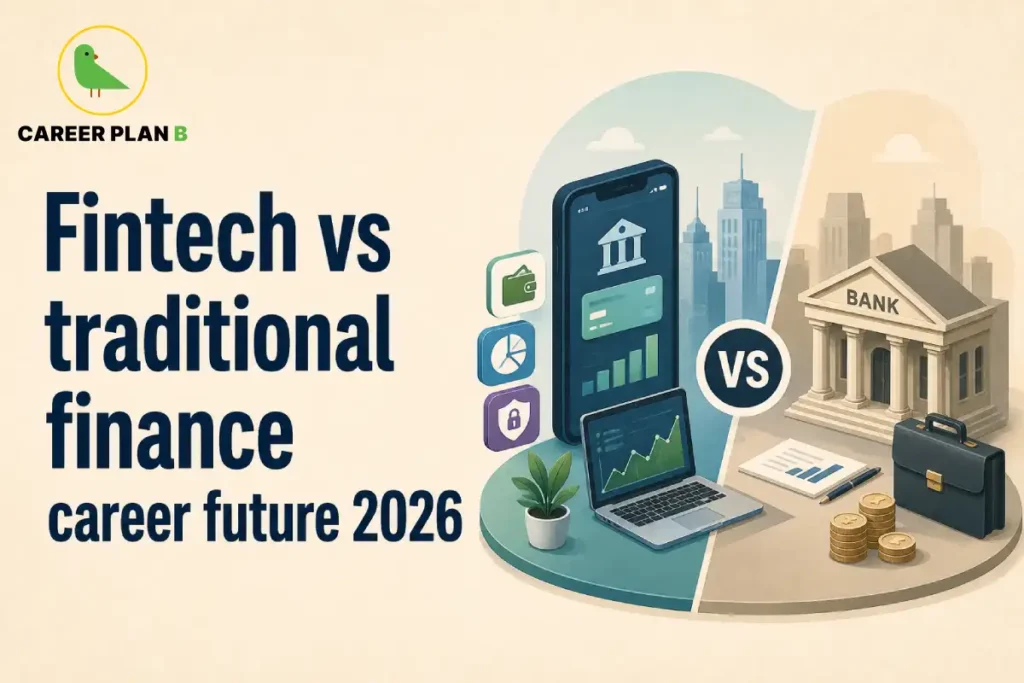
Introduction
The fintech vs traditional finance career future 2026 debate is one of the most consequential career questions facing finance students and professionals in India today.
Both sectors are growing. They continue to hire skilled professionals. At the same time, each sector is evolving and influencing the other.
Here is what the official data confirms: India’s UPI processed over 24,162 crore transactions worth approximately ₹314 lakh crore in FY 2025-26 — a more than 12,000-fold surge in volume from FY 2016-17. At the same time, the Reserve Bank of India (RBI) continues to be India’s most prestigious government employer for finance professionals, actively recruiting cybersecurity specialists, data scientists, and risk professionals through lateral entry drives in 2025-26.
This guide covers both sides of the fintech vs traditional finance career future 2026 debate — with verified data from the RBI, NPCI, NASSCOM, SEBI, IBPS, and IIBF only.
The Official Landscape: How Big Is Each Sector in 2026?
Traditional Finance — Scale and Stability
India’s traditional finance sector — public sector banks, private banks, NBFCs, insurance companies, and capital market intermediaries — remains the largest formal employer in India’s financial services industry.
The IBPS CRP PO/MT-XV official notification confirms that public sector bank recruitment continues at scale in 2026 — with IBPS PO 2026 Prelims scheduled for 22nd and 23rd August 2026 and Mains on 4th October 2026. The State Bank of India and Reserve Bank of India are actively recruiting across officer, specialist, and lateral entry cadres in FY 2025-26.
The RBI’s lateral recruitment drive under Advertisement No. RBISB/BA/04/2025-26 opened in December 2025 for 93 experienced professionals across Information Technology, Premises, and Supervision departments — covering cybersecurity, data science, project management, and financial risk roles. This is direct evidence of how traditional finance institutions are absorbing fintech-adjacent skills within their own structures.
Between 2016 and 2025, digital payment transaction volumes in India increased 33 times, while transaction values nearly tripled. Total payment transaction volumes surged from 6,437 crore in 2021 to 26,819 crore in 2025. In value terms, transactions increased from ₹1,741 lakh crore to ₹3,215 lakh crore — registering a CAGR of 42.9% in volume and 16.6% in value.
Fintech — Scale and Momentum
The fintech vs traditional finance career future 2026 debate cannot be understood without appreciating the scale of India’s fintech transformation — documented directly by the RBI.
India has an 87% fintech adoption rate against a global average of 64%, per the RBI Fintech Repository. The RBI defines FinTech as “technology-enabled innovation in financial services that could result in new business models, applications, processes or products with an associated material effect on the provision of financial services” — a definition sourced from the Financial Stability Board (FSB).
The National Payments Corporation of India (NPCI) — the umbrella organisation for digital payments under RBI oversight — reports that UPI processed 2,001 crore transactions in August 2025 alone, crossing 2,000 crore monthly transactions for the first time. December 2025 recorded 2,163 crore transactions — the highest monthly volume in UPI’s decade-long journey. UPI accounted for 85.5% of digital transaction volume in H2 2025, per the RBI’s digital payments report.
As of FY 2025-26, 703 banks are live on UPI — up from 44 banks in FY 2016-17. 56.86 crore QR codes were deployed to approximately 6.5 crore merchants as of FY 2024-25.
Fintech vs Traditional Finance Career Future 2026 — The Direct Comparison
Job Security and Stability
| Factor | Traditional Finance | Fintech |
|---|---|---|
| Job Security | High — government banking offers structured service conditions and long-term stability. | Moderate — startup-related risks exist, but the sector is growing rapidly. |
| Entry-Level Salary | ₹8–12 LPA (e.g., IBPS PO / SBI PO) | ₹5–15 LPA, depending on the company and role. |
| Career Growth Pace | Structured and largely based on seniority and promotions. | Fast-paced, with promotions based on performance and impact. |
| Government Recognition | Fully integrated under regulators such as RBI, SEBI, IRDAI, and IBPS recruitment. | Partially regulated, with increasing oversight from the RBI. |
| Pension & Benefits | Available in government banking and public sector institutions (as applicable). | Generally no pension; benefits depend on the employer. |
| Geographic Presence | Extensive presence across India, including rural and semi-urban areas. | Primarily concentrated in metro cities and Tier-2 technology hubs. |
Skills Required
The fintech vs traditional finance career future 2026 skills comparison reveals a convergence — not a divergence. Both sectors are increasingly demanding the same hybrid profile.
Traditional finance in 2026 demands: Banking regulations and compliance knowledge, JAIIB and CAIIB qualifications from IIBF, credit analysis and risk management, IT and cybersecurity awareness, and data literacy.
Fintech in 2026 demands: Python and SQL for data roles, product management and UX design, regulatory knowledge covering RBI, SEBI, and IRDAI frameworks, NISM certifications from NISM for securities roles, and AI and machine learning applications in financial services.
The RBI’s lateral recruitment drive highlighted cybersecurity, data science, AI/ML, FRM, and CFA as preferred qualifications. This hiring trend confirms that traditional finance is actively adopting fintech skill sets, even at the regulatory level.
Career Paths in Traditional Finance: What 2026 Looks Like
Government Banking — IBPS and SBI
Government banking remains the most accessible and stable career in the fintech vs traditional finance career future 2026 landscape. The IBPS CRP PO/MT-XV requires graduation in any discipline — no distinction between regular and distance mode — making it the most inclusive entry point into formal finance careers.
Key government banking careers in 2026:
- IBPS PO — Probationary Officer in public sector banks. 2026 Prelims: 22nd and 23rd August 2026. Mains: 4th October 2026. Starting salary: ₹8–12 LPA.
- SBI PO — Probationary Officer in State Bank of India. Active recruitment in 2026 per SBI Careers.
- RBI Grade B — Officer in the Reserve Bank of India. The most prestigious government banking career in India, with DEPR stream specifically for economics graduates.
- RBI Assistant — Entry-level role at the Reserve Bank of India for graduates. Active 2026 recruitment at RBI Opportunities.
SEBI — Capital Markets Regulator
The Securities and Exchange Board of India (SEBI) recruits Grade A Officers every year. These roles are among the most prestigious careers in the fintech vs traditional finance career future 2026. They are ideal for professionals with backgrounds in economics, law, finance, or technology.
IIBF Certifications for Career Growth Within Banking
For professionals already working in banking, the Indian Institute of Banking and Finance (IIBF) offers the JAIIB and CAIIB certifications. These qualifications are widely recognized as the standard credentials for career progression in India’s banking sector.
Career Paths in Fintech: What 2026 Looks Like
The Regulatory Framework That Governs Fintech Careers
Every professional in the fintech vs traditional finance career future 2026 works within a regulatory framework shaped by three statutory bodies.
- The Reserve Bank of India (RBI) regulates payment systems, digital lending, and banking operations. It also manages the RBI Fintech Repository.
- The Securities and Exchange Board of India (SEBI) regulates wealthtech, investment platforms, and securities market intermediaries.
- The Insurance Regulatory and Development Authority of India (IRDAI) regulates insurtech and digital insurance platforms.
Understanding these three regulatory bodies is essential for a fintech career in 2026. This knowledge is often more valuable than learning a specific programming language or software tool.
For Personalized Guidance
NISM Certifications — Mandatory for Fintech Securities Roles
The National Institute of Securities Markets (NISM) — established by SEBI in 2006 — administers certifications that are legally mandatory for specific fintech and wealthtech roles:
- NISM Series V-A – Mutual Fund Distributors Certification: Mandatory for professionals who distribute mutual funds.
- If you want to work in the equity derivatives market, earn the NISM Series VIII – Equity Derivatives Certification.
- Professionals registered as research analysts under the SEBI (Research Analyst) Regulations, 2014 must obtain the NISM Series XV – Research Analyst Certification. The revised certification came into effect on 20 January 2026.
In the fintech vs traditional finance career future 2026 context, NISM certifications are one of the clearest examples of where both sectors converge — wealthtech platforms and traditional brokerages both require the same regulatory credentials.
FutureSkills Prime — Government-Backed Fintech Upskilling
FutureSkills Prime is India’s official fintech upskilling ecosystem. It is a joint initiative of MeitY and NASSCOM. The platform offers training in AI for financial services, cybersecurity, cloud architecture, and data analytics, all aligned with the National Occupational Standards.
FutureSkills Prime NASSCOM certifications are aligned with the National Skills Qualification Framework (NSQF) and are widely accepted by IT and fintech companies. The government cashback incentive of up to ₹14,500 makes this one of the most accessible fintech skill-building pathways in the fintech vs traditional finance career future 2026 landscape.
The Convergence: Where Fintech and Traditional Finance Meet in 2026
The most important insight in the fintech vs traditional finance career future 2026 debate is simple: the two sectors are converging, not diverging.
In December 2025, the RBI launched a lateral recruitment drive for 93 professionals. The vacancies focused on cybersecurity, data science, AI/ML, and project management. These are skills traditionally associated with the technology and fintech sectors. This hiring trend shows that traditional finance is actively adopting fintech skills.
At the same time, fintech companies in India must comply with RBI, SEBI, and IRDAI regulations. Professionals who understand both financial regulations and technology therefore enjoy a clear competitive advantage.
The strongest career strategy for the fintech vs traditional finance career future 2026 is to build a hybrid profile. Combine finance domain knowledge, technology skills, and regulatory awareness. Employers across both sectors actively seek this combination, but qualified professionals remain in short supply.
NPCI’s Role in the Fintech vs Traditional Finance Career Future 2026
The National Payments Corporation of India (NPCI) bridges fintech and traditional finance. Operating under the oversight of the Reserve Bank of India (RBI), NPCI develops and manages key payment systems, including UPI, RuPay, NACH, FASTag, and Bharat Connect. It is the most direct institutional embodiment of the fintech vs traditional finance career future 2026 convergence.
NPCI’s Payments Infrastructure Development Fund (PIDF) had deployed approximately 5.45 crore digital touch points in Tier-3 to Tier-6 centres as of October 31, 2025 — creating demand for payments professionals, compliance officers, and digital infrastructure specialists across India’s deepest geographies.
The NPCI ecosystem continues to expand rapidly. It now connects 703 banks on UPI, supports 56.86 crore QR codes, and includes 22,427 billers on Bharat Connect. This growth has created one of India’s largest career ecosystems at the intersection of fintech and traditional banking.
How Career Plan B Helps
Choosing between fintech and traditional finance requires careful planning. You need to identify the sector that matches your academic background, financial goals, and risk appetite. You should also select the right certifications and build a career path that supports your long-term goals. Career Plan B helps you navigate the fintech vs traditional finance career future 2026 with a clear, personalised strategy.
Career Plan B simplifies this through:
- Personalised Career Counselling — Mapping your academic and professional background to the most suitable fintech or traditional finance career pathway in 2026
- Psycheintel and Career Assessment Tests — Identifying whether your strengths align with government banking stability, fintech agility, regulatory careers at SEBI or RBI, or hybrid finance-technology roles
- Admission and Academic Profile Guidance — Helping you prepare for IBPS PO, RBI Grade B, NISM certifications, IIBF qualifications, and FutureSkills Prime credentials — whichever combination fits your 2026 career target
- Structured Career Roadmapping — A clear step-by-step plan from your current qualification to your target finance role, with exam timelines, certification milestones, and skill-building checkpoints aligned to 2026 market demand
Whether you are a fresh graduate choosing between IBPS and a fintech startup, a working professional moving into payments or wealthtech, or a commerce student aiming for a career at SEBI or the RBI, your career path can feel overwhelming. Career Plan B helps you navigate the fintech vs traditional finance career future 2026 with confidence and clarity.
For Latest Information
Frequently Asked Questions
Q1. Which has better job security in 2026 — fintech or traditional finance?
Traditional finance — particularly government banking through IBPS, SBI, and RBI — offers structured service conditions, pension, and long-term stability. Fintech offers faster career growth and higher compensation at senior levels but carries startup risk.
Q2. What is India’s fintech adoption rate according to official data?
India has an 87% fintech adoption rate — against a global average of 64% — per the RBI Fintech Repository. UPI processed over 24,162 crore transactions worth approximately ₹314 lakh crore in FY 2025-26.
Q3. Are NISM certifications required for fintech careers?
Yes — for specific SEBI-regulated roles. NISM Series V-A (Mutual Fund Distributors), NISM Series VIII (Equity Derivatives), and NISM Series XV (Research Analyst, revised January 20, 2026) are legally mandatory under SEBI regulations — not optional credentials.
Q4. Is the RBI hiring fintech-skilled professionals in traditional banking roles?
Yes. The RBI’s lateral recruitment drive under Advertisement No. RBISB/BA/04/2025-26 in December 2025 actively targeted cybersecurity, data science, AI/ML, and project management professionals — confirming that traditional finance is absorbing fintech skills at the regulatory level.
Q5. What is the best government certification platform for fintech upskilling?
FutureSkills Prime — the joint MeitY and NASSCOM initiative — is India’s official fintech upskilling ecosystem, offering NASSCOM-certified courses in AI for finance, cybersecurity, cloud, and data analytics, aligned to NSQF standards, with government cashback of up to ₹14,500.
Q6. Which regulatory bodies govern fintech careers in India?
Three statutory bodies govern all fintech careers in India: the Reserve Bank of India (RBI) for payments and digital lending, the Securities and Exchange Board of India (SEBI) for wealthtech and investment platforms, and the Insurance Regulatory and Development Authority of India (IRDAI) for insuretech.
Conclusion
The fintech vs traditional finance career future 2026 is not a war between two opposing sectors — it is a convergence of two industries that are increasingly speaking the same language of data, regulation, and technology.
The numbers confirm both sides of the story simultaneously. UPI processed 24,162 crore transactions worth ₹314 lakh crore in FY 2025-26 — driven by NPCI infrastructure and 703 banks live on the platform. At the same time, IBPS PO 2026 Prelims are scheduled for August 2026, SBI PO is actively recruiting, and the RBI is conducting lateral entry drives for cybersecurity and data science specialists.
The winning profile in the fintech vs traditional finance career future 2026 is the hybrid professional: one who understands RBI, SEBI, and IRDAI regulations as deeply as they understand Python, data analytics, and digital product design. That profile is what both sectors are competing to hire — and what India’s government-backed skilling ecosystem through FutureSkills Prime, SWAYAM, NPTEL, NISM, and IIBF is designed to help you build.