Team6 · September 19, 2026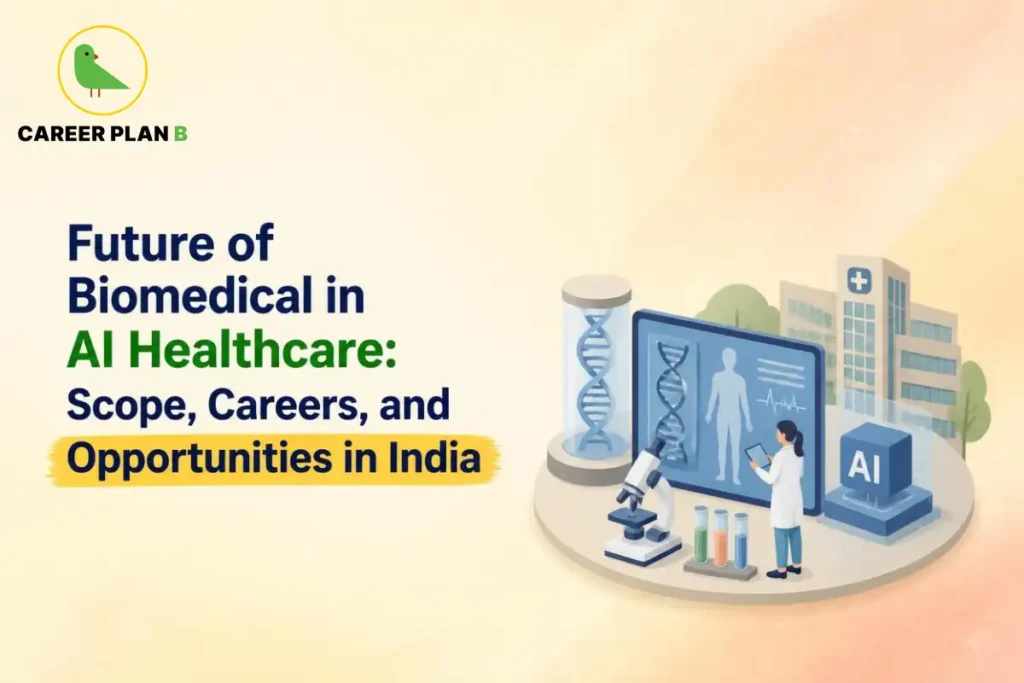
Introduction
Not too long ago, the idea of a machine reading an X-ray, predicting a heart attack before it happened, or guiding a surgical robot with millimetre precision seemed like something out of a science fiction film. Today, it is happening in hospitals across the world and increasingly, in India too.
The future of biomedicine in AI healthcare is not a distant possibility. It is already unfolding, and it is reshaping what biomedical engineers do, what skills they need, and what careers are available to them. Artificial intelligence is no longer just a tool for tech companies; it has moved firmly into operating theatres, diagnostic labs, and wearable health devices.
For students and professionals in biomedical engineering, this shift represents one of the biggest career opportunities of the decade. This blog explores how AI is transforming healthcare, where biomedical engineering fits into this revolution, and what you need to do to be part of it.
How Is AI Changing Healthcare Right Now?
AI in healthcare is no longer limited to pilot projects or academic research in India. Healthcare providers now use AI across diagnostics, patient monitoring, drug discovery, and hospital management.
AI tools can detect diabetic retinopathy from eye scans and identify tuberculosis from chest X-rays. They can also flag early-stage cancers in radiology reports. In some cases, these tools achieve accuracy comparable to experienced specialists.
India still faces major doctor-to-patient ratio challenges. Therefore, healthcare providers increasingly use AI to extend clinical capabilities and improve healthcare delivery.
The Government of India has taken this seriously. The Ministry of Health and Family Welfare has been integrating digital and AI-driven solutions into the national health framework. The Ayushman Bharat Digital Mission (ABDM) is building a digital health ecosystem that connects patients, hospitals, and health records, creating the data infrastructure that AI systems need to function at scale.
NITI Aayog’s National Strategy for Artificial Intelligence has specifically identified healthcare as one of the five priority sectors for AI adoption in India, signalling strong policy-level commitment to this transformation.
Where Does Biomedical Engineering Fit Into AI Healthcare?
This is the question every biomedical engineering student should be asking right now. Artificial intelligence in biomedical engineering is not replacing the field; it is expanding it.
Biomedical engineers are the professionals who design, develop, test, and maintain the devices and systems that collect biological data. When AI enters the picture, those devices become smarter. An MRI machine enhanced with AI can not only capture images but also analyse them in real time. A wearable heart monitor powered by machine learning can detect irregular rhythms and alert a cardiologist before a patient even feels symptoms.
The role of a biomedical engineer in this ecosystem is to bridge the gap between the biological world and the intelligent machine by designing hardware that captures reliable data and working alongside software engineers and data scientists to build systems that act on it meaningfully.
Key Areas Where AI and Biomedical Engineering Are Converging
AI in Medical Imaging and Diagnostics
Medical imaging is the single largest area where AI and biomedical engineering are coming together. AI-powered diagnostics in India are being used to analyse CT scans, MRI images, ultrasounds, and pathology slides with speed and precision that significantly reduces diagnostic errors.
Biomedical engineers play a central role in this space designing the imaging hardware, calibrating sensors, and integrating AI models into diagnostic workflows. Institutions like AIIMS New Delhi are already exploring AI-integrated diagnostic systems as part of their research and clinical programmes.
Machine Learning in Medical Devices
Machine learning in medical devices is one of the most exciting frontiers in the field. Smart pacemakers can now adjust their pacing based on a patient’s real-time activity levels. AI-enabled insulin pumps can predict blood sugar fluctuations and adjust dosage automatically. Wearable devices can continuously monitor ECG, SpO₂ and blood pressure, flagging anomalies before they become emergencies.
Biomedical engineers are responsible for the hardware, firmware, and safety validation of these devices, making them indispensable in the development pipeline of any AI-powered medical product.
AI in Robotic Surgery and Smart Prosthetics
Robotic surgery systems guided by AI assistance are helping surgeons operate with greater precision and smaller incisions, reducing recovery times and complication risks. In prosthetics, AI is enabling limbs that respond to muscle signals in real time, giving amputees far more natural control over their movements.
Both of these applications require deep biomedical engineering expertise in biomechanics, human-machine interfaces, materials science, and signal processing combined with AI integration capabilities.
Predictive Healthcare and Remote Monitoring
One of the most transformative applications of AI in healthcare is predictive medicine using patient data to forecast disease risk before symptoms appear. IoT-enabled remote monitoring devices, supported by the digital health infrastructure being built under ABDM, are creating real-time data streams that AI systems can analyse to flag health risks early.
Biomedical engineers are central to designing these monitoring systems, ensuring data accuracy, device reliability, and patient safety standards are consistently met.
What Skills Do Biomedical Engineers Need for AI Healthcare?
The intersection of biomedical engineering and data science is where the most valuable professionals in this field will emerge. To thrive in AI-driven healthcare, biomedical engineers need to build skills beyond traditional instrumentation and anatomy.
Key skills to develop include:
- Programming languages: Python and MATLAB are the most widely used in biomedical data analysis and AI model development
- Machine learning fundamentals: understanding how models are trained, validated, and deployed in clinical environments
- Medical image processing: knowledge of image segmentation, feature extraction, and classification techniques
- Signal processing: critical for working with ECG, EEG, and other physiological data streams
- Biomedical data science: managing, cleaning, and interpreting large-scale health datasets
- Regulatory knowledge: understanding how AI medical devices are approved through bodies like the Central Drugs Standard Control Organisation (CDSCO)
Students who combine their core biomedical engineering foundation with even basic proficiency in these areas will find themselves in a significantly stronger position in the job market.
Have Any Doubts?
Career Opportunities in AI-Driven Biomedical Engineering
The biomedical engineering career scope in 2026 looks very different from five years ago. New roles have emerged, while existing positions continue to evolve.
AI and biomedical engineering now overlap across several career paths. These include AI clinical engineer, biomedical data scientist, health-tech product developer, medical imaging AI specialist, and wearable technology engineer.
In India, health-tech startups and multinational medical device companies hire biomedical engineers. Hospital chains are also investing in digital infrastructure. Government research organisations like DRDO offer additional opportunities.
India’s health-tech startup ecosystem is also expanding. Growing venture capital investment is creating more opportunities for biomedical engineers with AI skills.
Government Initiatives Supporting AI in Indian Healthcare
The future of medical technology in India is being actively shaped by government policy. Several major initiatives are creating the infrastructure and funding environment for AI-driven healthcare to scale across the country.
The Ayushman Bharat Digital Mission is building a unified digital health ID system and interoperable health records platform that will generate the large-scale medical data needed to train and deploy AI systems effectively.
NITI Aayog’s National AI Strategy has outlined specific investment areas in healthcare AI, including diagnostic tools, drug discovery, and hospital management systems. The Digital India initiative further supports the connectivity and infrastructure needed for remote monitoring and telemedicine powered by AI.
Together, these programmes signal that AI in healthcare is a long-term national priority, not a short-term experiment, and that careers in this space will be both stable and growing for the foreseeable future.
How Career Plan B Helps
Navigating the rapidly evolving world of AI-driven biomedical engineering requires more than just technical knowledge; it requires a clear career strategy. Career Plan B offers personalised career counselling, PsycheIntel aptitude assessments, and career roadmapping sessions that help biomedical engineering students and professionals identify the right specialisation, upskilling path, and career direction in the AI healthcare space.
Get In Touch With Us
Frequently Asked Questions
1. What is the role of biomedical engineers in AI healthcare?
Biomedical engineers design and develop the medical devices, sensors, and imaging systems that generate the biological data AI systems analyse. They also integrate AI models into clinical devices, validate their safety, and ensure regulatory compliance, making them essential to every stage of AI-powered healthcare product development.
2. Is AI a threat to biomedical engineering jobs?
No. AI is expanding biomedical engineering careers rather than replacing them. While some routine tasks may be automated, the demand for engineers who can design AI-compatible medical devices, validate intelligent systems, and ensure clinical safety is growing significantly.
3. Which skills should biomedical engineers learn for AI careers?
Python programming, machine learning basics, medical image processing, signal processing, and biomedical data science are the most valuable skills to add to a core biomedical engineering foundation. Knowledge of AI device regulation through CDSCO is also increasingly important.
4. What are the top sectors hiring biomedical engineers with AI skills in India?
Health-tech startups, multinational medical device companies, hospital groups investing in digital health, government research organisations like DRDO, and institutions like AIIMS are among the top employers in this space.
5. How is the Indian government supporting AI in healthcare?
Through the Ayushman Bharat Digital Mission, NITI Aayog’s National AI Strategy, and the Digital India programme, the government is building digital infrastructure, funding AI research, and creating policy frameworks that support large-scale AI adoption in Indian healthcare.
Conclusion
The future of biomedicine in AI healthcare is not something biomedical engineers need to wait for; it is already here, and it is accelerating. From AI-powered diagnostics and smart medical devices to robotic surgery and predictive health monitoring, the boundaries of what biomedical engineering can achieve are expanding faster than ever before.
For students entering this field today, the opportunity is enormous. But making the most of it requires choosing the right specialisations, building the right skills, and planning your career path with clarity and purpose.
Ready to build your future in AI-driven biomedical engineering? Visit Career Plan B and take the PsycheIntel Career Assessment to get a personalised roadmap that helps you navigate this exciting and rapidly evolving field with confidence.