Team6 · July 21, 2026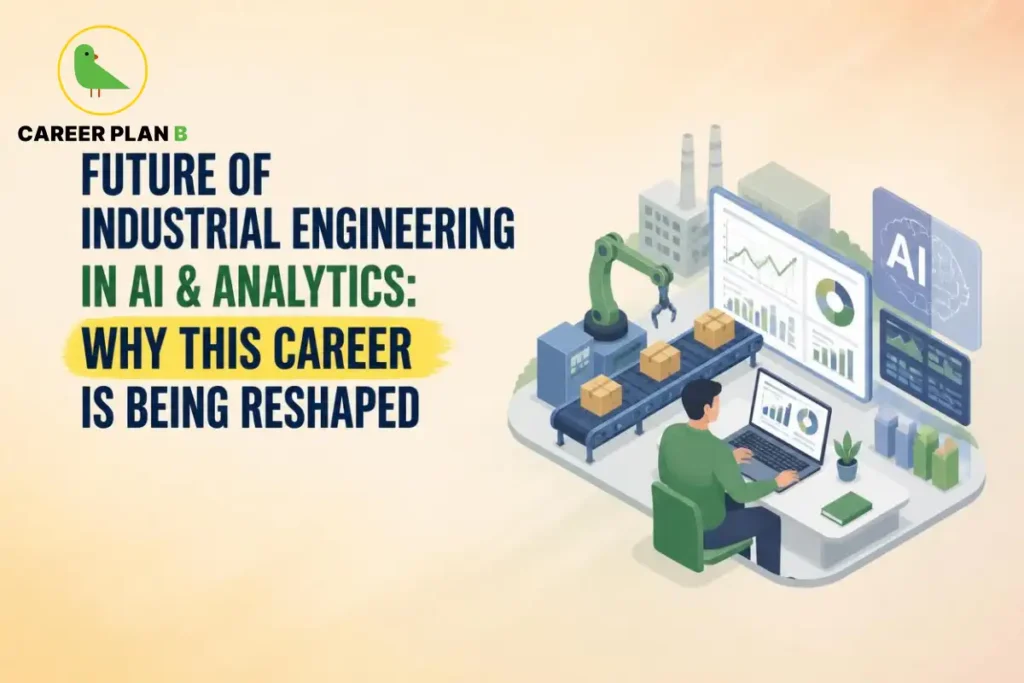
Introduction
India’s AI talent pool is projected to grow from roughly 650,000 professionals to over 1.25 million by 2027, and industrial and automotive sectors already rank among the leading adopters of this technology. This scale of change sits right at the centre of understanding the future of Industrial Engineering in AI & Analytics, since this specific branch is being reshaped more directly than most students realize. Many industrial engineering students still view AI and analytics as a domain reserved for software professionals, something that happens in a separate department entirely disconnected from factory floors and process design. However, this assumption is quickly becoming outdated, as AI-driven tools now sit at the core of how modern industrial systems get optimized, monitored, and improved. This blog explains, in real depth, exactly what’s changing, the specific emerging roles this shift creates, and what it means for your industrial engineering career.
Why Industrial Engineering Is Becoming an AI-Driven Discipline
India’s National AI Push and What It Means for This Field
India’s government has approached this transformation as a genuine national priority rather than a niche initiative. Through the IndiaAI Mission, run under the Ministry of Electronics and Information Technology, the country is building data and AI labs, funding research through dedicated Centres of Excellence, and rolling out skilling programmes that span students, industrial trainees, and working professionals simultaneously. This comprehensive approach matters significantly for industrial engineering specifically, since it explicitly targets sector-wide AI literacy rather than confining these efforts purely to computer science departments. Consequently, students entering industrial engineering programmes today are far more likely to encounter AI and analytics coursework woven directly into their core curriculum than students who graduated even five years earlier.
Why Industrial and Manufacturing Sectors Are Leading AI Adoption
What makes this shift particularly relevant for industrial engineers is where this AI adoption is actually concentrating. According to industry analysis citing PIB data, industrial and automotive sectors rank among India’s leading AI-adoption industries, with Deloitte reporting that Indian enterprises show strong scaled implementation in product development at 62%, strategy and operations at 56%, and supply chain at 48%. These aren’t abstract statistics; they represent real, functioning systems where AI in manufacturing in India now directly informs decisions that industrial engineers have traditionally owned, including process optimization, resource allocation, and quality management. Therefore, this isn’t a case of AI arriving from outside the field and disrupting it; it’s increasingly becoming an integrated part of how industrial engineering work actually gets done.
How Is the Future of Industrial Engineering in AI & Analytics Actually Taking Shape?
Is this genuinely changing how industrial engineers work, or is it simply new software layered on top of existing processes? The shift runs considerably deeper than surface-level tooling changes. Traditionally, industrial engineers relied heavily on manual time-motion studies, historical data analysis, and experience-based judgement to identify inefficiencies within a system. With AI and analytics tools now capable of processing enormous volumes of operational data in real time, however, engineers increasingly work alongside systems that surface inefficiencies automatically, often before a human analyst would even notice the pattern. This means the profession is shifting from primarily generating insights manually toward interpreting AI-generated insights and deciding how to act on them strategically, a meaningfully different skill set than what traditional industrial engineering training historically emphasized.
Core Areas Where AI and Analytics Are Transforming Industrial Engineering Work
Predictive Analytics for Process and Supply Chain Optimization
One of the clearest applications of this shift involves predictive analytics, where machine learning models analyze historical and real-time operational data to forecast bottlenecks, demand fluctuations, and resource constraints before they actually occur. Rather than reacting to a supply chain disruption after it happens, industrial engineers using these tools can identify warning signs considerably earlier, adjusting production schedules or supplier relationships proactively. This capability directly extends the industrial engineer’s traditional role in systems optimization, just with a considerably more powerful analytical toolkit supporting those decisions.
AI-Driven Simulation and Digital Twin Technology
Beyond predictive analytics, digital twin technology, essentially a virtual replica of a physical system that updates continuously using real-time data, has become an increasingly important tool for industrial engineers testing process changes safely before implementing them physically. This means engineers can simulate the impact of a proposed layout change, a new equipment configuration, or an altered workflow using AI-powered models, considerably reducing the risk and cost associated with trial-and-error experimentation on an actual production line. Consequently, industrial engineering scope now genuinely extends into simulation modelling and digital twin management, areas that barely existed within mainstream industrial engineering practice a decade ago.
Have Any Doubts?
The Skills Gap Industrial Engineers Need to Close Right Now
Technical Skills: Data Analytics, ML Fundamentals, and Optimization Tools
Staying relevant within this evolving field increasingly requires more than traditional systems and operations research knowledge alone. Basic proficiency in data analytics tools, a working understanding of machine learning fundamentals, and comfort with optimization software have quickly become genuine differentiators for AI skills for engineers entering this space. Importantly, this doesn’t necessarily mean industrial engineers need to become expert model builders themselves; rather, understanding how these models work, what data they require, and how to interpret their outputs critically matters enormously for working effectively alongside data science teams.
Why This Demand-Supply Gap Creates Real Opportunity
According to NASSCOM’s research on India’s AI talent landscape, the country’s AI talent pool needs to nearly double by 2027 to meet projected demand, with certain specialized roles showing demand-supply gaps ranging between 60 and 73 per cent. This substantial gap represents a genuine opportunity specifically for industrial engineers willing to build these complementary skills early, since companies actively investing in Industry 4.0 India initiatives need professionals who can bridge traditional systems engineering knowledge with genuine analytics literacy, a combination that remains scarce across the current talent pool.
Career Roles and Growth Path in AI-Integrated Industrial Engineering
| Career Stage | Typical Role | What You’ll Do |
|---|---|---|
| Entry-Level | Junior Industrial Engineer (Analytics-Focused) | Support predictive analytics dashboards, assist digital twin modelling. |
| Mid-Level | Smart Operations Engineer | Lead process optimization using AI tools and manage cross-functional data projects |
| Senior-Level | AI Integration Lead / Operations Analytics Manager | Oversee organization-wide analytics strategy and system-wide optimization |
>Given the scale of India’s projected AI talent gap and the strong adoption rates already documented across industrial and automotive sectors, professionals who combine core industrial engineering career fundamentals with genuine analytics capability are positioned for strong, sustained demand within smart manufacturing careers.
How Career Plan B Helps
Career Plan B helps students and professionals make informed career decisions through personalized guidance, assessments, and structured career planning to identify the right career path based on their interests, skills, and future goals.</p></p>
Personalized Career Counselling: Provides expert guidance to help students understand the opportunities emerging at the intersection of industrial engineering, artificial intelligence, data analytics, and smart manufacturing while aligning their career choices with their interests and professional aspirations.<p>Psychometric & Career Assessment Tests: Identify individual strengths, analytical abilities, problem-solving skills, personality traits, and career preferences to determine whether AI-driven industrial engineering, analytics, automation, or smart manufacturing careers match their capabilities.<p>Career Roadmapping: Creates a clear step-by-step plan covering required skills, certifications, and learning pathways, including areas like data analytics, machine learning fundamentals, digital twins, optimization tools, Industry 4.0 technologies, and AI applications in manufacturing.<p>Admission & Academic Profile Guidance: Helps students select suitable engineering branches, courses, and colleges while improving their academic profile to build a strong foundation for careers in industrial engineering, AI-enabled manufacturing, operations analytics, and future technology-driven industries.
Get In Touch With Us
Frequently Asked Questions
1. Is AI replacing industrial engineers, or creating new roles for them?
It’s primarily creating new, more analytical roles rather than replacing the profession, shifting engineers toward interpreting AI-generated insights and managing digital twin systems.
2. What analytics skills should an industrial engineer learn first?
Basic data analytics tools, machine learning fundamentals, and familiarity with simulation or optimization software offer the most practical starting point for this shift.
3. Which industries are combining AI with industrial engineering the fastest?
Automotive and broader manufacturing sectors currently lead this integration, backed by strong scaled AI implementation across product development, operations, and supply chain functions.
4. Do I need a data science degree to work in this space?
Not necessarily a full data science degree, though foundational analytics knowledge alongside your core industrial engineering training significantly strengthens your profile.
5.Is this a stable, long-term career direction?
Yes, particularly given India’s substantial projected AI talent gap through 2027, which creates sustained demand for professionals who combine engineering fundamentals with analytics skills.
Conclusion
Understanding the Future of Industrial Engineering in AI & Analytics makes one thing clear: the profession is becoming far more data-driven. At the same time, it continues to rely on the systems-thinking foundation that has always defined industrial engineering.
As initiatives like the IndiaAI Mission expand, AI adoption is accelerating across industrial and automotive sectors. Industrial engineers who combine traditional engineering knowledge with analytics and AI skills will be better positioned for long-term career growth.
This shift creates a valuable opportunity for engineering students. Building AI and analytics expertise today can help future-proof an industrial engineering career and keep professionals relevant in an increasingly technology-driven industry.
If you’d like guidance on developing the right AI and analytics skills, a Career Plan B counsellor can help you create a clear roadmap for your future.