Team Career Plan B · July 22, 2026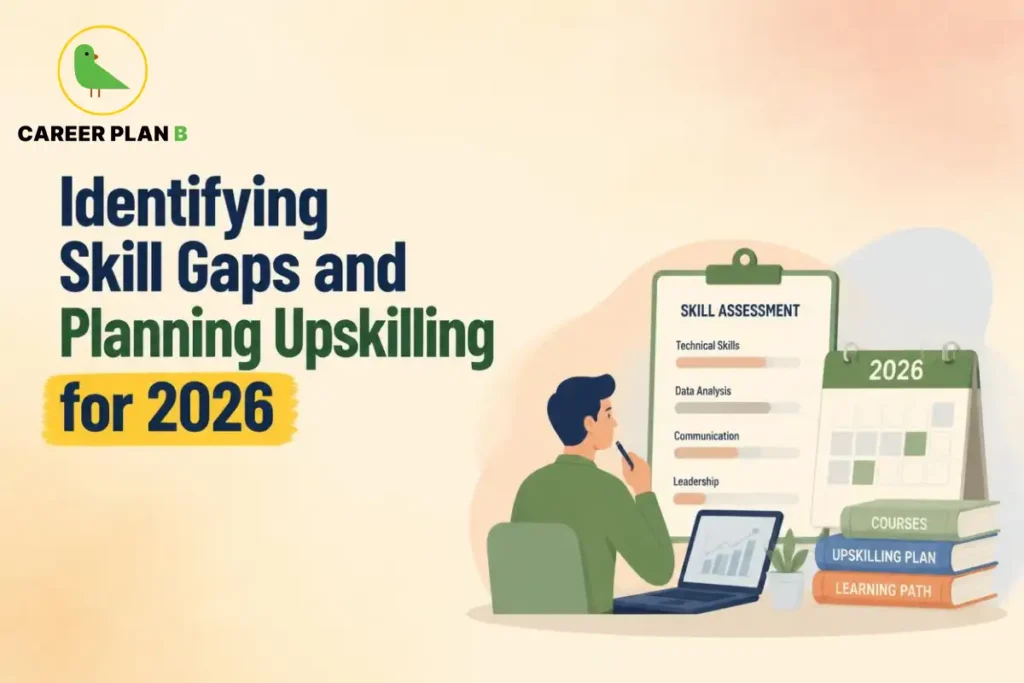
Introduction
A degree alone no longer guarantees job readiness in India’s fast-changing job market. Identifying skill gaps and planning upskilling for 2026 has become essential for students and working professionals alike. This guide covers how to spot your own skill gaps, and the official platforms that help close them.
Why identifying skill gaps and planning upskilling Analysis Matters More in 2026?
The Economic Survey 2025-26 highlights that employment-focused skilling initiatives help bridge skill gaps while improving productivity. [ Press Information Bureau, Ministry of Skill Development and Entrepreneurship]
The Periodic Labour Force Survey shows labour force participation for those aged 15 and above at 55.9% in February 2026. The data reflects a broadly stable market, but one where the right skills still determine who gets hired.
How to Identify Your Own Skill Gaps
Start by comparing your current abilities against recognised industry standards. The National Council for Vocational Education and Training regulates quality across India’s skilling ecosystem. It recognises awarding bodies, approves qualifications, and sets minimum standards for training providers.Sector Skill Councils, set up under NSDC, define the competency standards for each industry.
Compare your resume against current job postings in your target role. Note recurring requirements you cannot yet meet, whether a specific tool, certification, or soft skill. This gap list becomes your upskilling roadmap.
Fastest-Changing Skill Areas to Watch
Some sectors are evolving faster than others. Under the restructured Skill India Programme, PMKVY 4.0 has introduced over 400 new courses. These cover artificial intelligence, 5G technology, cybersecurity, green hydrogen, and drone technology.
These additions signal where the government sees near-term demand rising fastest. Professionals in adjacent fields should watch these areas closely, even without an immediate job change in mind.
Government Platforms for Structured Upskilling
PMKVY 4.0 offers free, industry-aligned Short-Term Training and Special Projects, aligned to the National Skills Qualification Framework. Training now includes On-the-Job Training, giving learners real workplace exposure alongside classroom instruction.
The Skill India Digital Hub complements this with a mobile-first platform for digital skilling. Learners can upskill and reskill without depending only on physical training centres. Courses cover areas like big data and machine learning.
Recognition of Prior Learning: Turning Experience Into Certification
Many workers already have practical skills, just without formal certification. Recognition of Prior Learning, offered under PMKVY 4.0, formally assesses and certifies these existing skills. This helps informal-sector workers gain recognised credentials without repeating training they do not need.
RPL particularly benefits experienced workers in trades, services, and technical roles. Many learned on the job rather than in a classroom. A certified skill set can open doors to better pay and formal employment status.
Step-by-Step Roadmap to Plan Your Upskilling
- List your current skills and compare them against job postings in your target role.
- Identify the specific gap: a tool, certification, or soft skill you are missing.
- Check whether PMKVY 4.0 or Skill India Digital Hub already offers relevant training.
- If you have informal experience, explore Recognition of Prior Learning for certification.
- Set a realistic timeline, since most short-term courses run for a few weeks.
- Track new course additions through PIB updates, since fast-changing sectors get new courses often.
Have Any Doubts?
Benefits, Challenges, and What the Data Says about identifying skill gaps and planning upskilling for 2026
Structured upskilling through recognised platforms improves employability and often speeds up hiring decisions. Government-backed certifications also carry more weight with employers than informal claims of experience.
However, no single official dataset breaks down the exact skill-gap headcount by sector precisely. Figures like specific shortfall numbers per industry often come from private industry reports, not verified government data. Treat such numbers as indicative only.
Common challenges include patchy participation in digital platforms and uneven access in rural and informal sectors. Choosing a course aligned with genuine market demand, not just convenience, makes the biggest difference.
How Career Plan B Helps
Figuring out exactly which skills to build next can feel overwhelming amid so many options. Career Plan B simplifies this through:
- Personalised Career Counselling: matching your current skill set and goals to the right upskilling path
- Psycheintel Career Assessment Tests: identifying which skill areas align best with your strengths and interests
- Certification Guidance: helping you choose relevant PMKVY 4.0 or Skill India Digital Hub courses for your target role
- Structured Career Roadmapping: a clear step-by-step plan from identifying your gap to certification and job readiness
For Latest Information
Frequently Asked Questions
Q1.How do I identify my own skill gaps?
Compare your current skills against job postings in your target role and note requirements you cannot yet meet.
Q2.Which platforms offer free upskilling courses in India?
PMKVY 4.0 and the Skill India Digital Hub both offer free, government-backed training across multiple sectors.
Q3.What is Recognition of Prior Learning?
It is a process under PMKVY 4.0 that certifies existing informal skills without requiring workers to repeat training.
Q4.Which skill areas are growing fastest right now?
Artificial intelligence, 5G, cybersecurity, green hydrogen, and drone technology have all seen major course expansions recently.
Q5.Are there official figures on India’s exact skill gap by sector?
No single official dataset breaks this down precisely. Treat sector-wise shortfall figures from private reports as indicative only.
Q6.How long do most upskilling courses take?
Many PMKVY 4.0 short-term courses run for a few weeks, though duration varies by sector and course level.
Conclusion
Identifying skill gaps and planning upskilling for 2026 starts with an honest comparison between what you know and what your target role demands. Government platforms like PMKVY 4.0 and Skill India Digital Hub make closing that gap accessible and free.
The professionals who move fastest track emerging skill areas early, rather than waiting until a gap becomes a barrier.
Connect with Career Plan B today to build a personalised upskilling roadmap for 2026.