Team6 · October 13, 2026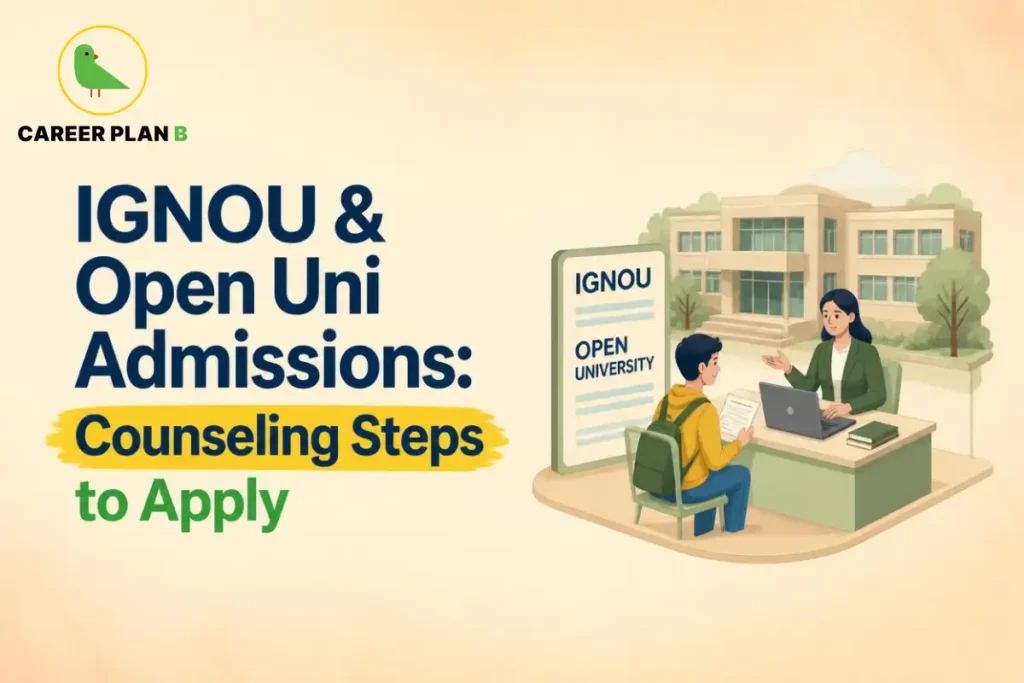
Introduction
Every year, thousands of students in India reach a crossroads. Board exams are done, results are out, and everyone around them seems to have a plan, except maybe you. Some are heading to regular colleges, some are preparing for competitive exams, and then there are those who are quietly wondering, “Is there another way?” If that sounds like you, IGNOU and open university admissions counseling might just be the path you have been looking for, and you are not alone in feeling unsure about where to begin.
Open and Distance Learning (ODL) is no longer the “backup plan” it was once thought to be. In 2026, with over 4 million active learners enrolled at IGNOU alone, distance education has become a real, respected, and incredibly flexible choice for students across India. Whether you missed the cutoff, want to study while working, or simply prefer learning at your own pace, understanding the IGNOU and open university admissions process is your first step toward a degree that fits your life.
What Makes Open Universities Different From Regular Colleges?
Imagine two students. One wakes up at 6 AM every day, travels an hour to college, sits through lectures, and rushes home. The other logs in when it suits them, studies between part-time work shifts, and still earns the same UGC-recognised degree. That second student is studying through an open university. And in 2026, that flexibility is not a compromise. It is a choice.
Freedom, Flexibility, and a Second Chance
Open universities, led by IGNOU (Indira Gandhi National Open University), operate on what is called the Open and Distance Learning model. This means no fixed attendance, no daily commute, and the freedom to pace your own learning. IGNOU currently offers 325 programmes, including Four-Year Undergraduate Programmes (FYUP) and skill-based courses, and continues to align with the National Education Policy 2020 to meet emerging educational and professional needs.
More importantly, the degrees are fully recognised. The degrees, diplomas, and certificates awarded by IGNOU are recognised by all member institutions of the Association of Indian Universities (AIU) and are at par with those issued by all Indian Universities, Deemed Universities, and institutions. So if anyone ever tells you that a distance degree is “not equal” to a regular one, you now have your answer.
Who Should Consider ODL Programmes in 2026?
Open universities are genuinely built for students who do not fit the traditional mold. Here is who benefits the most:
- Students who missed college cutoffs but still want a degree
- Working students or those managing family responsibilities
- Students in remote areas without access to good colleges
- Those who want to pursue two qualifications simultaneously
- Gap year students who want to use the time productively
- Anyone who simply learns better independently
Understanding IGNOU Admissions in 2026 — The Basics First
Before you fill any form, you need to understand how IGNOU actually works. Think of it less like a regular college and more like a self-paced learning system backed by a central government university.
Programmes Offered and Eligibility
IGNOU provides 200+ programmes across Bachelor’s degree, Master’s degree, Certificate, Diploma, and PhD levels, available in both distance and online modes. Here is a quick look at the popular ones:
| Level | Popular Programmes | Eligibility | 2026 Career ROI & Placement Scope |
|---|---|---|---|
| Undergraduate (UG) | BA, BCom, BSc, BBA, BCA | 10+2 from a recognised board | ₹3.5 – ₹8.5+ LPA entry-level base; forms the foundational academic baseline for corporate employment and higher certifications. |
| Postgraduate (PG) | MA, MCom, MBA, MSc, MCA | Bachelor’s degree (relevant subject) | ₹6.0 – ₹20.0+ LPA entry-level range; critical accelerator for leadership, technical specialization, and campus placements. |
| Diploma / Certificate | Various skill-based courses | Varies by programme | Fastest turnaround for job-readiness, adding practical tool stacks and immediate salary increments (₹4.0 – ₹10.0+ LPA). |
| PhD | Research programmes | Master’s degree + entrance test | Essential for advanced R&D roles, academic professorships, specialized data science leadership, and expert consulting. |
For UG programmes, you must complete 10+2 from a certified board in a relevant subject. For PG courses, candidates generally need a valid Bachelor’s degree. Most programmes offer direct admission without an entrance test, though some specific programmes like B.Ed and BSc Nursing require the OPENNET entrance examination.
CUET 2026 and Its Role in Open University Admissions
Here is something many students do not realise. CUET (Common University Entrance Test) is not only for central universities like Delhi University or JNU. Several open and state universities also participate in CUET 2026 for their UG admissions. CUET UG 2026, conducted by the National Testing Agency (NTA), was held from 11th May to 31st May and 6th to 7th June 2026, and qualified candidates can seek admission to UG and PG programmes in central universities, state universities, deemed universities, and other participating institutions.
However, it is important to note that IGNOU itself does not require CUET for most of its programmes. Admissions at IGNOU are primarily merit-based and direct. CUET matters more if you are targeting other open or state universities that have opted into the system. Always check individual university websites before assuming.
You can check CUET 2026 updates at the official NTA website: https://nta.ac.in and https://cuet.nta.nic.in
Step-by-Step Counseling Guide to Apply at IGNOU & Open Universities in 2026
This is where most students stumble. Not because the process is hard, but because no one walks them through it properly. Think of this section as that friend who has already done it and is now sitting across from you explaining exactly what to do.
Step 1 — Self-Assessment: What Do You Actually Want?
Before visiting any admission portal, ask yourself a few honest questions. What subject genuinely interests you? Do you want a degree for career advancement, or are you exploring something new? Are you okay with self-study, or do you need a more structured environment?
This step sounds simple, but it is the one most students skip. Choosing a programme without thinking about your interests leads to dropping out midway. Take at least a day to reflect on what you enjoy, what career you are eyeing, and what kind of workload you can realistically manage.
A good starting point is browsing through IGNOU’s official programme catalogue at https://www.ignou.ac.in to see all available courses, their durations, and fee structures before you decide.
Step 2 — Research Programmes and Check Eligibility
Once you have a rough idea of your subject area, go deeper. Read the programme guide carefully on the IGNOU website. Every programme has a detailed prospectus that tells you the exact eligibility, course duration, fee breakdown, and study structure.
IGNOU offers programmes through Open and Distance Learning (ODL) and Online modes, making higher education accessible to working professionals, homemakers, students from remote areas, and anyone who cannot attend a conventional college.
For the July 2026 session specifically, you can access the complete Common Prospectus for detailed programme information directly at: https://www.ignou.ac.in
Step 3 — Register for CUET 2026 (If Applicable)
If you are applying to an open or state university that accepts or requires CUET scores, this step is crucial. CUET UG is conducted by the National Testing Agency (NTA) for admissions into undergraduate programmes across central universities and other participating universities in India.
For IGNOU, CUET is generally not required for most programmes. But for universities like BRAOU (Dr. B.R. Ambedkar Open University) or other state open universities that may use CUET scores, always verify on their official websites. Check CUET counseling and score acceptance updates at https://cuet.nta.nic.in.
Step 4 — Fill Out the Application Form Correctly
This is where small mistakes cost students big time. Here is how to do it right for IGNOU:
For ODL (Distance Learning) programmes, apply through the official Samarth portal: https://ignouadmission.samarth.edu.in
For Online programmes, use the dedicated online admission portal: https://ignouiop.samarth.edu.in
The steps are: Visit the official IGNOU website, register with your email ID and phone number, fill out the online admission form, upload required documents, pay the admission fee using debit/credit cards or UPI, and then submit the form.
Two critical IDs you must have ready before filling the form:
APAAR ID: Your Automated Permanent Academic Account Registry ID. IGNOU officially states that students must keep their APAAR ID ready before starting the application process. You can create it through DigiLocker at https://www.digilocker.gov.in.
DEB ID: The Distance Education Bureau ID is mandatory for all ODL and online admissions. The application shall be submitted only after validation of your DEB ID, and you must provide the same email and mobile number in your application that you used for creating your DEB ID. Create your DEB ID at https://deb.ugc.ac.in.
Step 5 — Document Checklist Before You Submit
Many applications get rejected or delayed because of missing or incorrect documents. Go through this checklist before hitting submit:
- Passport-sized photograph (scanned, under 100 KB)
- Signature (scanned, under 100 KB)
- 10th marksheet and certificate
- 12th marksheet and certificate (for UG applicants)
- Bachelor’s degree certificate (for PG applicants)
- Category certificate (SC/ST/OBC, if applicable)
- Experience certificate (for certain management or professional programmes)
- APAAR ID and DEB ID (mandatory for all)
Keep all documents in PDF or JPG format, clearly scanned and legible. Blurry uploads are one of the most common reasons for application issues.
Step 6 — Fee Payment and Confirmation
The application form fee is INR 300, which is non-refundable, and students must pay the programme fee along with it. Fee payment can be done online through debit card, credit card, net banking, or UPI. Once payment is successful, download and save your payment receipt immediately. This is your proof of application.
For the July 2026 session, IGNOU admission last date 2026 is 15 July 2026 for all courses. Do not wait until the last day. Portals tend to get slow and crash near deadlines. After submission, track your admission status at: https://ignouadmission.samarth.edu.in
Have Any Doubts?
Common Mistakes Students Make During Open University Admissions in 2026
Even smart students make these errors. Knowing them in advance saves you from unnecessary stress.
Not creating APAAR and DEB IDs on time: These are mandatory steps, and they take time. Do not start your application without them.
Choosing a programme based on what others are doing: Your cousin chose MBA, your friend chose BCA but neither of them is you. Pick what matches your interests and career goals, not peer pressure.
Ignoring the programme prospectus: Every programme has specific rules about assignments, exams, and practical sessions. Skipping this reading leads to surprises later.
Missing the deadline: The July 2026 session closes on 15 July 2026. Extensions are not always announced. Apply at least two to three weeks before the last date.
Uploading incorrect documents: A blurry photo, a mismatched name between documents, or the wrong file format can delay your admission status for weeks.
Not checking regional centre details: IGNOU operates through regional centres. Some practical programmes require you to attend sessions at your nearest centre. Check your regional centre on the IGNOU website before applying.
How Career Plan B Helps
Career Plan B helps students navigate IGNOU and open university admissions with clarity, confidence, and personalized guidance:
- Personalized Career Counselling: Helps students identify programmes that align with their interests, strengths, educational background, and long-term career goals.
- Psycheintel & Career Assessment Tests: Provides data-backed insights into aptitude, personality traits, learning styles, and suitable academic and career pathways, helping students make decisions based on self-awareness rather than guesswork.
- Admission & Academic Profile Guidance: Supports students in understanding programme options, eligibility requirements, application processes, and academic planning for distance and open learning pathways.
- Career Roadmapping: Helps students create a structured long-term plan that connects their educational choices with future career opportunities and aspirations.
- End-to-End Guidance: Assists students throughout programme selection, admissions, academic planning, and career development so every decision is informed, intentional, and aligned with their future goals.
For Latest Information
Frequently Asked Questions
Q1. Is an IGNOU degree valid and recognised in 2026?
Yes, absolutely. IGNOU degrees are fully recognised by the Association of Indian Universities (AIU) and are considered equivalent to degrees from conventional universities under UGC regulations. You can use an IGNOU degree for government jobs, higher studies, and private sector employment.
Q2. Do I need to appear for CUET 2026 to get into IGNOU?
For most IGNOU programmes, no. IGNOU offers direct merit-based admissions without requiring CUET scores. However, some state or deemed open universities participating in CUET 2026 may use scores for admission. Always verify on the specific university’s official website.
Q3. What is DEB ID and why is it mandatory?
DEB ID is your Distance Education Bureau registration number, issued by UGC. It is compulsory for enrolling in any ODL or online programme in India, including IGNOU. Without it, your admission application cannot be submitted.
Q4. Can I apply for two programmes simultaneously at IGNOU?
Yes. IGNOU allows students to pursue two programmes simultaneously, provided the exam schedules do not clash and the student meets eligibility requirements for both. This is a major advantage over traditional colleges and is governed by UGC’s guidelines on dual degrees.
Q5. What is the last date for IGNOU July 2026 admission?
The last date to apply for the IGNOU July 2026 session is 15 July 2026 for all UG, PG, Diploma, and Certificate programmes.
Conclusion
Choosing open education is not a step back. For many students in India, it is the smartest step forward they ever take. Whether you are navigating a missed cutoff, managing responsibilities at home, or simply carving your own path, IGNOU and open universities in 2026 offer you a genuine, recognised, and flexible route to a degree. The process might look complicated at first, but once you know the steps, it is more straightforward than you think.
The most important thing is to start. Create your APAAR ID, get your DEB ID, browse the programmes, and take that first step toward an education that works for you, on your terms. You do not need a perfect situation to begin. You just need the right information and the courage to move forward. And now you have both.