Team6 · October 7, 2026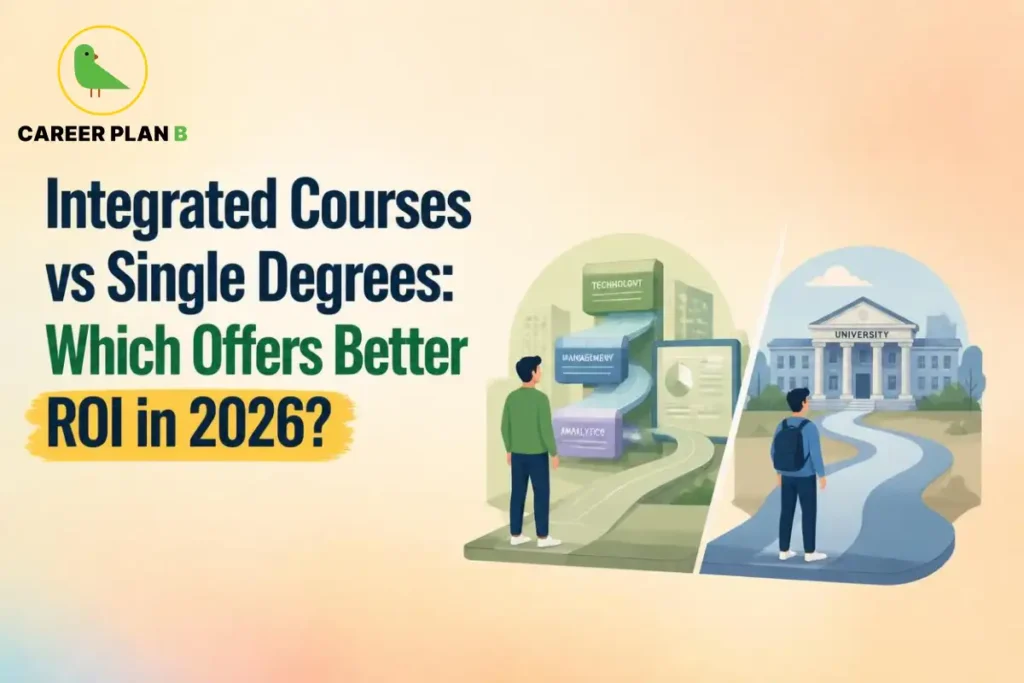
Introduction
The Indian educational landscape of 2026 is aggressively pivoting toward highly specialized, uninterrupted academic pathways. Consequently, ambitious high school graduates and anxious parents are constantly debating integrated courses vs single degrees to determine the absolute best long-term return on investment (ROI). Historically, pursuing a standard bachelor’s degree followed by a grueling battle for a separate master’s seat was the only acceptable route to corporate leadership.
However, modern tier-one universities now offer seamless, five-year dual programs that completely eliminate the brutal friction of postgraduate entrance exams. These innovative programs merge foundational theories directly with executive-level corporate strategy in a single, cohesive journey. Alternatively, traditional single degrees still provide unparalleled flexibility for students who are not entirely ready to lock in their lifelong career path at age eighteen.
This comprehensive guide explores exactly how these two distinct academic structures perform in the highly competitive 2026 job market. By analyzing the true financial cost, time investments, and corporate salary trajectories, you can confidently make a data-driven educational decision.
Analyzing Time and Tuition Investments
When evaluating integrated courses vs single degrees, the most immediate and undeniable differentiator is the massive volume of time and capital saved.
The Efficiency of the Dual Degree
Integrated programs completely condense the traditional six-year academic journey (a four-year bachelor’s plus a two-year master’s) into a highly efficient five-year structure. This streamlined approach allows students to completely bypass expensive coaching classes for postgraduate entrance exams like the CAT, GATE, or CLAT. By saving an entire year of expensive university tuition, graduates enter the corporate workforce 12 months ahead of their peers, massively accelerating their lifelong wealth generation.
The Flexibility of Single Degrees
Conversely, single degrees offer crucial breathing room for young students who are unsure about their long-term postgraduate ambitions. Approved and regulated by the University Grants Commission (UGC), the single degree framework allows students to switch specializations or change universities entirely for their master’s program. This modular approach provides unmatched global mobility, allowing graduates to secure their advanced degree from prestigious international universities after gaining a few years of vital corporate work experience.
Corporate Perception and Hiring Trends
Multinational corporations evaluating integrated courses vs single degrees care almost exclusively about the candidate’s specialized depth and practical portfolio.
The Value of Uninterrupted Specialization
Top-tier global consulting firms and tech giants actively recruit integrated graduates specifically for mid-level management roles right out of campus. Because their five-year training is completely uninterrupted, these graduates are frequently viewed as highly focused, executive-ready professionals. Companies love that these candidates possess a deep, unified academic foundation without the fragmented learning that sometimes occurs when switching colleges.
The Power of the Elite MBA Pivot
However, standard single degrees hold a massive, undeniable advantage if a student plans to secure their postgraduate credential from an absolute elite institution. A standard B.Tech from a regional engineering college paired with a subsequent MBA from an IIM will always command a higher corporate premium than a tier-two integrated B.Tech-MBA. Therefore, single degrees are superior for students utilizing the National Education Policy (NEP) 2020 flexibility to massively upgrade their college tier at the master’s level.
Have Any Doubts?
Salary Expectations and Financial ROI
The ultimate return on investment (ROI) depends heavily on how quickly you start earning a premium corporate salary versus your total educational debt. In 2026, the financial trajectory for both pathways remains incredibly lucrative if executed correctly.
| Academic Pathway | Core Financial Advantage | Average Starting Salary (2026) | Senior Salary Scope (8+ Yrs) |
|---|---|---|---|
| Integrated B.Tech + MBA | Saves 1 year tuition, immediate management role | ₹10.0 – ₹18.0 LPA | ₹30.0 – ₹60.0+ LPA |
| Single B.Tech + IIM MBA | Massive brand prestige, elite alumni network | ₹22.0 – ₹35.0+ LPA | ₹50.0 – ₹1.0+ Crore |
| Integrated BA LLB (NLU) | 5 years uninterrupted elite legal training | ₹12.0 – ₹18.0 LPA | ₹40.0 – ₹80.0+ LPA |
| Single BA + LLB (3 Yrs) | Flexibility to switch careers, lower initial cost | ₹6.0 – ₹10.0 LPA | ₹20.0 – ₹40.0+ LPA |
(Source: Educational framework comparisons strictly aligned with 2026 Indian corporate recruitment and tier-one university placement data).
How Career Plan B Helps
Deciding to commit to a five-year academic program or opting for a flexible single degree requires meticulous, long-term strategic forecasting. Career Plan B assists ambitious high school graduates in navigating this massive financial and educational decision with absolute clarity.
- Personalised Career Counselling: We thoroughly evaluate your natural academic certainty to determine if a rigid integrated course or a flexible single degree maximizes your ROI.
- Psycheintel & Career Assessments: Scientifically backed tests that accurately map your unique strengths for enduring five uninterrupted years of highly specialized study.
- Customized Admission Guidance: Strategic, end-to-end support to help you crack elite entrance exams for premium dual degrees or top-tier undergraduate programs.
- Career Roadmapping: Tailored, long-term pathways that guarantee your specific academic structure perfectly aligns with securing premium corporate roles in 2026.
Get In Touch With Us
Frequently Asked Questions
Q1. Which is better: integrated courses vs single degrees?
If you are 100% certain about your career path, an integrated course is vastly superior as it saves time and money. If you are unsure and want to upgrade to an elite university later, single degrees offer necessary flexibility.
Q2. Do employers prefer dual degrees over single degrees?
Employers highly value the specialized depth of a dual degree. However, if a single degree holder secures their master’s from a globally elite institution (like an IIM or Ivy League), they will generally command a higher premium.
Q3. Does an integrated course save money in 2026?
Yes, absolutely. Integrated programs typically save students one full academic year of expensive university tuition and completely eliminate the costs of preparing for secondary entrance exams.
Q4. Can I leave an integrated course halfway?
Following the NEP 2020 guidelines, many progressive universities now offer multiple exit points, allowing students to leave after 3 or 4 years with a standard bachelor’s degree.
Q5. What is the highest-paying integrated course?
Currently, integrated B.Tech + M.Tech in Artificial Intelligence, integrated BBA + MBA (IPM), and the 5-year BA LLB from top National Law Universities (NLUs) offer the absolute highest starting salaries.
Conclusion
Analyzing the modern educational sector reveals exactly why the debate over integrated courses vs single degrees is so critical in 2026. By choosing an integrated path, you aggressively optimize your financial ROI, eliminating wasted academic years and securing executive management roles much faster. Conversely, maintaining the flexibility of a single degree allows you to navigate the global market, gain practical work experience, and eventually secure a master’s from an absolute elite institution.
Ultimately, your educational ROI is entirely dependent on your personal clarity and long-term professional ambition. If you are ready to identify the exact academic structure that fits your unique strengths and budget, consult Career Plan B today to build a meticulously personalized roadmap to success.