Team6 · September 25, 2026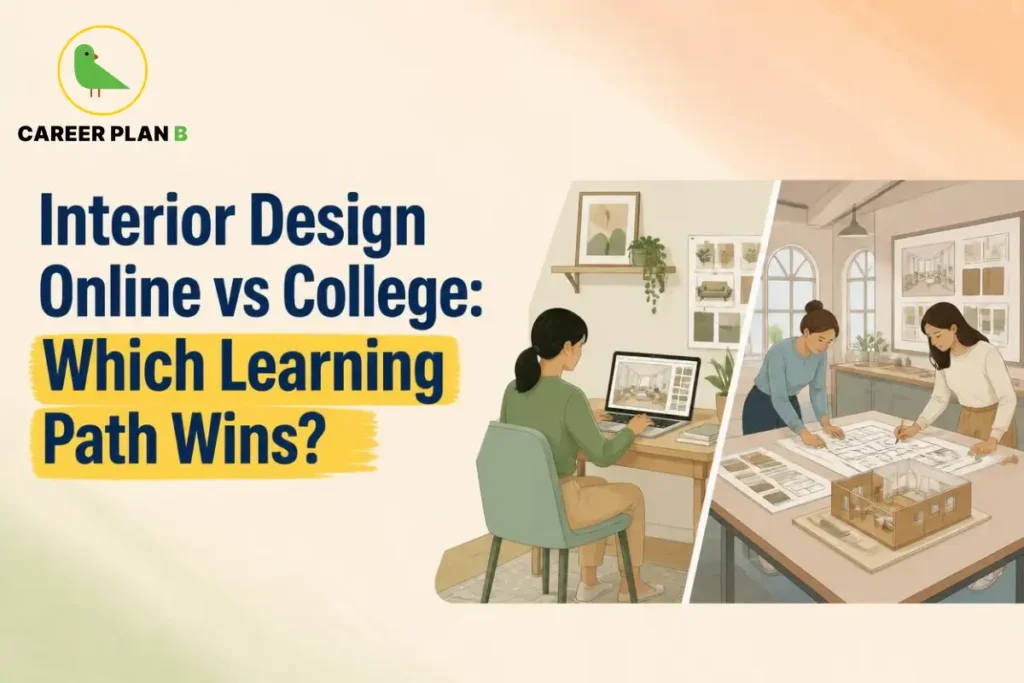
Introduction
Do you actually need a full college degree to build a real interior design career?
This question comes up constantly among students weighing time, cost, and recognition. Marketing pages on both sides tend to oversell their own path while downplaying the other.
This guide covers interior design online courses versus college degrees in India. You will find both paths compared honestly, using verified institutional recognition rather than assumptions.
Why This Comparison Isn’t a Simple Either-Or
Interior design sits in an unusual space between formal design education and applied, skill-based practice. This makes the online-versus-college decision less clear-cut than in more rigidly regulated fields.
The Regulation Gap
Unlike fields like medicine or law, interior design in India does not require a single mandatory licensing degree to practice. This gives both online and college paths genuine room to lead to real careers, depending on execution. This also means the decision comes down more to personal fit than legal necessity.
The Case for College: Structured, Recognised Education
College-based interior design programmes offer specific advantages rooted in institutional depth.
National Institute of Design (NID)
NID is a statutory Institute of National Importance. It falls under the Department for Promotion of Industry and Internal Trade, Ministry of Commerce and Industry. NID does not offer a program with the literal title of interior design. Even so, its design programmes approach spatial and furniture design with real academic rigour.
CEPT University
CEPT University runs a dedicated School of Interior Design. It was incorporated by the Government of Gujarat and is recognised by the UGC under Section 2(f). This programme combines design theory, studio practice, and critique-based learning over several years.
What College Offers That Online Often Cannot
Physical studio access, sustained peer critique, and long-form project development are harder to replicate outside a college setting. These elements matter significantly for design maturity, not just technical skill. Working alongside peers on shared studio problems also builds a professional network that online formats rarely replicate as naturally.
The Case for Online: Speed, Cost, and Flexibility
Online interior design learning has grown considerably as a faster, more affordable alternative.
Lower Cost and Time Investment
A full college degree can cost several lakhs and take three to four years. Online courses, by contrast, often complete in months and cost a fraction of degree programmes.
Government-Backed Skilling Options
Platforms like the Skill India Digital Hub and SWAYAM offer structured, credible design-adjacent courses. These provide a government-backed alternative to unregulated private online platforms.
What Online Cannot Fully Replace
Online courses typically cannot replicate hands-on material exploration, physical model-making, or sustained in-person critique. These gaps matter more for interior design than for some other digital-first skills. Students relying solely on online formats often need to seek out these experiences independently, through internships or freelance projects.
How to Decide Which Path Fits You
The right choice depends on your specific goals, timeline, and learning style.
If You Want Deep, Long-Term Design Mastery
A college programme, especially at institutions like NID or CEPT, offers deeper design thinking development. This suits students planning a long-term, design-led career.
If You Want a Faster, Practical Entry Point
Online courses suit students wanting quicker entry into practical roles, especially when paired with real project experience. This works well for those pivoting from another field.
A Hybrid Approach Is Also Valid
Some professionals complete an online foundation, then pursue further formal study later. This staged approach reduces upfront cost while keeping the college option open.
Have Any Doubts?
Benefits, Challenges, and What the Data Says
College programmes at NID and CEPT offer verified institutional depth and recognition. Online platforms like Skill India Digital Hub offer verified, though narrower, government-backed skilling instead.
However, no single official dataset ranks career outcomes by online versus college path specifically. Instead of estimating this comparison, this guide focuses on verified institutional recognition and structural differences between the two routes.
The Portfolio Factor
Regardless of path chosen, employers and clients in interior design consistently prioritise a strong, demonstrated portfolio over the credential itself.
The Outlook for Interior Design Education
Both structured college programmes and government-backed online skills are expanding in parallel. Neither path shows signs of becoming the sole dominant route going forward.
This suggests the right choice will keep depending on individual goals, rather than one path becoming universally superior.
How Career Plan B Helps
Understanding which path genuinely fits your interior design ambitions can feel overwhelming without guidance. Career Plan B simplifies this through:
- Personalised Career Counselling: evaluating whether online or college-based design education suits your goals
- Psycheintel Career Assessment Tests: confirming whether your strengths align with long-term design mastery or faster entry
- Admission and Academic Profile Guidance: exploring NID, CEPT, and verified online skilling options
- Structured Career Roadmapping: a clear plan connecting your chosen path to a real design career
Get In Touch With Us
Frequently Asked Questions
Q1.Is a college degree mandatory to become an interior designer in India?
No. Interior design does not require a single mandatory licensing degree, unlike some other regulated professions.
Q2.Are NID and CEPT government-recognised institutions?
Yes. NID is a statutory Institute of National Importance, and CEPT is UGC-recognised under Section 2(f).
Q3.Can online interior design courses lead to real careers?
Yes, especially when paired with strong portfolio projects and practical experience.
Q4.What can online courses not fully replace?
Hands-on studio access, physical model-making, and sustained in-person critique are hard to replicate online.
Q5.Is a hybrid approach realistic?
Yes. Many professionals start with an online foundation and pursue formal study later if needed.
Q6.What matters most when hiring or hiring clients evaluate designers?
A strong, demonstrated portfolio typically matters more than the specific credential behind it.
Conclusion
Neither online courses nor college degrees are universally “better” for interior design specifically.
College programmes like NID and CEPT offer deep, structured design education. Online platforms like Skill India Digital Hub and SWAYAM offer faster, more affordable entry points instead. The right choice depends on your specific goals, timeline, and appetite for hands-on studio learning.
Start by clarifying whether you want deep design mastery or a faster practical entry, then choose your path accordingly.
Ready to figure out which path fits your interior design goals? Talk to a Career Plan B counsellor and get a personalised roadmap today.