Team6 · July 15, 2026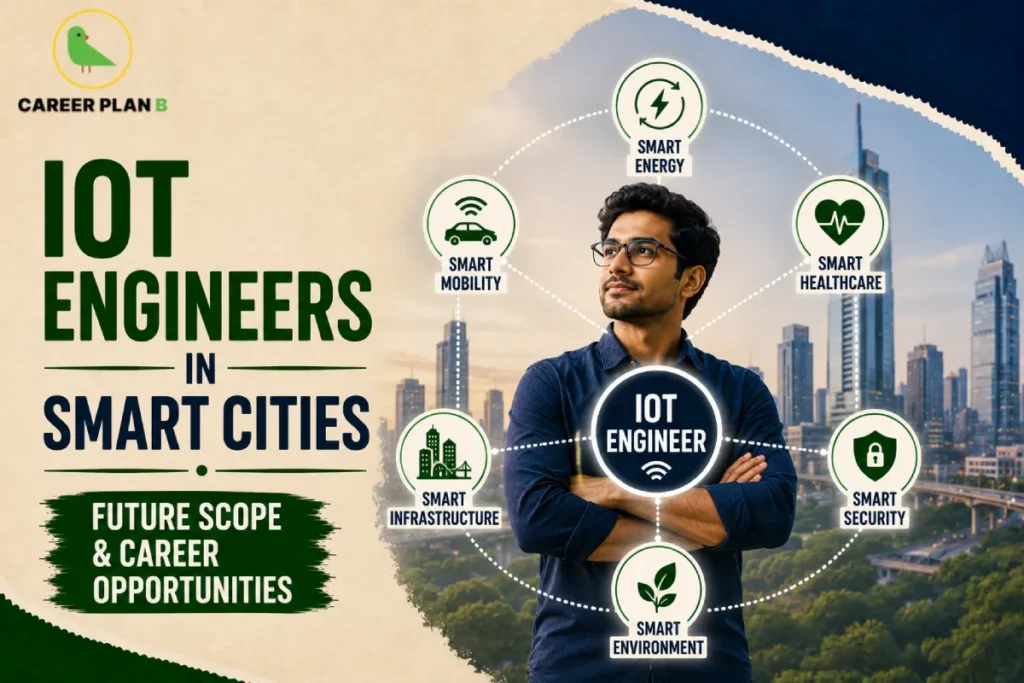
Introduction
Imagine waking up in a city where traffic signals adjust themselves based on real-time congestion, streetlights dim automatically when no one is around, and waste bins notify the municipality before they overflow. This isn’t a scene from a sci-fi movie; this is the reality that IoT engineers in smart cities are actively building today.
As urban populations surge and governments invest billions into modernising infrastructure, the demand for skilled Internet of Things career professionals has never been higher. According to the Smart Cities Mission, Government of India, India alone has committed to developing 100 smart cities under its flagship urban development programme. Globally, the smart city technology market is projected to reach $6.8 trillion by 2030.
If you are a student or early-career professional wondering where technology meets real-world impact, the future of smart cities is calling, and IoT engineers are the ones answering.
In this blog, we will explore what IoT engineers actually do, why smart cities cannot function without them, the top career opportunities available, and the skills you need to get there.
What Does an IoT Engineer Actually Do in a Smart City?
Before diving into career scope, it helps to understand the role clearly.
An IoT engineer designs, builds, and maintains the network of physical devices, sensors, actuators, cameras, and systems that collect and exchange data across a city. Think of them as the people who wire up a city’s nervous system.
Building the Nervous System of a City
In a smart city, an IoT engineer might:
- Install and programme sensors on roads to monitor traffic flow
- Design energy management systems for smart buildings
- Build connected infrastructure for water and waste management
- Develop real-time dashboards for city administrators
- Ensure all devices communicate securely across networks
A real-world example is Barcelona’s Superblocks project, where IoT-enabled urban tech solutions help manage noise, pollution, and pedestrian movement simultaneously. Similarly, Singapore’s Smart Nation initiative uses connected infrastructure across transport, healthcare, and housing.
These cities did not build themselves; IoT engineers made it possible.
Have Any Doubts?
Why Smart Cities Cannot Function Without IoT Engineers
Smart cities run on data. And data does not collect, process, or act upon itself.
Every sensor on a smart traffic pole, every connected water meter, every air quality monitor – all of it requires an IoT engineer to design the system, ensure connectivity, manage data pipelines, and troubleshoot failures.
Here is why the demand for IoT engineer roles is only going upward:
- 75 billion connected devices are expected globally by 2025, according to Statista
- India’s National Smart Cities Mission has already disbursed over ₹1.6 lakh crore for urban development projects
- The Ministry of Electronics and Information Technology (MeitY) actively promotes IoT skilling under its Digital India programme
- Sectors like transportation, energy grids, public safety, and healthcare all depend on IoT job opportunities to function efficiently
Without IoT engineers, a smart city is just a city with expensive hardware sitting idle.
Top Career Opportunities for IoT Engineers in Smart Cities
The Internet of Things career landscape is broad. Here are the most in-demand IoT engineer roles within smart city projects:
| Role | What They Do | Avg. Salary (India) |
|---|---|---|
| IoT Solutions Architect | Designs end-to-end IoT systems | ₹12–22 LPA |
| Embedded Systems Engineer | Programs hardware devices and sensors | ₹6–14 LPA |
| IoT Data Engineer | Manages data pipelines and analytics | ₹8–18 LPA |
| Network & Connectivity Engineer | Ensures device communication (5G, LPWAN) | ₹7–15 LPA |
| IoT Cybersecurity Specialist | Secures connected infrastructure | ₹10–20 LPA |
| Smart City Project Manager | Oversees urban tech solutions’ deployment | ₹10–20 LPA |
India-Specific Opportunity: Smart Cities Mission
India’s Smart Cities Mission is one of the largest government-backed IoT employment drivers in the world. With 100 cities under development, thousands of IoT engineering roles are being created in areas like:
- Integrated Command and Control Centres (ICCCs)
- Smart traffic management systems
- Sensor-based solid waste management
- Solar-powered smart street lighting
For Indian students, this represents a generational career opportunity backed by government investment.
What Skills Do You Need to Become an IoT Engineer?
Becoming a successful IoT engineer in the smart city space requires a mix of technical expertise and practical thinking.
Technical Skills
- Programming Languages: Embedded C, Python, JavaScript (Node.js)
- Communication Protocols: MQTT, CoAP, Zigbee, LoRaWAN
- Cloud Platforms: AWS IoT Core, Microsoft Azure IoT Hub, Google Cloud IoT
- Hardware Knowledge: Raspberry Pi, Arduino, ARM microcontrollers
- Networking: 5G, Wi-Fi, Bluetooth, LPWAN technologies
- Data & Analytics: Basic understanding of real-time data processing
Soft Skills
- Systems Thinking: Ability to see how all components interact in a city-wide network
- Problem Solving: Diagnosing failures in complex, multi-device environments
- Cross-functional Collaboration: Working with urban planners, government bodies, and software teams
Certifications Worth Pursuing
- AWS Certified IoT Specialty Amazon Web Services
- Microsoft Certified: Azure IoT Developer Microsoft Learn
- Cisco IoT Certifications Cisco
- NIELIT Courses on IoT Government of India’s National Institute of Electronics & IT
How Career Plan B Helps
Choosing a path in IoT and smart city technology can feel overwhelming, especially when the field evolves so rapidly. Career Plan B simplifies this journey for you.
Whether you are a student exploring an Internet of Things career or a professional looking to pivot into urban tech solutions, Career Plan B offers:
- Personalised Career Counselling Get one-on-one guidance tailored specifically to IoT and tech-driven career paths, helping you understand which IoT engineer roles align with your strengths and interests
- PsycheIntel Career Assessment Tests Discover your aptitude, personality fit, and skill alignment for technical careers like IoT engineering before committing to a path
- Career Roadmapping Receive a step-by-step plan covering the right courses, certifications, internships, and milestones to enter the smart city technology space
- Admission & Academic Profile Guidance Get expert support in choosing the right engineering programmes, universities, and specialisations that align with the future of smart cities
If you are serious about building a career where technology creates real-world urban impact, Career Plan B is the structured support system you need to get there faster and smarter.
For Latest Information
Frequently Asked Questions (FAQs)
Q1. What educational background do I need to become an IoT engineer in smart cities?
A degree in electronics engineering, computer science, electrical engineering, or information technology is typically the starting point. Specialisation through IoT-specific certifications from platforms like NIELIT or AWS strengthens your profile significantly.
Q2. What is the salary of an IoT engineer in India?
Entry-level IoT engineers in India earn between ₹4–7 LPA, while experienced professionals working on smart city technology projects can earn ₹12–22 LPA or more, depending on the role and organisation.
Q3. Is there real IoT job opportunity growth in India specifically?
Absolutely. India’s Smart Cities Mission and Digital India programme are directly creating thousands of IoT engineer roles across government projects, private contractors, and tech companies partnering with urban bodies.
Q4. Can I enter this field after a non-engineering degree?
Yes, with focused upskilling. Professionals from physics, mathematics, or IT backgrounds have successfully transitioned into IoT careers through certification programmes and hands-on project experience.
Q5. How long does it take to become job-ready as an IoT engineer?
With a relevant engineering degree, 6–12 months of focused skill-building in IoT tools, cloud platforms, and connected infrastructure projects can make you job-ready for entry-level roles.
Conclusion
The cities of tomorrow will not be built on concrete alone; they will run on data, sensors, and intelligent connected infrastructure. IoT engineers in smart cities are not just filling technical roles; they are shaping how billions of people live, move, and thrive in urban environments.
From India’s 100 Smart Cities Mission to global urban transformation projects, the future of smart cities is being written right now. The Internet of Things career space is expanding rapidly, and the window to enter it at the right time is open today.
The question is not whether IoT engineer roles will grow. The question is whether you will be ready when the opportunity arrives.
Start with clarity. Start with the right guidance. Visit Career Plan B to map your journey into the world of IoT and smart city technology because the best careers are built with a plan.