Team Career Plan B · August 7, 2026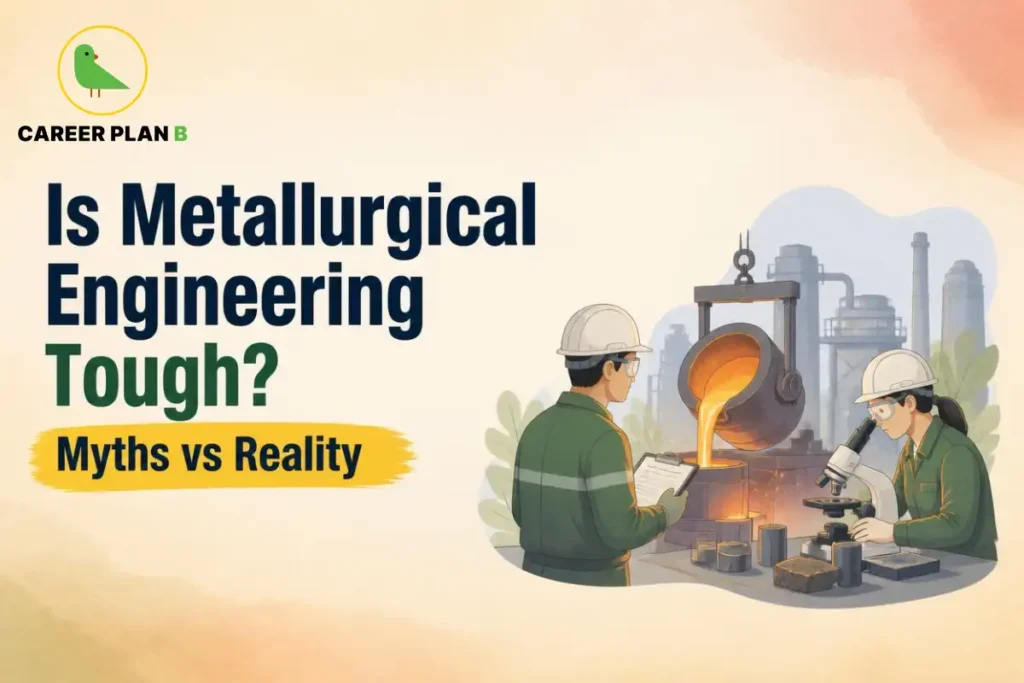
Introduction
Ask any Indian engineering aspirant about metallurgical engineering, and you’ll likely hear the same worried question: isn’t that branch impossibly hard? Exploring metallurgical engineering tough? myths vs reality matters because so many students avoid this field based on rumours rather than facts, often missing out on a genuinely rewarding core branch in the process.
The All India Council for Technical Education, the apex regulatory body overseeing engineering education in India, has developed structured model curricula for undergraduate engineering programmes, including metallurgical and materials engineering. Let’s separate what’s genuinely challenging about this field from what’s simply an outdated myth.
Why Metallurgical Engineering Gets Such a Tough Reputation
Metallurgical engineering carries a reputation for being dense, chemistry-heavy, and intimidating, largely because it sits at the intersection of physics, chemistry, and materials science all at once. This perceived metallurgical engineering difficulty often scares students away before they’ve even looked closely at what the coursework actually involves.
Myth 1: The Curriculum Is Overwhelmingly Theoretical
Many students assume this branch is buried in abstract theory with little practical relevance.
The Reality Behind the Curriculum
The metallurgy curriculum India follows through AICTE-regulated programmes blends foundational science with genuinely hands-on laboratory work, covering everything from material testing to process metallurgy. Far from being purely theoretical, students regularly work directly with furnaces, testing equipment, and real industrial processes throughout their degree. This balance of theory and application is precisely what prepares graduates for roles at companies like SAIL and Tata Steel.
Myth 2: It’s Harder Than Every Other Engineering Branch
This is perhaps the most persistent of all metallurgical engineering myths, the idea that this branch is somehow uniquely more difficult than mechanical, civil, or electrical engineering.
Why This Comparison Doesn’t Hold Up
In reality, every engineering branch has its own demanding subjects. Metallurgy leans more heavily into chemistry and materials behaviour, while other branches lean into different areas of difficulty entirely. Difficulty here is more about aptitude fit than an objective ranking; students genuinely curious about materials science often find this branch more intuitive than they expected, precisely because the subject matter aligns with their natural interests.
Myth 3: There’s No Real Career Outside Steel Plants
Many students assume a metallurgy degree locks them into working at a steel mill for their entire career.
What Career Prospects Actually Look Like
This is genuinely outdated thinking. According to the Ministry of Steel, the Production Linked Incentive Scheme for Speciality Steel has attracted 44 projects from 26 companies, with a committed investment of roughly ₹27,106 crore, reflecting genuine expansion well beyond traditional steel plants. Meanwhile, the Ministry of Mines oversees exploration and development of metals like aluminium, copper, and zinc, opening opportunities in mining and mineral processing too. Strong metallurgy career prospects in India now extend into EV battery manufacturing, aerospace materials, and mineral recycling, sectors that simply didn’t exist as career paths a decade ago.
Have Any Doubts?
What Do Actual Students Say About Their Experience?
Beyond myths and government data, it helps to understand what studying this branch genuinely feels like day to day.
A More Honest Student Experience
The typical metallurgical engineering student experience involves a genuine mix of lab work, mathematical modelling, and site visits to industrial facilities. Students often describe the first year as challenging while building foundational chemistry and physics knowledge, followed by increasingly specialized and genuinely engaging coursework as they progress into materials-specific subjects. This progression, difficult early on but rewarding later, mirrors most engineering disciplines rather than representing something uniquely brutal about metallurgy specifically.
Separating Myth from Reality: A Quick Comparison
| Common Myth | Actual Reality |
|---|---|
| “It’s purely theoretical with no practical use” | Heavy lab work and real industrial process training |
| “It’s harder than every other branch.” | Difficulty depends on individual aptitude and interest fit |
| “Career options are limited to steel plants.” | Spans mining, aerospace, EVs, and mineral recycling |
| “Job opportunities are shrinking.” | Steady growth backed by sustained government investment |
How Career Plan B Helps
Career Plan B helps students understand whether metallurgical engineering matches their interests, abilities, and career goals through personalized guidance, assessments, and structured career planning.
Personalized Career Counselling: Provides expert guidance to help students understand the realities of metallurgical engineering, including curriculum difficulty, career opportunities, industries, and suitable career paths.
Psychometric & Career Assessment Tests: Helps identify students’ strengths, learning preferences, scientific interests, and suitability for core engineering fields like metallurgy and materials science.
Career Roadmapping: Creates a step-by-step plan covering engineering branch selection, academic preparation, skill development, internships, and future career opportunities in industries like steel, aerospace, EVs, and research.
Admission & Academic Profile Guidance: Helps students select the right colleges, metallurgy programs, and academic pathways while building a strong profile for future opportunities in metallurgical engineering careers.
Get In Touch With Us
Frequently Asked Questions
- Is metallurgical engineering actually harder than mechanical engineering?
Not objectively. Each branch has its own demanding subjects; metallurgy leans into chemistry and materials science, which some students find more intuitive than others.
- Does metallurgical engineering only lead to steel plant jobs?
No. Career prospects have genuinely expanded into mining, aerospace, EV battery manufacturing, and mineral recycling in recent years.
- Is the metallurgy curriculum outdated in India?
Not under AICTE’s current model curriculum, which continues to be periodically reviewed and updated to reflect current industry needs.
- Do I need to be exceptional at chemistry to succeed in this branch?
Strong chemistry helps, but consistent effort and genuine interest in materials matter just as much as raw natural aptitude.
- Is job growth in metallurgy actually declining in India?
No, quite the opposite. Sustained government investment through steel and mining sector initiatives continues supporting steady long-term demand.
Conclusion
Is answering metallurgical engineering tough? Myths vs reality honestly means acknowledging that yes, it has genuinely challenging coursework, but so does every engineering branch worth pursuing. The real myths, limited career options, purely theoretical coursework, and universal difficulty simply don’t hold up against what the field actually offers today.
If you’re still weighing whether this branch matches your strengths, Career Plan B can help you explore it with real clarity rather than secondhand rumours. Metallurgical engineering remains a genuinely solid, evolving core branch, and it deserves a fair look before you rule it out.