Team Career Plan B · August 13, 2026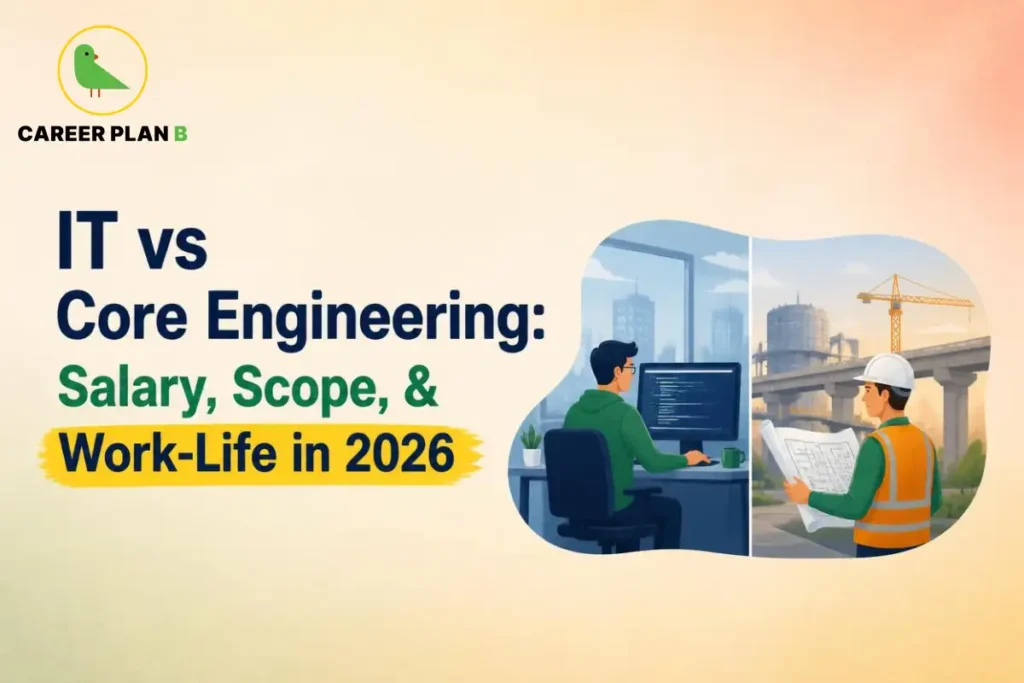
Introduction
Almost every engineering graduate in India eventually faces the same fork in the road. Stay in core engineering, or move into IT. This decision shapes more than just the first job. It often shapes the pace of work, the cities available, and the kind of problems solved daily. IT vs core engineering gets debated constantly among students and graduates. Yet the comparison is rarely made using verified, official data.
Part of the confusion comes from how differently these two paths are marketed. IT careers are visible everywhere, in placement drives, campus branding, and everyday conversation. Core engineering’s scale often stays hidden behind manufacturing plants and infrastructure projects. These don’t trend online the way tech careers do. This guide covers how these two paths genuinely differ in scope, salary structure, and work-life balance. It uses official government data on both sectors rather than assumptions.
Why This Comparison Matters More in 2026
The Union Budget 2026-27 pushed growth on both fronts simultaneously. It proposed reforms to expand India’s IT and IT-enabled services sector. The Economic Survey 2025-26 highlighted that medium and high-technology industries now contribute 46.3% of India’s manufacturing value added.
This dual push means IT vs core engineering is not a story of one sector rising while the other declines. Both are expanding, just through very different mechanisms and in different locations.
IT Careers: Scope and Sector Scale
Where the Jobs Actually Are
India’s technology and AI ecosystem employed roughly 6 million people as of 2025. This spans IT services, business process management, and software products. Global Capability Centres now form a major share of this growth. Government sources project these centres will keep driving new white-collar tech job creation.
IT roles concentrate heavily in metro and tier-1 cities, particularly Bengaluru, Hyderabad, and Pune. Smaller cities are gaining ground through digital skilling pushes.
What Skills Matter Most
Cloud computing, AI and machine learning, and cybersecurity dominate current hiring demand within IT. The Union Budget 2026-27 specifically proposed measures to support AI integration and workforce upskilling within IT and IT-enabled services.
Unlike core engineering, IT careers often allow lateral movement between industries. Software and cloud skills transfer across banking, retail, and manufacturing clients alike.
Core Engineering Careers: Scope and Sector Scale
Where the Jobs Actually Are
Core engineering roles concentrate around India’s manufacturing base: automotive, steel, cement, electronics, and infrastructure. The Index of Eight Core Industries recorded provisional growth of 3.7% in December 2025. Cement, steel, electricity, and fertilizer all posted positive growth.
These roles tend to concentrate around industrial hubs and manufacturing corridors rather than metro tech parks. Tier-2 cities near plants and factories dominate. India’s manufacturing Purchasing Managers’ Index also remained above its long-run average into early 2026. This signals sustained job gains.
What Skills Matter Most
Core engineering rewards deep, discipline-specific technical mastery: mechanical design, process engineering, quality control, and systems integration. The sector’s growing automation and digitalisation also mean core engineers increasingly need familiarity with industrial software and data-driven production tools.
Unlike IT, core engineering skills tend to be less transferable across industries. A process engineer’s expertise is often domain-specific.
Salary: What’s Genuinely Comparable vs. Not
Direct salary comparisons between IT and core engineering are genuinely difficult to make well. Starting compensation varies enormously by company tier, city, and specific role within each field. This matters more than the broad label suggests.
What can be said with more confidence: IT’s compensation often includes faster early growth tied to skill certifications. Core engineering’s growth ties more closely to seniority and plant responsibility.
Work-Life Balance: A Structural, Not Just Anecdotal, Difference
This difference is more structural than commonly assumed. IT roles often run on project deadlines and client time zones. This can mean irregular hours during release cycles, but predictable off-cycle periods. Core engineering roles often run on production schedules and shift-based plant operations, which can mean more physically demanding, location-bound work.
Neither structure is inherently better or worse. They simply demand different kinds of flexibility and tolerance for physical versus schedule-based demands.
Which Path Fits Which Kind of Engineer
Students drawn to software, systems thinking, and client-facing problem-solving tend to fit naturally into IT. Students drawn to hands-on technical work and physical systems tend to fit more naturally into core engineering.
Neither path represents a lesser choice. IT vs core engineering is ultimately a question of working style preference, not a ranking of superiority.
Step-by-Step Roadmap to Decide
- Reflect honestly on whether you prefer software-based problem-solving or hands-on physical systems work.
- Research the specific companies and roles within your target field, not just the broad sector label.
- Speak with working professionals in both fields about their actual daily schedules and demands.
- Consider location preferences, since core engineering often means industrial hubs, not metro cities.
- Remember that switching between these paths later is possible, though it usually requires additional upskilling.
Have Any Doubts?
Benefits, Challenges, and What the Data Says
Both IT and core engineering are backed by genuine, expanding government-supported growth. Budget 2026-27’s services push and manufacturing’s rising tech contribution both matter.
However, no single official dataset directly compares average salaries or work-life satisfaction scores between IT and core engineering roles. Figures claiming one field pays significantly more, or offers dramatically better balance, usually come from private surveys, not government data. Treat such comparisons as indicative only.
Common challenges include underestimating how location-bound core engineering can be. IT project cycles can also get demanding despite the flexible reputation. Realistic expectations matter more than sector stereotypes.
How Career Plan B Helps
Choosing between IT vs core engineering without knowing your own working style can feel like a coin toss. Career Plan B simplifies this through:
- Personalised Career Counselling: matching your genuine working style and interests to the right engineering path
- Psycheintel Career Assessment Tests: identifying whether you lean toward software-based or hands-on physical systems work
- Admission and Academic Profile Guidance: helping you understand specific company and role differences within each field
- Structured Career Roadmapping: a clear step-by-step plan from your engineering degree to a well-matched career path
For Latest Information
Frequently Asked Questions
Q1.Is IT or core engineering better for salary growth?
Neither is universally better. IT often sees faster early growth tied to certifications, while core engineering ties growth to seniority and plant responsibility.
Q2.Does core engineering really have worse work-life balance than IT?
Not necessarily. Core engineering follows shift-based schedules, while IT follows project cycles; both carry different, not lesser, demands.
Q3.Can I switch from core engineering to IT later?
Yes, though it usually requires additional upskilling in programming, cloud computing, or other IT-specific technical areas.
Q4.Are core engineering jobs only available in industrial hubs?
Mostly yes. Core engineering roles concentrate around manufacturing corridors and industrial hubs rather than metro tech parks.
Q5.Is there official data comparing IT and core engineering salaries directly?
No official dataset compares them directly. Treat salary comparisons from private sources as indicative only.
Q6.Which field offers more transferable skills across industries?
IT skills generally transfer more easily across industries, while core engineering skills tend to be more domain-specific.
Conclusion
IT vs core engineering is not a contest between a winning field and a fading one. Both are expanding under real, government-backed growth. Both demand genuinely different skills, locations, and working rhythms from the people who choose them.
The stronger question isn’t which field pays more, or offers better balance, in the abstract. It’s which kind of daily work genuinely suits your working life, software-based problem-solving, or hands-on physical systems.
Making that choice with real self-awareness produces far more lasting career satisfaction than chasing whichever field currently sounds more impressive. Sector reputation fades quickly once the daily reality of the work sets in.
Connect with Career Plan B today to choose the engineering path that genuinely fits your working style.