Careerplanb · May 7, 2026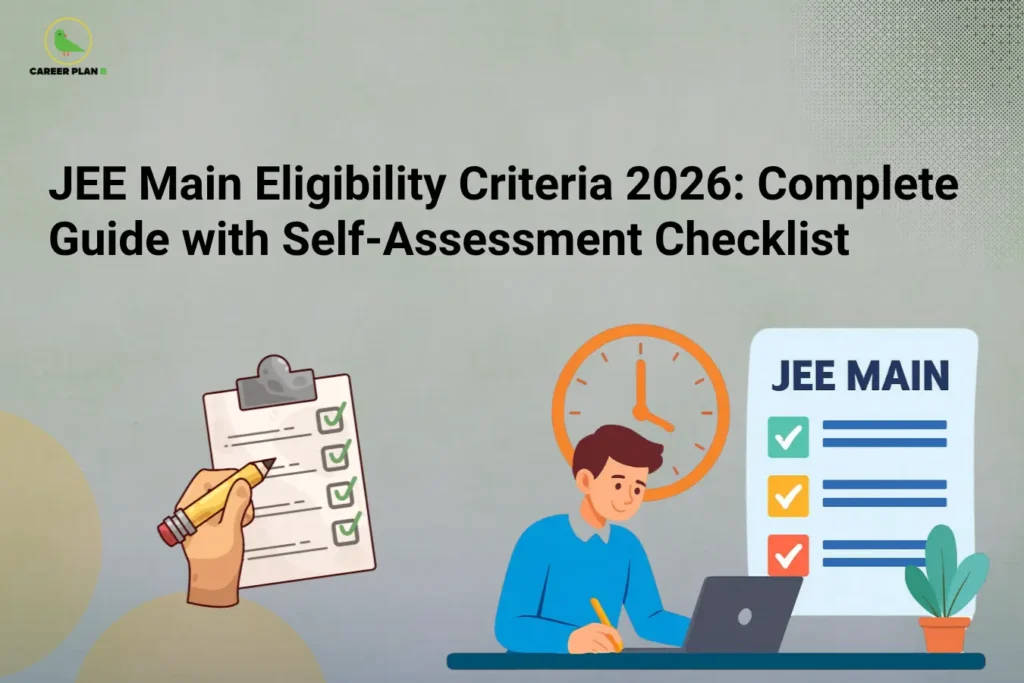
Introduction
Planning to appear for JEE Main 2026? Before you dive into study schedules and mock tests, there’s one thing every aspiring engineer must confirm first — am I actually eligible?
Missing a single eligibility condition can result in your application being rejected, or worse, your result being cancelled after you’ve already appeared for the exam. And yet, JEE Main eligibility is one of the most misunderstood aspects of the entire process — thanks to rule changes in 2019 and again post-COVID that many students and even parents aren’t aware of.
Here’s the good news: the current eligibility framework is actually more flexible and inclusive than ever before. There’s no upper age limit. No minimum percentage requirement. And for JEE Main (not JEE Advanced), you get a maximum of six attempts over three consecutive years.
This guide breaks down every eligibility condition for JEE Main 2026 — subject requirements, category rules, nationality criteria, and the key differences between JEE Main and JEE Advanced eligibility. We’ve also included a self-assessment checklist at the end so you can confirm your status in minutes.
For Complete Information About JEE: JEE Admissions 2026: Complete Guide to JEE Main, JEE Advanced & IIT/NIT College Selection
JEE Main 2026 Eligibility Overview
JEE Main 2026 is conducted by the National Testing Agency (NTA) for admission to NITs, IIITs, and CFTIs. Eligibility is determined by four main factors:
- Academic qualifications (which exam you’ve passed or are appearing for)
- Subject combination in Class 12
- Number of attempts
- Nationality and category
The rules below apply to Paper 1 (B.E./B.Tech), which is the most common paper. Paper 2A (B.Arch) and Paper 2B (B.Planning) have additional subject-specific requirements.
For Personalized Guidance
Academic Qualification Requirements
Class 12 Subjects Required (PCM Compulsory)
To be eligible for JEE Main 2026 (B.E./B.Tech), you must have studied the following subjects in Class 12 or equivalent:
- Physics (compulsory)
- Mathematics (compulsory)
- Chemistry / Biology / Biotechnology / Technical Vocational Subject (any one as the third subject)
- Language (any one)
- Any fifth subject
Physics and Mathematics are non-negotiable. Students from State Boards, CBSE, ICSE, and all other recognised boards are eligible as long as they meet this subject condition.
For B.Arch (Paper 2A), Mathematics must be one of the subjects. For B.Planning (Paper 2B), Mathematics is also mandatory.
No Minimum Percentage Required (75% Norm Removed Post-COVID)
This is the rule change that surprises most students and families.
Before 2020, candidates needed at least 75% aggregate in Class 12 (65% for SC/ST) to be eligible for admission to IITs, NITs, and other central institutions via JEE. That rule has been removed.
As of now, there is no minimum percentage requirement to appear for JEE Main 2026. You simply need to have passed Class 12 with the required subjects.
However, a small but important caveat: individual institutes — particularly NITs and IIITs — may set their own minimum percentage cutoffs as part of their admission criteria during counselling (through JoSAA). This is separate from JEE Main eligibility itself.
Key takeaway: No minimum marks are needed to appear for JEE Main 2026. But check the admission criteria of your target colleges separately.
Appearing vs Passed Students (Both Eligible)
You are eligible to appear for JEE Main 2026 if:
- You passed Class 12 or equivalent examination in 2024 or 2025, OR
- You are appearing for Class 12 in 2026
Students who passed Class 12 in 2023 or earlier are not eligible for JEE Main 2026, as per the rule that limits eligibility to the current year and the two preceding years.
Age Limit for JEE Main 2026
No Upper Age Limit (As of 2019)
Prior to 2019, there was an upper age limit of 25 years (30 for SC/ST/PwD) for JEE Main. That restriction no longer exists.
There is no upper age limit for JEE Main 2026. Whether you’re 17 or 30, as long as you meet the academic qualification criteria, you are eligible.
There is also no lower age limit specified for JEE Main, though practically, most students appear after completing Class 12 at 17–18 years of age.
This is particularly relevant for:
- Students who took a gap year (or multiple gap years)
- Working professionals considering a career change into engineering
- Students who had health, family, or other disruptions
Number of Attempts Allowed
Unlimited Attempts for JEE Main (Post-2019 Rule Change)
Before 2019, students were allowed a maximum of 3 attempts for JEE Main. That cap was removed.
As of 2026, there is no limit on the number of times you can appear for JEE Main, as long as you meet the eligibility criteria (passed Class 12 in 2024, 2025, or appearing in 2026).
Within a given year, JEE Main is typically conducted in two sessions (Session 1 in January–February and Session 2 in April). You can appear in one or both sessions. Your best score across sessions is considered for ranking.
JEE Advanced Limit: 2 Attempts in Consecutive Years
This is where it gets crucial — especially for students aiming for IITs.
JEE Advanced allows only 2 attempts, and they must be in consecutive years. If you qualify for JEE Advanced in 2025 but don’t get the rank you want, you get one more attempt in 2026 — and that’s it.
| Exam | Attempt Limit | Notes |
| JEE Main | Unlimited | Subject to Class 12 year eligibility |
| JEE Advanced | 2 (consecutive) | Must also qualify JEE Main cutoff |
Drop year students take note: If you took a drop after Class 12 in 2025, you’re eligible for JEE Advanced 2026 — but this will be your second (and final) JEE Advanced attempt.
Category-wise Eligibility
General, EWS, OBC, SC, ST Criteria
JEE Main does not have different eligibility criteria based on category — the academic qualification requirements are the same for all candidates. However, category affects:
- Reservation of seats during JoSAA counselling
- Rank cutoffs for qualifying to JEE Advanced
- Age relaxation (not applicable now since there’s no age limit anyway)
Here’s a quick reference:
| Category | Reservation in NITs/IIITs/CFTIs | JEE Advanced Qualifying Percentile (Approx.) |
| General (UR) | Open merit | Highest cutoff |
| EWS | 10% | Slightly lower than General |
| OBC-NCL | 27% | Moderate |
| SC | 15% | Lower cutoff |
| ST | 7.5% | Lower cutoff |
| PwD | 5% horizontal | Additional relaxation |
Important: OBC candidates must belong to the Non-Creamy Layer (NCL) to claim OBC reservation. Candidates must have valid certificates issued by the competent authority.
Nationality & Domicile Requirements
Indian Nationals
All Indian citizens are eligible to appear for JEE Main 2026. There is no domicile or state-specific restriction for JEE Main itself — you can be from any state and apply.
However, state-level engineering colleges (through state counselling) may have separate domicile requirements. JEE Main scores are accepted by many state colleges, but their admission rules are governed independently.
Foreign Nationals, OCI, PIO
Foreign nationals, Overseas Citizens of India (OCI), and Persons of Indian Origin (PIO) are also eligible to appear for JEE Main 2026 under specific conditions:
- They must meet the same academic qualification requirements
- They are eligible for admission to NITs, IIITs, and CFTIs under the supernumerary seats reserved for foreign nationals
- OCI/PIO candidates are generally treated on par with Indian nationals for most purposes
Candidates holding passports from other countries must check the NTA notification for any specific documentation requirements applicable to their category.
JEE Main vs JEE Advanced Eligibility: Key Differences
Many students confuse the two, especially when planning a drop year or a second attempt. Here’s a clear comparison:
| Parameter | JEE Main 2026 | JEE Advanced 2026 |
| Qualifying exam | Class 12 passed in 2024/25 or appearing in 2026 | Must qualify JEE Main 2026 |
| Minimum marks | None | None (but JEE Main cutoff rank required) |
| Age limit | None | None |
| Attempts | Unlimited | Max 2 (consecutive years) |
| Who conducts | NTA | IIT (rotating) |
| Leads to | NITs, IIITs, CFTIs | IITs |
The most critical difference to understand: qualifying JEE Main is a prerequisite for JEE Advanced. Only the top 2.5 lakh candidates (approximately) from JEE Main are eligible to appear for JEE Advanced, and they must additionally meet the attempt limit criteria.
Eligibility for Session 1 vs Session 2
JEE Main 2026 is expected to be conducted in two sessions:
- Session 1: January–February 2026
- Session 2: April 2026
Both sessions have the same eligibility criteria. There is no additional condition for appearing in Session 2 vs Session 1.
You can appear in:
- Session 1 only
- Session 2 only
- Both sessions (recommended, as your best score is counted)
The registration for each session is done separately. If you plan to appear in both, you need to register for each session individually when NTA opens applications.
Strategy tip: Most coaching experts recommend appearing in both sessions. The January attempt gives you a benchmark; April gives you a chance to improve.
Self-Assessment: Am I Eligible for JEE Main 2026?
Here’s a plain-text version of the checklist for easy reference:
JEE Main 2026 Eligibility Checklist
- ☐ I passed Class 12 in 2024 or 2025, or I am appearing in 2026
- ☐ My Class 12 subjects include Physics and Mathematics
- ☐ I studied Chemistry / Biology / Biotechnology / Technical Vocational subject as a third subject
- ☐ I appeared in at least 5 subjects in my qualifying exam
- ☐ I am an Indian national, OCI, PIO, or foreign national
- ☐ I understand the JEE Advanced attempt limit (2 consecutive attempts) if I’m targeting IITs
If all six apply to you, you are eligible for JEE Main 2026. Proceed to register when NTA opens applications.
What If You Don’t Meet the Eligibility Criteria?
Not meeting one or more conditions doesn’t necessarily mean the end of your engineering aspirations. Here’s what you can explore depending on your situation:
If you passed Class 12 before 2024: You are not eligible for JEE Main 2026. However, several state-level engineering entrance exams (like MHT-CET, KCET, WBJEE) have different eligibility windows. BITSAT also has its own separate criteria. Check these as alternative pathways to strong engineering colleges.
If you don’t have Physics and Mathematics: JEE Main B.E./B.Tech is not an option. However, you may still be eligible for B.Sc. programmes, polytechnic diplomas, or lateral entry engineering paths depending on your subject combination.
If you’ve exhausted your JEE Advanced attempts: JEE Main itself has no attempt cap, so you can still target NITs, IIITs, and CFTIs through JEE Main. Many of these institutions offer excellent programmes and strong placement records.
If you’re a foreign national or NRI: You may be eligible under Direct Admission to Students Abroad (DASA) or the CIWG scheme for NITs and IIITs, which have their own eligibility and process.
How Career Plan B Helps
Figuring out JEE eligibility is just the first step — knowing which stream, college, and career path is the right fit for you is the bigger question.
Career Plan B provides
- Personalized career counselling
- Psycheintel and career assessment tests
- Admission and academic profile guidance
- Detailed career roadmapping
To help students make confident decisions whether they’re preparing for JEE, considering alternative entrance exams, or exploring entirely different career paths.
A structured career roadmap ensures you’re not just eligible, but genuinely prepared for what comes next.
For Latest Information
FAQs: JEE Main Eligibility 2026
Q1. Is there a minimum percentage required in Class 12 for JEE Main 2026?
No. The 75% minimum marks requirement has been removed post-COVID and has not been reinstated. You only need to have passed Class 12 with the required subjects. However, note that some colleges may have their own admission cutoffs during JoSAA counselling.
Q2. Can I appear for JEE Main 2026 if I passed Class 12 in 2023?
No. JEE Main 2026 eligibility is limited to students who passed in 2024, 2025, or are appearing in 2026. Candidates who passed in 2023 or earlier are not eligible.
Q3. Is there any age limit for JEE Main 2026?
No. The upper age limit was removed in 2019 and has not been reinstated. There is no upper or lower age restriction for JEE Main 2026.
Q4. How many times can I appear for JEE Main in my lifetime?
As of current rules, there is no cap on JEE Main attempts. You can appear as many times as you are within the eligibility window (Class 12 passed in current year minus 1, or appearing in current year).
Q5. I want to get into an IIT. How is JEE Advanced eligibility different?
JEE Advanced allows only 2 attempts, and they must be in consecutive years. You also need to qualify JEE Main and rank within the top 2.5 lakh candidates to be eligible for JEE Advanced. If you attempted JEE Advanced in 2025 for the first time, 2026 will be your last attempt.
Q6. Are students from all boards (CBSE, ICSE, State Boards) eligible?
Yes. JEE Main accepts candidates from all recognised boards — CBSE, ICSE, state boards, NIOS, and international boards like IB and Cambridge — as long as the subject and year conditions are met.
Conclusion
JEE Main 2026 has one of the most straightforward eligibility frameworks in recent history — no age bar, no minimum percentage, and unlimited attempts for JEE Main. If you’ve passed Class 12 with Physics and Mathematics in 2024 or 2025 (or are appearing in 2026), you’re almost certainly eligible.
The confusion usually arises around two areas: the JEE Advanced attempt limit (which is 2 consecutive attempts), and the year-of-passing restriction (only the last two years count). If either of these applies to your situation, plan carefully.
Your next steps:
- Confirm your eligibility using the checklist above
- Track NTA’s official notification for JEE Main 2026 (expected to be released on the official NTA/JEE Main portal)
- Register as soon as the window opens — don’t wait for the last day
- Read our JEE Main Registration 2026 guide → for a step-by-step walkthrough of the application process
The eligibility box is checked. Now it’s time to focus on what really matters — your preparation.