Team Career Plan B · July 20, 2026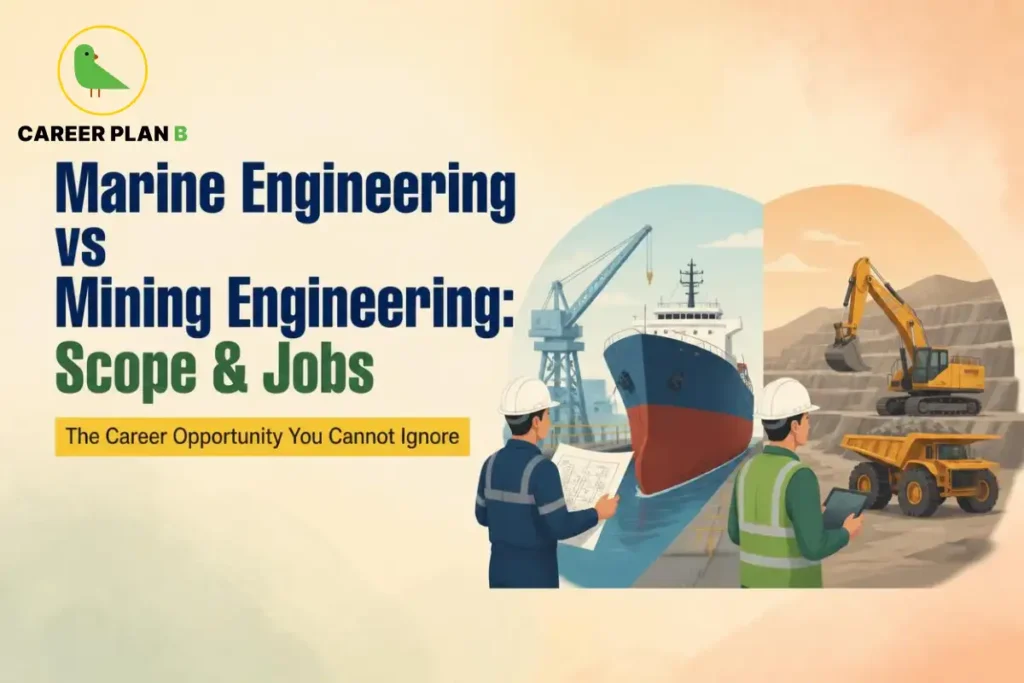
Introduction
Both fields sound adventurous on paper: one takes you out to sea, the other takes you deep underground. But the moment you actually compare marine engineering vs mining engineering, you realize these are two completely different working lives wrapped in similarly rugged, hands-on reputations. Students weighing an engineering career after 12th science often shortlist both because they promise something outside the typical desk job. This blog breaks down what each field actually involves day to day, how they stack up on pay and stability, what the lifestyle trade-offs really look like, and where the long-term career scope stands for each.
What Does a Marine Engineer Actually Do?
A marine engineer works on a ship and focuses on everything that keeps it running. This includes engines, propulsion systems, fuel and cooling systems, and other onboard machinery. Early in their career, marine engineers may spend long periods at sea. They work in engine rooms and troubleshoot mechanical problems in real time, often far from a port or repair facility. The work can be physically demanding and requires quick thinking. Engineers must fix a malfunction during a voyage rather than schedule it for later. This career suits people who enjoy hands-on mechanical problem-solving and can handle extended periods away from home.
What Does a Mining Engineer Actually Do?
A mining engineer’s world looks entirely different, even if the physical demands feel similarly intense. Their work centres on planning how to extract minerals safely and efficiently, designing mine layouts, managing ventilation and structural stability underground, and ensuring safety protocols are followed at every stage of operation. Much of a mining engineer’s career unfolds on-site, often in remote locations near mineral-rich regions, working closely with geologists and safety officers. The job carries real physical risk, since mine collapses and gas-related hazards remain genuine concerns, which is exactly why safety regulation plays such a central role in this profession.
Marine Engineering vs Mining Engineering: Key Differences
Here’s a direct comparison to make the choice easier:
| Aspect | Marine Engineering | Mining Engineering |
|---|---|---|
| Work Environment | Ships, engine rooms, often at sea | Underground or open-pit mine sites |
| Core Focus | Propulsion, machinery, ship systems | Extraction planning, safety, structural stability |
| Physical Demands | Confined spaces, long sea voyages | Physical risk from mine conditions, remote postings |
| Typical Employers | Shipping companies, navies, marine consultancies | Mining companies, PSUs, government mineral boards |
| Regulatory Body (India) | Directorate General of Shipping | Directorate General of Mines Safety |
Which Field Pays Better and Offers More Stability?
This is where the two fields genuinely diverge. Marine engineering salaries, especially early in a career with sea time, tend to be quite competitive, and demand largely follows global trade volumes; when international shipping is busy, opportunities grow. Marine engineer salary figures in India often look attractive precisely because of this international pay structure. Mining engineering salaries are respectable too, but demand tends to move with commodity cycles. When mineral prices rise and mining activity expands, mining engineer job opportunities grow correspondingly; when prices dip, hiring can slow. Neither field is inherently more stable; they’re just tied to different economic cycles, one to global trade, the other to commodity markets.
Lifestyle and Work Environment What’s the Real Trade-off?
Both fields ask for sacrifices most desk careers don’t. Marine engineers spend months away from family while at sea, often in isolated conditions with limited connectivity. Mining engineers frequently work in remote postings near mine sites, which can mean relocating away from cities for extended periods. The physical risk profile also differs. Marine engineers face mechanical and confined-space hazards onboard, while mining engineers work under strict safety oversight due to the genuine dangers of underground operations, which is precisely why bodies like the Directorate General of Mines Safety exist to regulate occupational safety in this sector.
Have Any Doubts?
Career Scope and Growth Opportunities
Marine engineering opens doors to shipping companies, naval forces, offshore oil rigs, and marine consultancies, with strong international mobility built into the career. For structured academic pathways, the Indian Maritime University, a central university under the Ministry of Ports, Shipping and Waterways, offers recognized marine engineering. Mining engineering, meanwhile, offers growth through public sector mining companies, government mineral development boards, and private mining and mineral processing firms. As one of India’s core engineering branches’ comparison points out, both fields remain classified as core disciplines precisely because they serve industries the economy fundamentally depends on: energy, trade, and raw materials.
How Career Plan B Helps
Trying to decide between these two demanding but rewarding fields? Career Plan B offers personalized career counselling and PsycheIntel assessment tests to help you understand which environment, sea-based or site-based, genuinely matches your temperament, along with academic guidance and career roadmapping to help you plan the right path forward.
For Latest Information
Frequently Asked Questions
- Which pays more starting out, marine or mining engineering?
Marine engineering often offers stronger early salaries due to international pay structures, though this varies by company, region, and sea time experience.
- Is mining engineering considered a dying field due to automation?
Not really. While automation is changing certain mining processes, skilled engineers remain essential for planning, safety, and site management.
- Which field involves more time away from family?
Both involve significant time away, though marine engineering typically means being at sea for months, while mining engineering usually means remote postings rather than isolation at sea.
- Is one field considered safer than the other?
They carry genuine occupational risks, which is why strict regulatory bodies oversee safety standards in each DGMS for mining and the Directorate General of Shipping for maritime operations.
- Which field has better long-term career growth in India?
Both remain classified as the best engineering branches for jobs in core sectors, since demand for global trade and mineral resources isn’t disappearing anytime soon.
Conclusion
Choosing between marine engineering scope and jobs and a career in mining engineering comes down to the environment where you see yourself thriving: the ocean or a mine site. Both fields demand commitment and play essential roles in the economy. They also offer strong long-term career opportunities. Instead of choosing the option that sounds more exciting, take time to understand the daily reality of each field. The right choice should match how you want to spend your working life, not just how the career looks on paper.