Team6 · September 16, 2026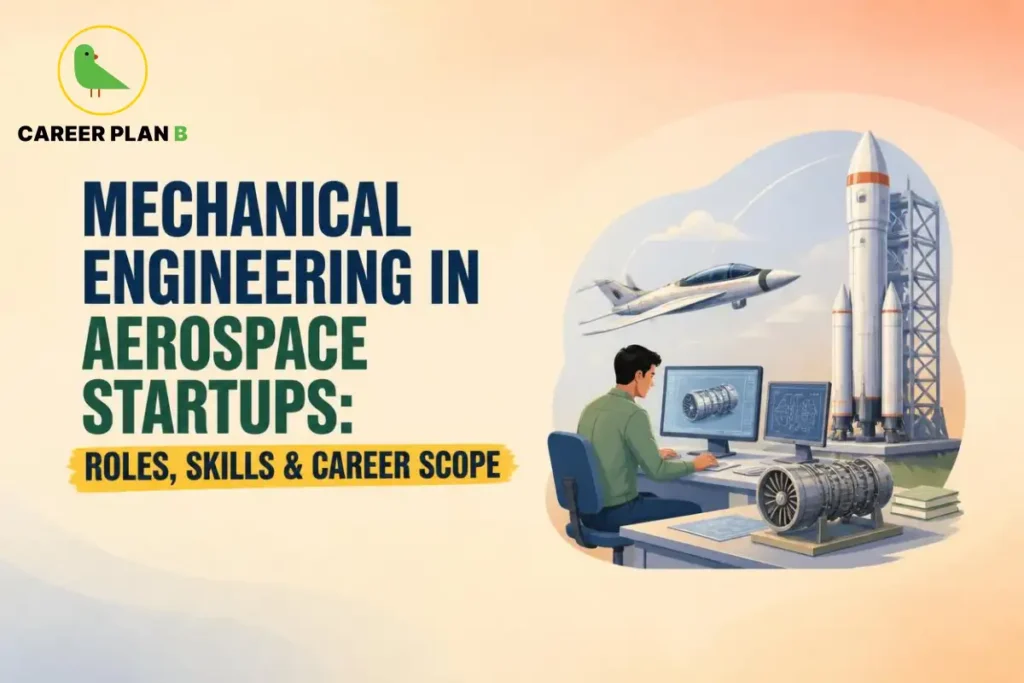
Introduction
India is no longer just watching the space race; it is running in it. With over 200 space tech startups registered under IN-SPACe (Indian National Space Promotion and Authorisation Centre) and the private space sector projected to grow to $44 billion by 2033, the country’s aerospace industry is expanding at a pace few could have imagined a decade ago.
At the heart of this boom? Mechanical engineers.
If you are a mechanical engineering student or a working professional wondering where your skills can take you next, mechanical engineering in aerospace startups may just be the most exciting answer. From designing rocket nozzles to building satellite structures that survive launch forces, mechanical engineers are not just participants in India’s space story; they are writing it.
This blog breaks down the key roles, must-have skills, top companies to watch, and exactly how you can position yourself for a career in the aerospace industry.
Why Aerospace Startups Are a Gold Mine for Mechanical Engineers
For decades, space work in India meant one destination: ISRO. That changed in 2020 when the government of India opened the space sector to private players through the Indian Space Policy reforms. The creation of IN-SPACe as the regulatory body gave startups a clear path to build, launch, and operate space systems independently.
Today, private space companies India-wide are designing their own rockets, satellites, and propulsion systems, and they are hiring. According to the Department for Promotion of Industry and Internal Trade (DPIIT), India’s space startup ecosystem has seen a sharp rise in registered entities, with hundreds of crores in private investment flowing in over the last three years.
For mechanical engineers, this is significant. Unlike software-heavy industries, aerospace is fundamentally a mechanical discipline. Every rocket that lifts off is, at its core, a triumph of mechanical design, thermal management, structural integrity, and fluid dynamics, all areas where mechanical engineers lead.
Key Roles Mechanical Engineers Play in Aerospace Startups
One of the biggest advantages of aerospace startup opportunities compared to large organisations is that engineers wear multiple hats. You are not siloed into one function; you contribute across the product lifecycle. Here are the core mechanical engineer roles in space startups:
Propulsion & Rocket Systems Engineer
This is one of the most sought-after profiles in the sector. A rocket propulsion engineer works on the design, testing, and optimisation of engines, including liquid, solid, and hybrid propulsion systems. If thermodynamics, combustion, and fluid mechanics were your strengths in college, this role is built for you.
Structural & Materials Engineer
Every satellite or launch vehicle must survive intense vibration, acoustic loading, and temperature extremes during launch and operation in space. Structural engineers design the frames and bodies of these systems, while materials engineers select alloys, composites, and coatings that can handle these conditions. Knowledge of FEA (Finite Element Analysis) tools like ANSYS or NASTRAN is highly valued here.
Manufacturing & Production Engineer
Startups move fast. A manufacturing engineer in an aerospace startup bridges the gap between design and actual hardware. You will work with CNC machining, 3D printing for aerospace components, and quality control protocols, often all in the same week.
Thermal Systems & Fluid Dynamics Engineer
Spacecraft generate heat. Managing that heat so electronics and payloads stay functional is a critical engineering challenge. Thermal systems engineers design heat shields, heat pipes, and radiators. CFD (Computational Fluid Dynamics) skills are especially valuable in this role.
What Skills Do You Actually Need?
Breaking into space tech jobs in India as a mechanical engineer requires a combination of technical depth and startup adaptability. Here is what actually matters:
Technical Skills:
- CAD proficiency: CATIA, SolidWorks, or CREO
- Simulation tools: ANSYS, MATLAB, OpenFOAM (CFD)
- Understanding of aerospace standards: ECSS, MIL-SPEC
- Knowledge of lightweight materials: titanium alloys, CFRP composites
- Basics of GD&T (Geometric Dimensioning and Tolerancing)
Soft Skills:
- Comfort with ambiguity and rapid iteration
- Cross-functional collaboration with electronics and software teams
- Strong documentation and technical communication
- Problem-solving under resource constraints: a startup reality
Certifications That Help:
- ANSYS Learning Hub courses
- NPTEL courses on aerospace structures or propulsion (free, IIT-delivered)
- ISRO’s online training programmes
Have Any Doubts?
Top Aerospace Startups in India Hiring Mechanical Engineers
These are some of the most active private space companies India has produced, and all of them are known to actively hire mechanical engineering talent:
- Agnikul Cosmos builds semi-cryogenic, fully 3D-printed rocket engines. One of the first startups globally to 3D print an entire rocket engine in one piece.
- Skyroot Aerospace developed Vikram-S, India’s first privately built rocket to reach space. Strong focus on solid propulsion.
- Pixxel is building Earth observation satellites with hyperspectral imaging capability.
- Dhruva Space is working on small satellite platforms and orbital transfer vehicles.
All four companies are IN-SPACe authorised entities and have received funding through government and private channels.
How Career Plan B Helps
Entering aerospace engineering careers from a traditional mechanical engineering background can feel overwhelming without the right guidance. Career Plan B offers personalised career counselling, PsycheIntel assessments to identify your strongest engineering aptitudes, and career roadmapping tailored to niche sectors like aerospace. Whether you are a student building your profile or a professional pivoting into space tech, Career Plan B helps you find your clearest path forward.
For Latest Information
Frequently Asked Questions (FAQs)
Q1. Can a core mechanical engineer get into aerospace startups without a specialised aerospace degree?
Yes. Most Indian aerospace startups hire mechanical engineers with strong fundamentals in thermodynamics, fluid mechanics, and structural design. Relevant projects, simulations, and internships matter more than a specialised degree at the entry level.
Q2. What is the average salary for a mechanical engineer in an Indian aerospace startup?
Entry-level salaries typically range from ₹6–12 LPA, depending on the startup stage and your skill set. Senior engineers with propulsion or structures expertise can earn significantly more.
Q3. Is there government support for aerospace startups in India?
Yes. IN-SPACe provides regulatory clearances and technical support, while DPIIT recognises space startups under its startup policy.
Q4. Which software should I learn first as an aspiring aerospace mechanical engineer?
Start with SolidWorks or CATIA for CAD and ANSYS for structural/thermal simulation. Add CFD basics via OpenFOAM or ANSYS Fluent once you are comfortable.
Q5. Are there internship opportunities at aerospace startups in India for students?
Yes. Companies like Skyroot, Agnikul, and Dhruva Space have run structured internship programmes. Follow their official career pages and LinkedIn profiles for openings.
Conclusion
Mechanical engineering in aerospace startups is not a niche detour; it is one of the most high-impact career paths available to engineers in India right now. The sector is young, growing fast, and hungry for engineers who combine strong mechanical fundamentals with the willingness to build from scratch.
Your degree is already your entry ticket. What you do next, the projects you build, the tools you master, and the guidance you seek determine how far you go in this industry.
India’s space economy is being built by engineers just like you. The question is, will you be one of them?
For personalised guidance on your aerospace career path, visit Career Plan B and take the first step today.