Team6 · November 4, 2026
Introduction
India’s defence sector is undergoing one of the most ambitious transformations in its history. The defence budget crossed ₹6.21 lakh crore in 2024–25, reflecting the government’s strong focus on national security. Through the Atmanirbhar Bharat initiative, India is investing heavily in indigenous weapons systems, aerospace platforms, armoured vehicles, and missile technology. Mechanical engineers in defence R&D are at the heart of this transformation. They design the structures, propulsion systems, and mechanical assemblies that power these advanced technologies. Despite these opportunities, many mechanical engineering students overlook this career path. Instead, they choose IT, consulting, or private manufacturing roles. However, defence R&D offers a unique combination of innovation, job security, and long-term career growth. This blog explains why it deserves a closer look and why it could be one of the most rewarding career choices for mechanical engineers in India today.
What Does Defence R&D Actually Involve for Mechanical Engineers?
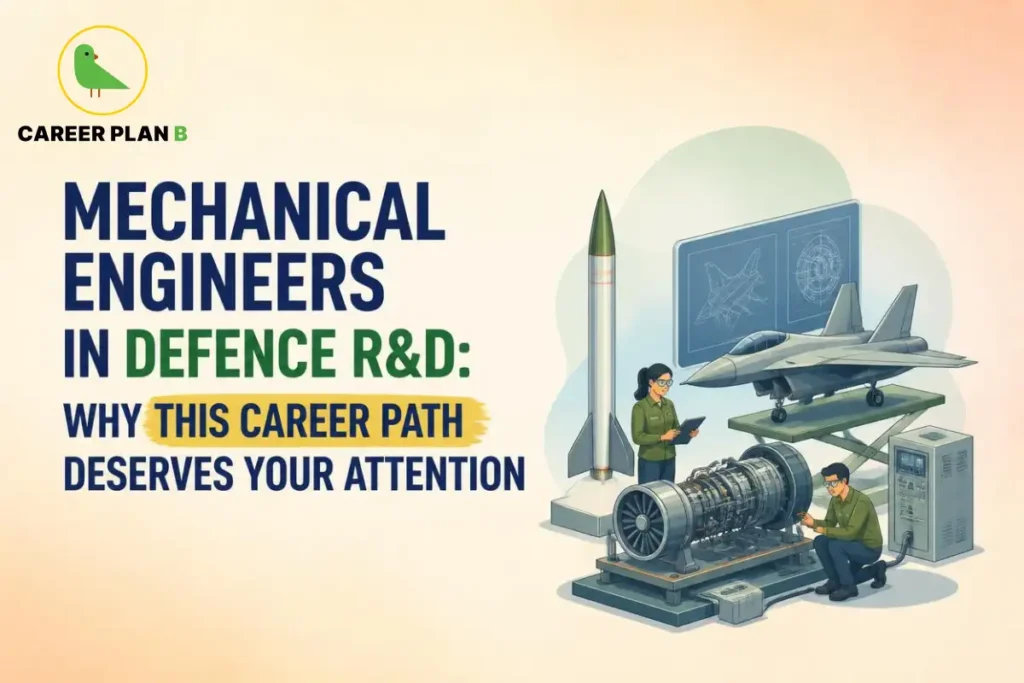
When most people hear “defence R&D,” they usually think of electronics or computer science. In reality, the field relies heavily on mechanical engineering. Mechanical engineering jobs in the defence sector cover a wide range of responsibilities. These include designing the aerodynamic structures of fighter jets and missiles, as well as developing propulsion systems for naval vessels and armoured fighting vehicles. Mechanical engineers in organisations like DRDO work on thermal management, structural analysis using FEA and ANSYS, materials testing, computational fluid dynamics (CFD), and precision manufacturing for defence-grade components. HAL employs mechanical engineers in aircraft design and MRO (maintenance, repair, and overhaul) operations. BEML focuses on heavy defence equipment and advanced mobility platforms. The work is highly technical, constantly evolving, and directly supports national security. It also offers a strong sense of purpose that few private-sector engineering roles can match.
Why India’s Defence Sector Needs Mechanical Engineers Now More Than Ever
India has set a target of achieving ₹1.75 lakh crore in defence production by 2025, with a significant portion driven by indigenous development. The Ministry of Defence’s Positive Indigenisation Lists have banned the import of hundreds of defence items, from artillery systems to military helicopters, pushing the responsibility of domestic production squarely onto Indian R&D organisations and PSUs. This is where defence research and development careers in India are seeing the sharpest growth. The PLI scheme for defence manufacturing, the establishment of two dedicated Defence Industrial Corridors in Uttar Pradesh and Tamil Nadu, and increased DRDO funding are all generating sustained demand for skilled mechanical engineers who can take an idea from concept to tested, field-ready hardware. This is not a short-term hiring spike; it is a structural, decade-long shift in how India builds and sustains its defence capabilities.
Career Growth Path Inside Defence R&D
Entry via GATE and DRDO CEPTAM
The most well-defined entry route into defence R&D for mechanical engineers is through GATE for defence sector jobs. A strong GATE score in Mechanical Engineering opens doors to DRDO’s Scientist B recruitment through RAC (Recruitment and Assessment Centre), which is the primary gateway for research-level roles. Additionally, DRDO CEPTAM recruits technical officers and technicians across various labs. Defence PSUs like HAL, BEL, BEML, and GRSE conduct their own written tests and interviews, often using GATE scores as the first filter. Clearing these exams demands focused preparation, but the reward is entry into one of the most intellectually stimulating environments an engineer can work in.
Progression from Scientist B to Distinguished Scientist
Once inside, mechanical engineer career growth in India’s defence sector follows a structured ladder. DRDO scientists begin at Scientist B and can progress through Scientist C, D, E, F, and G levels up to Distinguished Scientist and ultimately Scientific Adviser to the Raksha Mantri, the highest technical position in Indian defence. Each level brings increased research responsibility, team leadership, and compensation. Unlike many private sector roles where growth depends heavily on market conditions or management politics, defence R&D growth is merit- and seniority-based, with clearly defined timelines and appraisal processes. Scientists are also encouraged to pursue higher education, publish research, and file patents, all of which count toward career advancement.
Salary, Job Security, and Perks The Full Picture
Government engineering jobs in India are often underestimated when it comes to salary. However, the overall compensation package tells a different story. DRDO Scientist B roles start with a basic pay of approximately ₹56,100 per month under Pay Level 10 of the 7th Pay Commission. Employees also receive research allowances, house rent allowance (HRA), and transport allowance. As engineers progress, the salary increases significantly. Senior scientists at the Scientist F and G levels can earn between ₹1.2 lakh and ₹1.8 lakh per month in total emoluments. The benefits extend beyond salary. They include subsidised housing or HRA, comprehensive medical coverage for the family, strong job security, and retirement benefits under the National Pension System (NPS). For mechanical engineers seeking long-term stability and intellectually rewarding work, government defence careers offer an excellent combination of financial security and professional growth.
Top Organisations Hiring Mechanical Engineers in Defence
Here is a quick overview of the key organisations offering defence PSU careers for engineers with a mechanical background:
DRDO is India’s apex defence research organisation with over 50 labs working on missiles, aeronautics, armaments, and naval systems. Primary recruiter of research-level mechanical engineers.
HAL (Hindustan Aeronautics Limited) designs and manufactures military aircraft, helicopters, and aero engines. Strong demand for aerospace mechanical engineers.
BEML produces heavy defence equipment, including tanks, artillery platforms, and military vehicles.
BELBharat Electronics Limited Though electronics-focused, recruits mechanical engineers for systems integration, enclosure design, and manufacturing.
GRSE (Garden Reach Shipbuilders and Engineers) Builds naval vessels and warships, requiring mechanical engineers in hull design, propulsion, and marine systems.
The Ordnance Factory Board, now reorganised under seven Defence Public Sector Undertakings, recruits mechanical engineers for ammunition, weapons, and armoured vehicle production.
DRDO recruitment for mechanical engineers across these labs is announced through RAC and individual DRDO lab portals. Candidates should bookmark all official notifications.
Have Any Doubts?
Challenges You Should Know Before Choosing This Path
Intellectual honesty matters, so here are the trade-offs. Entry into defence R&D is genuinely competitive. GATE cutoffs for DRDO are high, and the selection process is rigorous. Postings can be to remote locations depending on the lab assignment, which may not suit everyone. Career progression, while structured, is slower compared to the fast-track growth some private sector roles offer in the first few years. The work environment is also more process-driven than a startup, which may feel restrictive to engineers who prefer rapid iteration. None of these are deal-breakers, but they are worth factoring into your decision before you commit to this path.
How Career Plan B Helps
Choosing a career in defence R&D involves more than just cracking GATE; it requires understanding which organisations suit your profile, which DRDO labs align with your mechanical specialisation, and how to build an academic and competitive profile that stands out. Career Plan B offers personalised one-on-one counselling for engineering students eyeing defence careers and psychometric assessments through Psycheintel to evaluate research aptitude and work-style fit and structured career roadmapping that maps your strengths directly to the right entry route, whether that is RAC, CEPTAM, or PSU recruitment.
For Latest Information
Frequently Asked Questions (FAQs)
1. Can mechanical engineers apply for DRDO scientist roles?
Yes. DRDO recruitment for mechanical engineers happens regularly through RAC. Mechanical Engineering is one of the core disciplines recruited at the Scientist B level. Candidates need a valid GATE score and a BE/BTech or ME/MTech in mechanical or related engineering branches.
2. Is GATE mandatory for defence PSU careers?
For DRDO scientist roles, GATE is the primary eligibility filter. For defence PSU careers for engineers at organisations like HAL, BEML, and GRSE, GATE scores are used in screening, though some PSUs also conduct independent written tests. A strong GATE score significantly improves selection chances across all routes.
3. What is the starting salary for a DRDO scientist B?
The basic pay starts at ₹56,100 per month under pay level 10 of the 7th Pay Commission, with additional allowances taking the gross monthly compensation to approximately ₹80,000 to ₹90,000 depending on posting location.
4. What specialisations within mechanical engineering are most relevant for defence R&D?
Thermal engineering, structural mechanics, aerospace propulsion, materials science, fluid dynamics, and manufacturing engineering are among the most directly applicable. Knowledge of tools like ANSYS, CATIA, SolidWorks, and CFD software adds strong value.
Conclusion
Mechanical engineers in defence R&D hold one of the most unique roles in today’s job market. The career is technically challenging, nationally significant, financially stable, and offers long-term growth. As India accelerates its indigenisation efforts and invests heavily in domestic defence manufacturing, the demand for skilled mechanical engineers will continue to rise. Opportunities are expanding across DRDO laboratories developing next-generation missiles and HAL facilities manufacturing fighter aircraft. The career path is structured, the opportunities are promising, and the work has a meaningful impact on national security. If you are a mechanical engineering student or professional considering this field, do not make your decision in isolation. Visit Career Plan B for expert guidance, career assessments, and a personalised roadmap that helps you enter India’s defence sector with clarity and confidence.