Deepti · July 17, 2026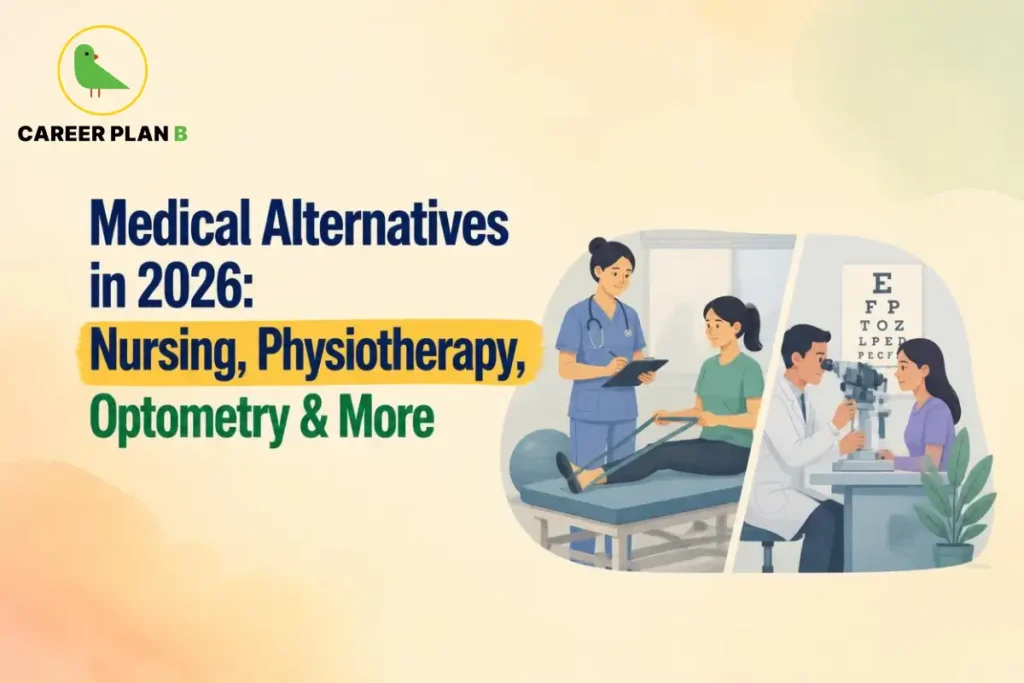
Introduction
Not securing an MBBS seat can feel like a closed door, but India’s healthcare sector offers genuinely rewarding, well-regulated career paths beyond MBBS. Medical alternatives in 2026 — nursing, physiotherapy, optometry, and several other allied health professions — now sit within a more organised regulatory framework than ever before, thanks to the National Commission for Allied and Healthcare Professions (NCAHP). This guide walks through the real options, their eligibility, and what makes 2026 a particularly relevant year to consider them.
Understanding India’s Healthcare Regulatory Landscape
Until recently, many allied health professions in India lacked a unified regulator, creating inconsistency in course standards and recognition. That changed significantly with the National Commission for Allied and Healthcare Professions (NCAHP) Act, 2021, which now organises the workforce into ten recognised category groups, covering professions ranging from physiotherapy to medical laboratory sciences. Meanwhile, nursing remains separately regulated by the Indian Nursing Council (INC), an autonomous body under the Ministry of Health and Family Welfare.
This growing regulatory structure means students choosing these paths in 2026 benefit from more standardised curricula and clearer registration pathways than earlier cohorts did.
BSc Nursing: The Established Route
Nursing remains one of the most stable, in-demand medical alternatives, regulated by the INC under the Indian Nursing Council Act, 1947.
Eligibility: A Class 12 pass in the Science stream (Physics, Chemistry, Biology, and English), with a minimum aggregate commonly around 45%–50% in the science subjects, though this varies by institution.
Admission route: Government college seats increasingly rely on NEET-UG qualification, while some premier institutions like AIIMS conduct their own separate nursing entrance exams. Several state governments also run their own nursing entrance processes.
Duration and structure: A four-year programme comprising classroom study, laboratory training, and a mandatory clinical internship, typically in the final year.
Physiotherapy (BPT): A Growing Specialisation
Physiotherapy trains students to help patients recover mobility and manage pain following injury, surgery, or chronic conditions — a field with steadily rising demand as India’s population ages.
Eligibility: A Class 12 pass in the Science stream with Physics, Chemistry, and Biology.
Regulatory update for 2026: Physiotherapy now falls under NCAHP’s regulatory framework, with the Bachelor of Physiotherapy (BPT) structured as a four-year programme with an additional mandatory internship year. NCAHP has been progressively notifying NEET-UG as an eligibility requirement for several allied health programmes, including BPT, from the 2026-27 academic session onward — students should verify the exact requirement for their specific target institution and admission year directly through NCAHP’s official notifications, since implementation timelines have been getting clarified in phases.
Optometry (B.Optom): An Often-Overlooked Option
Optometry focuses on eye care, vision correction, and management of vision-related conditions — a specialised, increasingly recognised allied health profession.
Eligibility: A Class 12 pass in the Science stream, with Physics, Chemistry, and Biology.
Structure: The Bachelor of Optometry (B.Optom) is generally a four-year programme with an additional internship year, now regulated under NCAHP’s notified curriculum framework.
Other Genuine Allied Healthcare Pathways
Beyond nursing, physiotherapy, and optometry, NCAHP’s ten recognised category groups also cover several other credible medical alternatives:
- Bachelor of Medical Laboratory Science (B.MLS), training students in diagnostic laboratory testing and analysis
- Bachelor of Occupational Therapy, focused on helping patients regain functional independence after injury or illness
- Bachelor of Medical Radiology and Imaging Technology (B.MRIT), covering diagnostic imaging techniques like X-rays and MRI
- Bachelor of Anaesthesia and Operation Theatre Technology (B.AOTT), supporting surgical and anaesthesia procedures
- Bachelor’s degree in Nutrition and Dietetics, focused on clinical and community nutrition guidance
- Emergency Medical Technology and Respiratory Technology programmes, both increasingly relevant given growing critical care demand
Each of these programmes has been notified with a competency-based curriculum under NCAHP, with eligibility criteria specified within each notified curriculum document — students should check NCAHP’s official notifications for their specific course before applying.
For Personalized Guidance
Why 2026 Is a Notable Year for These Options
Several factors make 2026 particularly relevant for students considering medical alternatives:
- NCAHP has notified competency-based curricula covering a wide range of allied health professions, implementable from the 2026-27 academic year, bringing more consistency to course quality across states
- NEET-UG is being progressively introduced as an eligibility requirement for several allied health courses, aligning admission standards more closely with MBBS and BDS
- Growing government focus on healthcare capacity, alongside the Ayushman Bharat Digital Mission’s push toward structured digital health systems, is creating sustained demand for trained allied health professionals
Comparing the Options
| Course | Typical Duration | Regulator | Best Suited For |
|---|---|---|---|
| BSc Nursing | 4 years + internship | Indian Nursing Council (INC) | Students interested in direct, hands-on patient care |
| BPT (Physiotherapy) | 4 years + internship | NCAHP | Students interested in rehabilitation and physical recovery |
| B.Optom (Optometry) | 4 years + internship | NCAHP | Students interested in specialised, focused clinical practice |
| B.MLS (Medical Lab Science) | 4 years | NCAHP | Students interested in diagnostics and laboratory-based work |
Source: National Commission for Allied and Healthcare Professions, Ministry of Health and Family Welfare
Career Scope After These Courses
Graduates across these fields can pursue roles such as:
- Staff Nurse or Nurse Practitioner, in government and private hospitals
- Physiotherapist, in hospitals, rehabilitation centres, and sports medicine settings
- Optometrist, in eye care clinics, hospitals, or independent practice
- Medical Laboratory Technologist, supporting diagnostic testing across hospitals and diagnostic chains
- Further specialisation through postgraduate study, opening doors to teaching, research, or advanced clinical roles
Government hospitals, private healthcare chains, diagnostic centres, and India’s expanding rehabilitation and elder-care sector are among the primary employers across these fields.
How Career Plan B Helps
Not securing an MBBS seat does not mean stepping away from a meaningful healthcare career. Career Plan B’s Personalised Career Counselling helps students understand which allied health pathway genuinely matches their interests and strengths, without treating these options as a lesser fallback. Psycheintel and career assessment tests clarify whether a student’s temperament suits direct patient care, diagnostics, or rehabilitation-focused work. With Admission and Academic Profile Guidance and Career Roadmapping, students can navigate NCAHP’s evolving eligibility requirements and plan the right entrance exam preparation confidently.
Get In Touch With Us
FAQs
Q1. Is NEET compulsory for all allied healthcare courses in 2026?
NCAHP has been progressively notifying NEET-UG as an eligibility requirement for several allied health programmes from the 2026-27 session onward, but exact implementation varies by course and institution, so always verify directly through NCAHP’s official notifications.
Q2. Which body regulates nursing education in India?
The Indian Nursing Council (INC), an autonomous body under the Ministry of Health and Family Welfare, regulates nursing education and practice across India.
Q3. Is physiotherapy a good alternative to MBBS?
Physiotherapy is a genuinely credible, in-demand healthcare career in its own right, particularly given India’s growing rehabilitation and elder-care needs, rather than merely a fallback option.
Q4. What is NCAHP, and why does it matter for these courses?
NCAHP is India’s regulatory body for allied and healthcare professions, established under the NCAHP Act, 2021, organising ten professional category groups and standardising curricula across previously less-regulated fields.
Q5. Can I pursue a master’s after these undergraduate allied health courses?
Yes, most of these fields offer postgraduate specialisation options, which open doors to advanced clinical roles, research, and academic careers.
Q6. What eligibility do I need for these courses after Class 12?
Most require a Class 12 pass in the Science stream with Physics, Chemistry, and Biology, with a minimum aggregate that varies by institution and course.
Conclusion
Medical alternatives in 2026 — nursing, physiotherapy, optometry, and several other NCAHP-regulated allied health professions — offer genuinely stable, meaningful career paths for students who didn’t secure an MBBS seat. With India’s healthcare regulatory framework maturing and demand for trained allied health professionals steadily growing, these options deserve serious consideration rather than being viewed as consolation choices. If you are exploring these paths and want clarity on eligibility and admission timelines, Career Plan B can help you plan the right route — because a fulfilling healthcare career takes many forms beyond a single entrance exam.