Team5 · August 7, 2026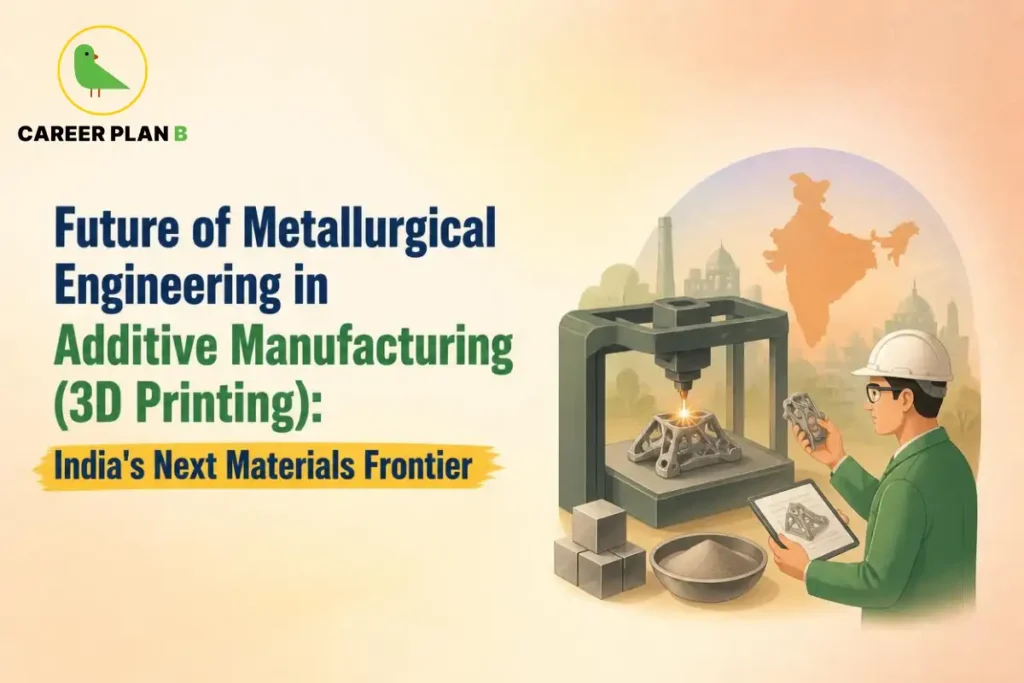
Introduction
DRDO and IIT Hyderabad recently unveiled one of India’s largest metal 3D printers. The system focuses on fabricating rocket components using advanced additive manufacturing techniques. At the same time, India’s national strategy aims to establish more than 50 dedicated additive manufacturing technology centres nationwide. These developments highlight the growing future of metallurgical engineering in additive manufacturing (3D printing). Yet, many metallurgy students haven’t fully explored this emerging field. They still associate metallurgy mainly with traditional processes such as casting, forging, and rolling. Metal 3D printing, however, introduces an entirely new set of materials science challenges. Metallurgical engineers can play a crucial role in solving them. This blog explores why metal 3D printing is fundamentally a metallurgical challenge. It also examines major Indian projects already underway and what this growing field could mean for your career.
Why Metal 3D Printing Is Fundamentally a Metallurgical Challenge
How Additive Manufacturing Changes a Metal’s Microstructure
Metal additive manufacturing builds components layer by layer using digital design data. This process fundamentally changes how a metal’s internal grain structure forms compared to traditional casting or forging.
The repeated melting and rapid solidification create unique microstructures, thermal stresses, and potential defects. These characteristics are rarely found in conventionally manufactured parts. Understanding and controlling them requires specialized metallurgical expertise. Consequently, metal 3D printing India-wide requires metallurgists who understand not just traditional material science but also the specific thermal and microstructural behaviour unique to additive processes.
India’s National Strategy on Additive Manufacturing
This isn’t a niche academic interest; it’s backed by serious national policy. In 2022, the Ministry of Electronics and Information Technology launched the National Strategy on Additive Manufacturing, aiming to position India as a global hub for 3D printing by establishing over 50 dedicated additive manufacturing technology centres across the country. This strategy explicitly emphasizes building an indigenous additive manufacturing ecosystem to reduce dependency on imported technologies, directly supporting adoption across aerospace, defence, and automotive sectors. Therefore, National Strategy on Additive Manufacturing funding isn’t just about printers and software; it fundamentally depends on metallurgists who can develop and qualify the metal powders and processes this ecosystem needs.
Real Indian Projects Putting Metallurgists to Work Right Now
DRDO’s LAAM System: India’s Largest Metal 3D Printer
This isn’t theoretical research happening overseas. Significant work is already underway in India. The DRDO-Industry-Academia Centre of Excellence at IIT Hyderabad, in collaboration with DRDO’s Defence Research and Development Laboratory, recently achieved a major milestone in large-area additive manufacturing. The team successfully fabricated a one-metre-tall rocket component using this system.
The indigenously designed machine features a build volume of 1 m × 1 m × 3 m. It uses powder-based directed energy deposition technology with dual heads for thermal balancing. This makes it one of the largest metal additive manufacturing machines in India. Achieving this milestone required a deep understanding of metallurgy. Researchers had to manage the thermal and structural behaviour of layer-by-layer metal deposition at an unprecedented scale.
DMRL’s Dedicated Metal Additive Manufacturing Research
Beyond this specific project, DRDO’s own official documentation confirms that its Defence Metallurgical Research Laboratory maintains dedicated additive manufacturing research specifically focused on manufacturing metal components using this technology. This sits alongside parallel work at DRDO’s Research Centre Imarat, which develops rapid prototype printing for missile components using metal, plastic, and composite materials. This confirms DRDO metallurgical research now formally treats additive manufacturing as a core competency area, not a peripheral experiment.
Where This Technology Is Scaling Fastest
Is this genuinely scaling into real industry demand, or does it remain confined to a few showcase government projects? The market data suggests genuine, accelerating growth. India’s 3D printing market in aerospace and defence specifically is projected to grow from USD 285.4 million in 2026 to USD 1,125.8 million by 2034, a compound annual growth rate exceeding 18 per cent, driven by rising aircraft production and additive manufacturing adoption growing over 22 per cent year-on-year across aerospace manufacturers.
ISRO and Hindustan Aeronautics Limited are actively integrating metal 3D printing for rocket components, brackets, and heat exchangers, while the Indian Army recently participated in the National Additive Manufacturing Symposium 2026, according to All India Radio, reinforcing collaborative innovation between government, industry, and academia to build a resilient, self-reliant manufacturing ecosystem. This breadth of adoption across space, aviation, and land forces confirms aerospace metallurgy jobs in this space represent genuine, structural demand rather than isolated experimentation.
What Metallurgists Actually Do in This Emerging Space
Powder Metallurgy and Feedstock Development
Metal additive manufacturing depends entirely on specially engineered metal powders with precise particle size, shape, and purity, since inconsistent feedstock directly causes defects in printed parts. Metallurgists working in this space develop and characterize these powders, often working with titanium alloys, Inconel superalloys, and other advanced materials specifically suited to aerospace applications requiring lightweight, heat-resistant, high-strength components.
Post-Processing, Heat Treatment, and Defect Analysis
Beyond the printing process, metal components typically require post-processing heat treatments. These treatments relieve internal stresses and help achieve the required mechanical properties. This work applies traditional metallurgical heat treatment expertise to a modern manufacturing process.
Metallurgists also perform defect analysis using techniques such as X-ray computed tomography. These methods detect internal porosity, cracks, and other defects. The inspections ensure that printed components meet the strict qualification standards required for aerospace and defence applications.
Have Any Doubts?
Skills Metallurgists Need to Enter This Field
Succeeding in this space requires understanding specific additive manufacturing processes like directed energy deposition and powder bed fusion, alongside traditional metallurgical fundamentals in phase transformations and microstructure analysis. Familiarity with qualification and certification standards becomes particularly important given how much this technology is scaling within aerospace and defence, sectors where component failure carries genuinely serious safety consequences. This combination of traditional metallurgical engineering scope and additive-specific process knowledge is precisely what makes this specialization genuinely valuable right now, since relatively few metallurgists currently possess both skill sets together.
Career Roles and Growth Path
| Career Stage | Typical Role | Where You Might Work |
|---|---|---|
| Entry-Level | Junior Materials Engineer (Additive Manufacturing) | DRDO labs, IIT-affiliated AM centres, aerospace suppliers |
| Mid-Level | Additive Manufacturing Process Engineer | ISRO, HAL, defence PSUs, private AM service providers |
| Senior-Level | Materials R&D Lead / AM Qualification Specialist | DMRL, large aerospace and defence manufacturers |
Given the aerospace and defence additive manufacturing market’s projected growth exceeding an 18 per cent CAGR through 2034, and given MeitY’s commitment to building over 50 dedicated AM tech centres nationwide, professionals who build genuine expertise at this intersection of metallurgy and additive manufacturing are positioned for strong, sustained demand across metallurgical engineering career opportunities in India.
How Career Plan B Helps
Career Plan B helps students explore emerging metallurgy careers like additive manufacturing through personalized guidance, assessments, and structured planning based on their interests, technical skills, and future career goals.
Personalized Career Counselling: Provides expert guidance to help students understand opportunities in additive manufacturing, metal 3D printing, aerospace materials, defence research, and advanced manufacturing industries based on their interests and career goals.
Psychometric & Career Assessment Tests: Helps identify students’ strengths, technical abilities, and suitable career paths by evaluating their aptitude for materials science, research, manufacturing technology, and innovation-driven engineering roles.
Career Roadmapping: Creates a step-by-step career plan covering specialization choices, skill development, internships, higher education options, and industry pathways for careers in additive manufacturing, metallurgy, and advanced materials engineering.
Admission & Academic Profile Guidance: Helps students select the right colleges, courses, and academic pathways while improving their profile for opportunities in DRDO, aerospace companies, research institutes, and advanced manufacturing sectors.
Get In Touch With Us
Frequently Asked Questions
- Is metal 3D printing really a metallurgical specialization?
Yes, since it requires deep understanding of how layer-by-layer melting and solidification affect a metal’s microstructure, properties, and potential defects, all core metallurgical concerns.
- Which Indian organizations are leading this work?
DRDO, IIT Hyderabad, ISRO, and Hindustan Aeronautics Limited are among the leading organizations actively developing and applying metal additive manufacturing technology in India.
- Which industries use metal additive manufacturing the most?
Aerospace and defence currently lead adoption, followed by growing use in automotive prototyping and medical implant manufacturing.
- Do I need additional certifications beyond a metallurgy degree?
Specialized knowledge of additive manufacturing processes and qualification standards significantly strengthens your profile beyond a standard metallurgical engineering degree alone.
- Is this a stable, long-term career direction?
Yes, backed by India’s National Strategy on Additive Manufacturing and a projected aerospace and defence market growth rate exceeding 18 per cent annually through 2034.
Conclusion
Understanding the Future of Metallurgical Engineering in Additive Manufacturing (3D Printing) makes it clear that this isn’t a passing technological trend; it’s a genuine, policy-backed materials science frontier requiring the exact kind of expertise metallurgists are trained to provide. As DRDO’s LAAM system continues advancing large-scale metal 3D printing and India’s broader additive manufacturing ecosystem scales toward the government’s 50-centre target, metallurgists who build genuine expertise in this space are positioned to play a central role in one of India’s most technologically ambitious manufacturing transformations. This represents a real opportunity for engineering students who want their materials science training to align directly with cutting-edge, high-growth technology rather than purely traditional manufacturing processes.
If you’d like help figuring out how to position yourself for this specific, emerging career direction, a conversation with a Career Plan B counsellor can help you plan the right path forward.