Team5 · August 7, 2026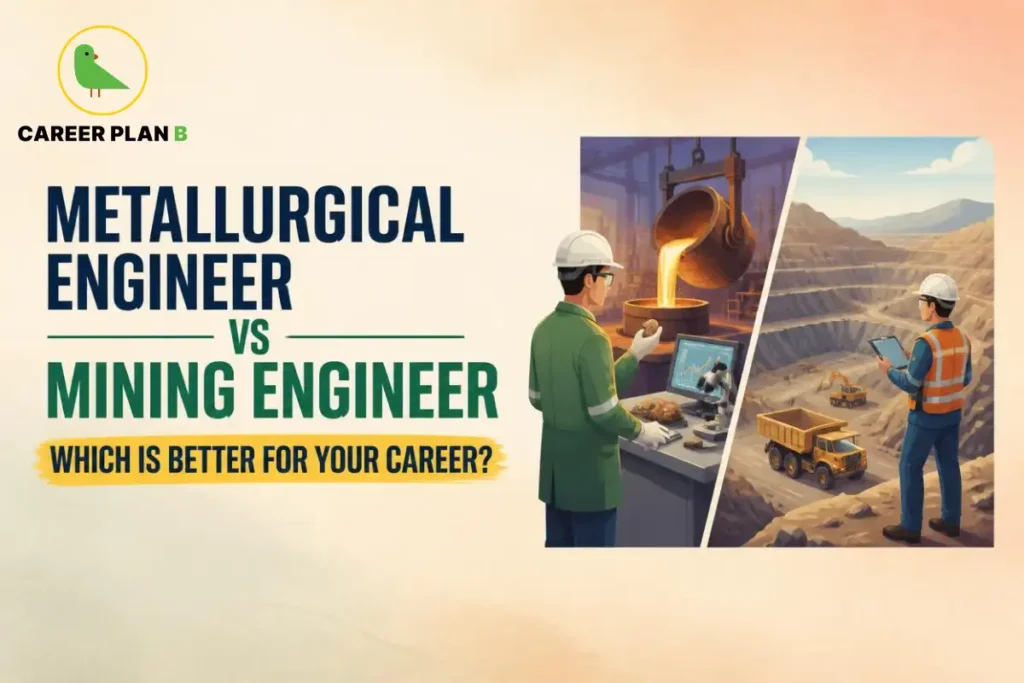
Introduction
Both these branches trace metals and minerals from the earth all the way to finished, usable products, yet they operate at genuinely different stages of that same value chain. This overlap is exactly why Metallurgical Engineer vs Mining Engineer: Which is Better? remains a common question among students, since both fields sound related and sometimes even get grouped together in college brochures and entrance exam listings. Many students confuse these branches simply because they both deal with “metals”, without realizing how differently their daily work, required skills, and career paths actually unfold. This blog breaks down both fields honestly, covering eligibility, scope, and salary in genuine depth, so you can choose with real clarity.
What’s the Core Difference Between These Two Branches?
Mining Engineering: Extracting Resources From the Earth
Mining engineering deals primarily with the identification, extraction, production, and processing of valuable minerals such as coal, petroleum, metallic, and non-metallic resources directly from the earth. This branch requires a genuinely broad knowledge base, spanning geology, mechanical and civil engineering, economics, management, and even law, since mining engineers oversee everything from exploration and feasibility studies to mine design and operational planning. Consequently, this mining engineering scope stays closely tied to the physical, on-site work of locating and extracting resources safely and sustainably.
Metallurgical Engineering: Transforming Raw Ore Into Usable Metal
Metallurgical engineering, by contrast, picks up essentially where mining leaves off, focusing on transforming raw ore, waste, and recycled materials into usable metals and alloys with specific desired properties. This branch studies extractive metallurgy, mineral processing, and the physical and chemical behaviour of metallic components, using tools like electron microscopes, X-ray machines, and spectrographs to analyze and improve materials. Therefore, a metallurgical engineering career India-wide centres more on laboratory-based materials science and processing than on the geological, site-based exploration work that defines mining engineering.
Which of These Two Paths Actually Suits You Better?
So how do you decide between these two closely linked but genuinely different branches? If you’re drawn to fieldwork, geology, and the challenge of locating and safely extracting resources from the earth, mining engineering offers exactly that hands-on, exploration-driven career. If you’re more interested in laboratory analysis, materials behaviour, and transforming raw metal into products with specific mechanical and chemical properties, metallurgical engineering is likely the stronger fit. Mining engineers spend considerable time on-site at mines and quarries, while metallurgical engineers typically split their time between labs, foundries, and production facilities, a meaningful difference in daily rhythm worth considering honestly before you commit to either path.
Eligibility and GATE Routes for Both Branches
Entry Requirements After Class 12
Both branches require Class 12 with Physics, Chemistry, and Mathematics, generally with a minimum of 50 to 60 per cent aggregate marks, followed by entrance exams like JEE Main or state-level equivalents such as WBJEE. Notably, some institutes admit mining engineering students purely on Class 12 board marks without a mandatory entrance exam, while metallurgical engineering eligibility typically follows the more standard JEE-based route, particularly for IITs and NITs.
Postgraduate Routes and GATE Competitiveness
For postgraduate specialization, both branches rely heavily on the Graduate Aptitude Test in Engineering, with mining engineering eligibility for M.Tech programmes requiring a valid GATE score alongside a relevant undergraduate degree. Programmes in both fields need approval from the All India Council for Technical Education (AICTE), the Government of India’s apex technical education regulator, and you can verify official exam details through the GATE official website, maintained by the IIT hosting the exam that year.
Career Scope: Where Each Path Actually Leads
Mining Engineering’s Core Industries
Mining engineers find substantial government sector opportunities since India’s mining industry remains heavily regulated and publicly managed, with organizations like Coal India Limited and various state mining corporations actively recruiting graduates. This mining engineering scope stays fairly concentrated around extraction-focused sectors, though it offers genuinely strong, stable government demand given India’s continued reliance on domestic coal and mineral resources.
Metallurgical Engineering’s Broader Industrial Spread
Metallurgical engineering, meanwhile, spreads across a considerably wider industrial base, including steel, automotive, aerospace, defence, energy, and increasingly, semiconductor and electronics manufacturing. Companies like Tata Steel, JSW, BHEL, ISRO, and Hindalco regularly recruit metallurgical graduates, alongside government bodies like SAIL, GAIL, and BARC that hire extensively through GATE scores. You can track official PSU recruitment activity through the Department of Public Enterprises, which oversees India’s central public sector undertakings, reflecting how this GATE PSU recruitment pathway remains genuinely strong across both branches, just concentrated in different specific sectors.
Have Any Doubts?
Salary Comparison: Metallurgical vs Mining Engineering
| Career Stage | Metallurgical Engineering | Mining Engineering |
|---|---|---|
| Entry-Level (Private) | INR 4 – 6 lakh | INR 3 – 5 lakh |
| Entry-Level (PSU/GATE) | INR 8 – 12 lakh | INR 8 – 9 lakh (M.Tech route) |
| Mid-Level | INR 7 – 10 lakh | INR 6 – 10 lakh |
| Senior-Level | INR 10 – 17+ lakh (managerial/research) | INR 10+ lakh (senior mine management) |
It’s worth noting honestly that both metallurgical engineer salary India and mining engineer salary India figures vary considerably across different sources since most job platforms pull from relatively small, self-reported samples. That said, metallurgical engineering does appear to show a somewhat wider senior-level ceiling, largely due to its access to a broader range of high-paying industries like aerospace and defence research.
Career Roles and Growth Path
| Career Stage | Metallurgical Engineer | Mining Engineer |
|---|---|---|
| Entry-Level | Graduate Engineer Trainee / Metallurgist | Junior Mining Engineer / Mine Planning Trainee |
| Mid-Level | Quality Control Engineer / Welding Engineer | Mine Planning Engineer / Operations Engineer |
| Senior-Level | Plant Equipment Engineer / Materials R&D Lead | Senior Mine Manager / Chief Mining Engineer |
How Career Plan B Helps
Career Plan B helps metallurgical and mining engineering students make informed career decisions by understanding their interests, skills, and suitable industry opportunities.
Personalized Career Counselling: Provides guidance on choosing between metallurgical engineering and mining engineering based on career goals, work preferences, and interest in areas like materials science, mining operations, research, or industrial roles.
Psychometric & Career Assessment Tests: Helps identify individual strengths, technical interests, and personality traits to determine whether a student is better suited for laboratory-based metallurgical careers or field-orientated mining engineering roles.
Career Roadmapping: Creates a structured career plan covering required skills, certifications, GATE preparation, internships, and specialization paths for building a successful career in metallurgy or mining.
Admission & Academic Profile Guidance: Helps students choose suitable colleges, engineering branches, postgraduate programmes, and academic pathways that improve their opportunities in metallurgical industries, mining sectors, and PSU recruitment.
Get In Touch With Us
Frequently Asked Questions
- Which is better, metallurgical or mining engineering?
Neither is objectively better metallurgical engineering offers broader industry access and lab-focused work, while mining engineering suits those drawn to fieldwork and resource extraction specifically.
- Can a mining engineer switch to metallurgical roles later?
It’s possible with additional specialization, though the two fields require genuinely different core skill sets, making a smooth lateral switch less common than transitions within the same branch.
- Which branch has more diverse industry options?
Metallurgical engineering offers considerably more diverse industry access, spanning steel, aerospace, defence, and electronics, compared to mining engineering’s more concentrated extraction-focused scope.
- Which branch has stronger government job security?
Both offer strong government demand mining engineering through Coal India and state mining corporations and metallurgical engineering through SAIL, BARC, and DRDO.
- Which branch involves more fieldwork versus lab work?
Mining engineering involves considerably more on-site fieldwork at mines and quarries, while metallurgical engineering leans more heavily toward laboratory and production-facility-based work.
Conclusion
Answering Metallurgical Engineer vs Mining Engineer: Which is Better? ultimately depends on whether you’re drawn to the fieldwork-heavy challenge of locating and extracting resources or the laboratory-based work of transforming raw materials into high-performance metals and alloys. Metallurgical engineering offers broader industry diversification and access to high-growth sectors like aerospace and semiconductors, while mining engineering provides genuinely stable, concentrated government demand tied directly to India’s resource extraction needs. Rather than choosing based on which branch sounds more traditional, it’s worth reflecting honestly on whether you’re more excited by geological exploration or materials science and processing.
If you’re still unsure which path fits you best, a conversation with a Career Plan B counsellor can help you weigh your genuine interests and aptitude clearly before you finalize your entrance exam choices.