Team5 · August 7, 2026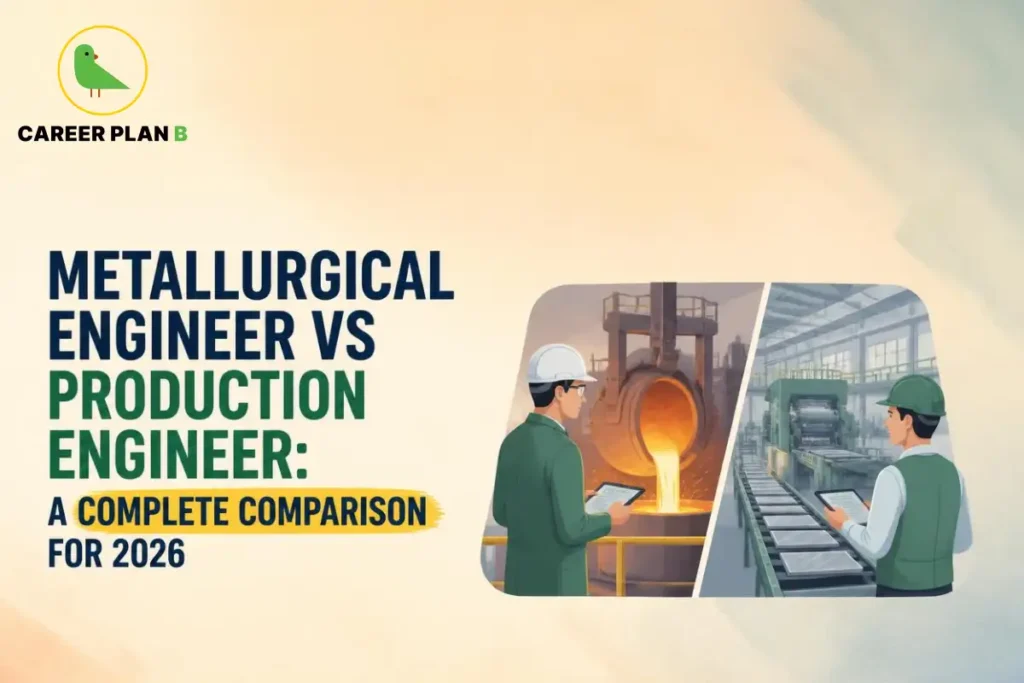
Introduction
Both these roles show up on the same factory floor, sometimes even within the same steel plant, yet they approach that floor from genuinely different angles. This overlap sits right at the heart of Metallurgical Engineer vs Production Engineer: Career Comparison, a question worth answering carefully since job titles in this space often blur together in confusing ways. Students frequently mix up these two branches, partly because metallurgical engineers sometimes work explicitly as “production metallurgists”, a title that sounds like it belongs to the other field entirely. This blog breaks down both roles honestly, covering eligibility, scope, and salary in genuine depth, so you can choose with real clarity.
What’s the Core Difference Between These Two Roles?
Metallurgical Engineer: Understanding and Improving the Material Itself
A metallurgical engineer focuses on understanding and improving the metal itself, studying its physical and chemical properties, extraction methods, and how different processing techniques change its performance characteristics. This role involves developing new alloys, refining metals for specific applications, and using tools like electron microscopes and spectrographs to analyze material behaviour at a fundamental level. Consequently, a metallurgical engineering career India-wide centres on the science of the material, asking what a metal is and how to make it better.
Production Engineer: Optimizing How That Material Becomes a Product
A production engineer, by contrast, focuses on the manufacturing process itself, optimizing how raw materials, including metals, get transformed into finished products efficiently and cost-effectively. This role concerns itself with production schedules, quality control systems, and process efficiency, treating the material as an input to a broader manufacturing workflow rather than the primary subject of study. Therefore, production engineering scope centres on the system and process surrounding material transformation, not the material’s underlying science itself.
Why the Line Between These Two Roles Sometimes Blurs
Is this distinction genuinely clear-cut in practice, or does it get messier at actual workplaces? The honest answer is that it does blur meaningfully. Within metallurgical engineering itself, one common career path is explicitly called “Production Metallurgist”, a role that oversees metal production processes, ensuring quality and efficiency, work that sounds remarkably similar to core production engineering. This happens because both roles ultimately serve the same manufacturing floor, just entering from different technical backgrounds, one trained deeply in materials science and the other trained broadly in process optimization and manufacturing systems.
Eligibility and GATE Routes for Both Branches
Entry Requirements After Class 12
Both branches require Class 12 with physics, chemistry, and mathematics, generally with a minimum of 50 to 60 per cent aggregate marks, followed by entrance exams like JEE Main or state-level equivalents such as UPSEE and BCECE. Metallurgical engineering eligibility typically follows the more standard JEE-based route for IITs and NITs, while production engineering programmes are offered more widely, including at a broader range of state and private institutions.
Postgraduate Routes and GATE Competitiveness
For postgraduate specialization, both branches rely on the Graduate Aptitude Test in Engineering, with metallurgical engineering candidates appearing for a dedicated metallurgical engineering paper, while production engineering candidates typically sit for the broader mechanical engineering GATE paper, which covers production and industrial engineering topics jointly. Programmes in both fields need approval from the All India Council for Technical Education (AICTE), the Government of India’s apex technical education regulator, and you can verify official exam details through the GATE official website, maintained by the IIT hosting the exam that year.
Career Scope: Where Each Path Actually Leads
Metallurgical Engineering’s Materials-Focused Industries
Metallurgical engineers find opportunities across iron and steel, non-ferrous metals, aerospace, defence, and increasingly, semiconductor and EV battery materials research. Companies like Tata Steel, Bharat Forge, and Hindustan Copper actively recruit for this branch, alongside government bodies like BARC, DRDO, and ISRO that value deep materials expertise for specialized, high-stakes applications.
Production Engineering’s Manufacturing-Wide Reach
Production engineers, meanwhile, find demand across a considerably wider set of manufacturing sectors, including automotive, electronics, and consumer goods, wherever efficient, cost-effective production processes matter. This production engineering career in India’s landscape benefits significantly from government initiatives like ‘Make in India’ and the Production Linked Incentive Scheme, which have strengthened domestic manufacturing capacity across multiple industries simultaneously. You can track official PSU recruitment activity for both branches through the Department of Public Enterprises, which oversees India’s central public sector undertakings.
Salary Comparison: Metallurgical vs Production Engineering
| Career Stage | Metallurgical Engineer | Production Engineer |
|---|---|---|
| Entry-Level (Private) | INR 3.5 – 6 lakh | INR 3 – 6 lakh |
| Entry-Level (PSU/GATE) | INR 5 – 17 lakh (varies by PSU) | INR 5 – 14 lakh |
| Mid-Level | INR 6 – 10 lakh | INR 7 – 12 lakh |
| Senior-Level | INR 10 – 20+ lakh (managerial/research) | INR 12 – 20+ lakh |
It’s worth noting honestly that both metallurgical engineer salary India and production engineer salary India figures vary considerably across different platforms since most rely on relatively small, self-reported samples that mix junior and senior professionals. That said, both branches show broadly comparable pay trajectories at similar experience levels, with the real differentiator being specific industry and sector rather than the branch itself.
Have Any Doubts?
Career Roles and Growth Path
| Career Stage | Metallurgical Engineer | Production Engineer |
|---|---|---|
| Entry-Level | Graduate Engineer Trainee / Metallurgist | Junior Production Engineer |
| Mid-Level | Production Metallurgist / Quality Control Engineer | Manufacturing Engineer / Process Engineer |
| Senior-Level | Senior Metallurgist / Materials R&D Lead | Plant Manager / Quality Head |
How Career Plan B Helps
Career Plan B helps students make informed career decisions between metallurgical engineering and production engineering by providing personalized guidance, assessments, and structured planning based on their interests, skills, and career goals.
Personalized Career Counselling: Provides expert guidance to help students choose between metallurgical engineering and production engineering based on their interests, preferred industries, and career goals in areas such as steel, automotive, manufacturing, aerospace, and advanced materials.
Psychometric & Career Assessment Tests: Helps identify strengths, technical preferences, and suitable career opportunities by evaluating whether students are better suited for materials-focused roles like metallurgy and research or process-focused roles in production and manufacturing.
Career Roadmapping: Creates a step-by-step career plan covering required skills, certifications, GATE preparation, internships, higher education options, and specialization areas to build a successful career in metallurgical or production engineering.
Admission & Academic Profile Guidance: Helps students select the right colleges, engineering branches, and academic pathways while improving their profiles for opportunities in GATE PSU recruitment, manufacturing industries, materials science, and production engineering roles.
Get In Touch With Us
Frequently Asked Questions
- Is a production metallurgist the same as a production engineer?
Not exactly. A production metallurgist is a metallurgical engineer specializing in overseeing metal production processes, while a production engineer has a broader manufacturing background applicable across many materials.
- Which branch pays more at the entry level?
Both branches show broadly comparable entry-level pay, with actual compensation depending more on the specific industry and employer than the branch itself.
- Which branch has broader industry access?
Production engineering generally offers broader access across automotive, electronics, and consumer goods manufacturing, while metallurgical engineering stays more concentrated around materials-intensive sectors.
- Can a metallurgical engineer work as a production engineer?
Yes, particularly in roles like production metallurgist, where deep materials knowledge combines directly with process oversight responsibilities.
- Which branch has less competition for GATE-PSU seats?
Metallurgical engineering generally sees less competition per seat, given fewer institutes offer this specialization compared to production engineering’s wider availability.
Conclusion
Answering Metallurgical Engineer vs Production Engineer: Career Comparison ultimately comes down to whether you’re drawn to understanding materials at a scientific level or to optimizing the broader manufacturing systems that turn those materials into finished products. Metallurgical engineering offers deep, specialized expertise concentrated in materials-intensive industries like steel, aerospace, and defence, while production engineering offers wider manufacturing access across a broader range of sectors. Rather than choosing based on which title sounds more technical, it’s worth reflecting honestly on whether you’re more drawn to the science of the material itself or the systems that transform it into a finished product.
If you’re still unsure which path fits you best, a conversation with a Career Plan B counsellor can help you weigh your genuine interests and aptitude clearly before you finalize your entrance exam choices.