Team5 · August 7, 2026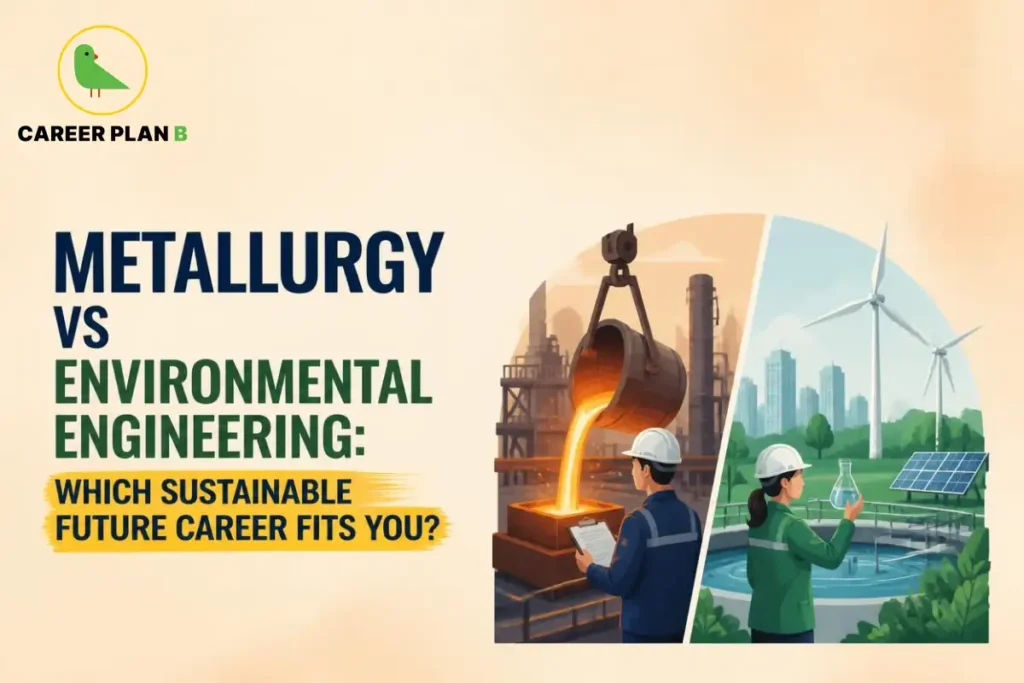
Introduction
Roughly 20 per cent of India’s workforce currently works in green occupations, and this figure is expected to double to 40 per cent by 2030, a genuinely dramatic shift that both these branches contribute to, just through very different technical approaches. This is exactly why Metallurgy vs Environmental Engineering: Sustainable Future Careers deserves a careful look, since students interested in sustainability tend to default toward environmental engineering, missing how directly metallurgy contributes through green metallurgy and circular economy work. Many students genuinely don’t realize that recycling metals, reducing extraction emissions, and building a circular materials economy are metallurgical challenges as much as environmental ones. This blog breaks down what each field actually contributes to a sustainable future, comparing scope, skills, and salary, so you can choose the path that genuinely fits you.
What Each Field Actually Contributes to a Sustainable Future
Environmental Engineering: Direct Ecological Protection
Environmental engineering approaches sustainability directly, designing systems that reduce pollution, treat contaminated water, manage waste, and assess ecological impact before industrial projects proceed. This branch sits at the very core of what most people picture when they think “green career”, since its entire foundation revolves around protecting ecosystems and public health from industrial side effects. Consequently, an environmental engineering career India-wide naturally aligns with government sustainability missions and regulatory compliance work from day one.
Metallurgy: Sustainable Materials Through Green Processing
Metallurgy, by contrast, contributes to sustainability through an entirely different mechanism, transforming how metals get extracted, processed, and reused throughout their entire lifecycle. Rather than protecting the environment from industrial impact after the fact, sustainable metallurgy works to reduce that impact at its source by replacing hazardous reagents, cutting fossil fuel consumption, and promoting circular economy practices within the metals industry itself. This means the metallurgical engineering scope contributes to sustainability from within the manufacturing process, rather than through external monitoring and compliance.
What Is Green Metallurgy, and Why Does It Matter?
Is metallurgy genuinely a sustainability-focused field, or is this just rebranding traditional metal work? The evidence suggests something genuinely substantive. Hydrometallurgy, which uses aqueous solutions to recover valuable metals from ores or recycled materials, significantly reduces energy consumption and pollutant emissions compared to conventional pyrometallurgy, operating at considerably lower temperatures with less environmental impact. This process also facilitates using secondary raw materials like electronic waste or industrial slag, directly contributing to circular economy practices within the metals sector. However, it’s worth being genuinely honest here: research published in Chemical Reviews notes that recycling metals isn’t automatically a clean technology; it can carry its own harmful and polluting effects if the recycling techniques themselves aren’t designed sustainably, meaning this field requires real technical rigour rather than assuming recycling is inherently virtuous.
Where Environmental Engineering’s Sustainability Work Concentrates
Environmental engineering’s sustainability contributions concentrate heavily around pollution control, water and waste management, and increasingly, ESG compliance work as companies face growing reporting obligations. India generates roughly 160,000 tonnes of waste daily, creating substantial demand for waste processing engineers and circular economy consultants who understand waste segregation technologies and material recovery, work that sits squarely within environmental engineering’s traditional domain. This concentration around regulatory compliance and public health protection remain this field’s core identity, even as it increasingly overlaps with the same circular economy themes metallurgy is now embracing.
Which of These Two Paths Actually Suits Your Sustainability Interests?
So how do you decide between these two genuinely different approaches to sustainability? If your interest centres on ecological protection, regulatory compliance, and direct environmental impact assessment, environmental engineering offers that focus more naturally. If you’re drawn to sustainability through materials science, understanding how different extraction and recycling processes affect environmental footprint at a chemical level, metallurgy’s green processing approach might align better with how you naturally think about problems. Neither path represents a lesser commitment to sustainability; they simply intervene at different points in the same broader environmental challenge.
Have Any Doubts?
Career Scope and Certifications That Matter for Both
Both branches benefit significantly from specialized sustainability certifications that strengthen a candidate’s profile. Credentials like ISO 14001 Environmental Auditor certification and EIA Professional certification suit environmental engineers well, particularly for compliance-focused roles requiring formal environmental impact assessment training. For metallurgists, expertise in hydrometallurgical recycling techniques and circular economy principles increasingly commands attention from companies scaling circular economy careers India-wide, particularly as critical mineral recycling receives growing government backing. Both paths also connect to India’s broader climate commitments, with the Ministry of Environment, Forest and Climate Change serving as the nodal agency coordinating the country’s net zero by 2070 strategy across sectors, including manufacturing and materials recovery.
Salary and Growth Comparison in Sustainable Careers
| Career Stage | Environmental Engineering (Green Roles) | Sustainable Metallurgy Roles |
|---|---|---|
| Entry-Level | INR 4.5 – 7 lakh | INR 3.5 – 6 lakh |
| Mid-Level | INR 8 – 18 lakh | INR 6 – 12 lakh |
| Senior-Level | INR 15 – 30+ lakh | INR 12 – 20+ lakh |
Overall, green jobs India-wide command competitive compensation, with entry-level positions across sustainability-focused roles generally ranging from ₹3.5 to 6 lakh annually and experienced professionals with 5 to 10 years of experience commanding ₹12 to 25 lakh, figures that broadly hold across both these fields’ green-focused specializations.
How Career Plan B Helps
Career Plan B helps students make informed decisions about sustainable engineering careers by providing personalized guidance, assessments, and structured career planning for fields like metallurgy and environmental engineering.
Personalized Career Counselling: Provides expert guidance to help students choose between metallurgical engineering and environmental engineering based on their interests, sustainability goals, technical strengths, and preferred career areas such as green metallurgy, waste management, environmental protection, and circular economy.
Psychometric & Career Assessment Tests: Helps identify students’ problem-solving abilities, career preferences, and aptitude to understand whether they are better suited for materials-focused sustainability roles, environmental management, research, or regulatory careers.
Career Roadmapping: Creates a step-by-step career plan covering engineering specialization, skill development, certifications, internships, higher education options, and career pathways in sustainable metallurgy, environmental engineering, and green industries.
Admission & Academic Profile Guidance: Helps students select the right courses, colleges, and specialization pathways while improving their academic profile for opportunities in sustainable manufacturing, environmental organisations, research institutions, and green technology sectors.
Get In Touch With Us
Frequently Asked Questions
- Is metallurgy actually a sustainable career or just environmental engineering?
Both genuinely qualify, since green metallurgy directly reduces environmental impact through cleaner processing and recycling, while environmental engineering focuses on ecological protection and compliance.
- What is green metallurgy?
It’s a set of technologies and practices aimed at reducing the environmental impact of metal production, using approaches like hydrometallurgy and circular economy principles.
- Which field has stronger green job growth in India?
Both are growing strongly, with India’s overall green workforce share expected to double from 20 to 40 per cent by 2030, benefiting both fields’ sustainability-focused roles.
- Is recycling metals always more sustainable than mining new ore?
Not automatically, recycling processes must themselves be designed sustainably, or they can carry their own harmful environmental effects despite reducing raw material extraction.
- Which certifications help for sustainable careers in these fields?
ISO 14001 and EIA Professional certifications suit environmental engineers, while hydrometallurgy and circular economy expertise strengthen metallurgists’ sustainability profiles.
Conclusion
Comparing Metallurgy vs Environmental Engineering: Sustainable Future Careers makes it clear that sustainability careers genuinely welcome both branches, just through fundamentally different technical approaches to the same underlying environmental challenges. Environmental engineering offers a more direct path into ecological protection and regulatory compliance work, while metallurgy contributes through green processing techniques and circular economy practices that reduce environmental impact at the source of material production. Rather than assuming only environmental engineering counts as a genuine green career, it’s worth reflecting honestly on whether your interest in sustainability leans more toward ecological protection or materials science and processing.
If you’re still unsure which path fits your genuine interests best, a conversation with a Career Plan B counsellor can help you weigh your options clearly before you commit to either direction.