Deepti · September 17, 2026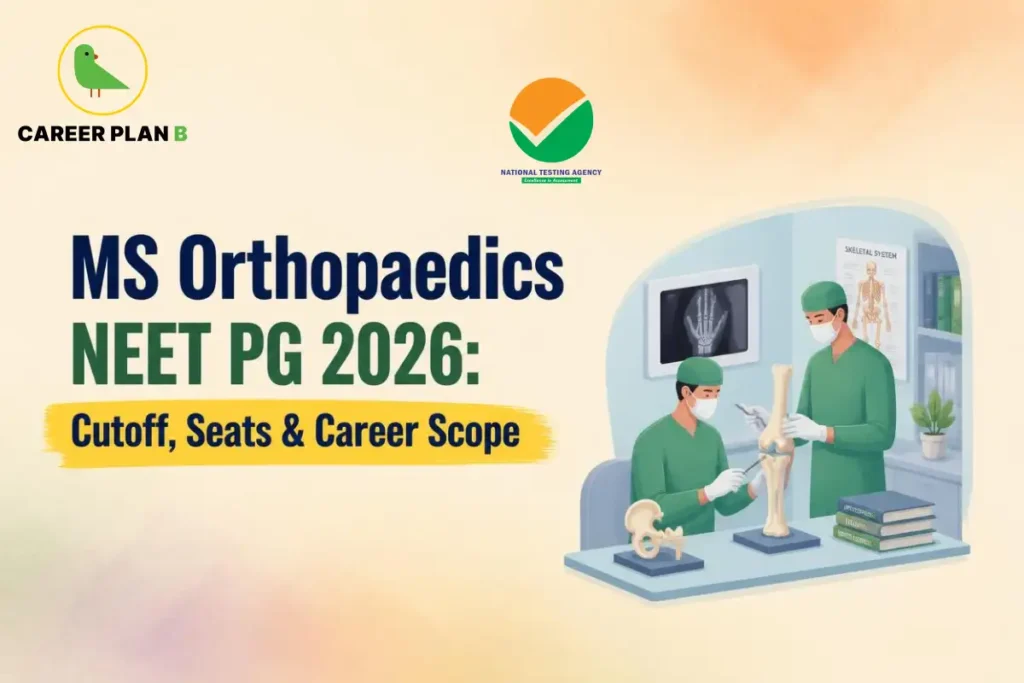
MS Orthopaedics through NEET PG 2026 opens one of India’s toughest, most rewarding surgical branches. Surgeons build careers in trauma care, joint replacement, and sports medicine after this degree. This guide breaks down cutoff trends, seats, fees, colleges, and career scope for every MS Orthopaedics aspirant.
What Is MS Orthopaedics?
MS Orthopaedics is a three-year postgraduate surgical degree. Doctors learn to diagnose, treat, and operate on bone, joint, muscle, and ligament disorders. The course covers trauma management, joint replacement surgery, paediatric orthopaedics, and sports injuries. Every candidate enters through NEET PG, the single national entrance exam for MD, MS, and PG Diploma seats; no state, private college, or university can run a separate entrance test for these programmes.
Eligibility for MS Orthopaedics NEET PG
Candidates need a recognised MBBS degree and a completed one-year internship. NBEMS fixed the internship deadline for NEET PG 2026 at September 30, 2026. No college grants direct entry into MS Orthopaedics; NEET PG remains mandatory for every seat except at AIIMS, PGIMER, JIPMER, NIMHANS, and SCTIMST, which admit through INI-CET instead.
MS Orthopaedics NEET PG Cutoff 2026: What to Expect
NBEMS conducted NEET PG 2026 on August 30, 2026. As of September 17, 2026, the result and official cutoff remain awaited; NBEMS has scheduled the result by September 30, 2026.
- The standard qualifying criteria set the entry gate to counselling at the 50th percentile for General/EWS, 45th for General-PH, and 40th for SC/ST/OBC.
- Authorities have revised percentiles downward in past cycles to fill vacant seats: on January 13, 2026, NBEMS cut the Round 3 qualifying percentile for NEET PG 2025-26 to 7th for General/EWS, 5th for General-PwBD, and 0th for SC/ST/OBC. Whether NEET PG 2026 sees a similar revision depends on how counselling progresses.
- The qualifying cutoff only opens the counselling gate. Your actual MS Orthopaedics seat depends on your rank against the branch-wise closing rank at each college, which varies by state, quota, category, and round.
- Closing rank example: In 2025 Round 2 counselling, government-college data for MS Orthopaedics showed the Open-category closing rank in Karnataka at 17,062, corresponding to 526 marks. Treat this as one state’s data point, not a national AIQ benchmark; different states and colleges close at very different ranks within the same round.
- Round-wise pattern: Round 1 usually closes at the sharpest ranks. Round 2 and Round 3 open up as candidates upgrade or resign seats, and mop-up or stray vacancy rounds can carry more relaxed cutoffs where seats remain vacant. This pattern holds broadly, but varies by college and category.
AIQ vs State Quota for MS Orthopaedics NEET PG
MCC conducts counselling for 50% All India Quota seats in participating government colleges, open to candidates from any state.
MCC also runs 100% counselling for deemed university seats and specified central institutions, so it isn’t limited to exactly half of every seat pool. State health departments run the remaining government college seats through state quota counselling, which usually needs state domicile or an MBBS degree from within that state. Private college seats generally go through state-level counselling too. Track both the MCC schedule and your state DME calendar for MS Orthopaedics.
For Personalized Guidance
MS Orthopaedics Seats in India: Government, Private, Deemed & DNB
NMC’s 2025-26 seat matrix reports 57,503 broad-specialty MD/MS/PG Diploma seats nationwide across government, private, and deemed colleges.
MS Orthopaedics is one of the largest surgical branches within this pool, alongside General Surgery and Obstetrics & Gynaecology, though sanctioned Orthopaedics seats change every cycle as NMC approves, renews, or withdraws intake at individual colleges after appeals and Letter of Permission approvals.
Check the current NMC seat matrix for the exact seat count during your admission year rather than relying on a fixed figure.
DNB Orthopaedics runs as a separate pathway administered by NBEMS, with its own seat matrix, counselling stream, and fee structure. It gives candidates who miss the MS cutoff a genuine second route into the same specialty, and Indian regulators treat DNB as equivalent to MS for practice and further training within India. Recognition abroad depends on the destination country’s own regulator, so don’t assume automatic acceptance overseas.
Maharashtra, Delhi, Uttar Pradesh, Tamil Nadu, and Karnataka lead the government PG seat count in India overall, which generally means more MS Orthopaedics seats concentrate in these states too.
MS Orthopaedics Fees: Government, Private & Deemed Colleges
Fees vary substantially by state, institution, and quota, so treat the following as indicative ranges, not fixed national rates:
- Government colleges (AIQ and state quota): commonly reported around Rs 50,000 to Rs 1.5 lakh per year
- Private medical colleges: commonly reported around Rs 18 lakh to Rs 50 lakh per year
- Deemed universities: commonly reported around Rs 20 lakh to Rs 60 lakh per year
Confirm the current fee notification for your shortlisted college before you finalise a choice.
Most institutes pay a stipend too. Kasturba Medical College Manipal, for instance, lists a monthly stipend of Rs 45,000 to Rs 55,000 for MS students on its official compliance page. Stipend amounts differ by college, so check each institute’s current notification directly.
MS Orthopaedics Colleges in India: Where to Apply
Well-known institutions with established orthopaedic departments include AIIMS Delhi, Maulana Azad Medical College, Grant Medical College Mumbai, King George’s Medical University, CMC Vellore, and KMC Manipal, among many others across the government, private, and deemed sectors. Check the current NMC or NBEMS seat listing for any shortlisted college, and weigh surgical case volume and faculty strength alongside reputation; hands-on operating experience shapes your surgical skill as much as the college name does.
Our detailed breakdown of PG courses after MBBS explains how MS Orthopaedics fits among other surgical and clinical branches, useful if you’re still weighing specialisations.
MS Orthopaedics Scope and Career After MBBS
Orthopaedic surgeons practise across a wide range of settings after MS. Career paths include:
- Trauma and fracture surgery in government and corporate hospitals
- Joint replacement (arthroplasty) for hip and knee surgery
- Spine surgery as an advanced sub-specialty track
- Sports medicine and arthroscopy for athletes and active patients
- Paediatric orthopaedics for congenital and growth-related conditions
- Academic and teaching roles at medical colleges
After MS Orthopaedics, many graduates pursue focused advanced training in spine surgery, arthroplasty, sports medicine, or paediatric orthopaedics. Depending on the sub-specialty, this can mean a fellowship, structured advanced clinical training, or a formal postgraduate pathway. KMC Manipal, for example, runs a one-year Spine Surgery fellowship open to MS and DNB Orthopaedics graduates. Our guide on NEET SS and super-specialisation walks through the broader NEET SS route for doctors weighing DM/MCh options.
MS Orthopaedics Salary After MBBS
Reported starting salaries for fresh orthopaedic surgeons vary widely, commonly cited around Rs 10 to 20 lakh per year in early hospital roles, with income rising alongside surgical case volume and experience. Treat any single figure as indicative, not a guarantee; actual pay depends on the employer, city, hospital type, and whether a surgeon works on salary or a revenue-sharing model. Orthopaedics is generally considered a relatively high-earning surgical speciality in India, driven partly by rising road trauma cases and an ageing population that needs joint replacements.
How Career Plan B Helps
Career Plan B guides MS Orthopaedics aspirants through NEET PG counselling with personalised career counselling, PsycheIntel and career assessment tests to confirm surgery fits your aptitude, admission and academic profile guidance for AIQ and state quota, and career roadmapping toward super-specialisation or private practice.
Get In Touch With Us
FAQs
Q1. When was NEET PG 2026 conducted, and when is the result?
NBEMS conducted NEET PG 2026 on August 30, 2026. NBEMS scheduled the result by September 30, 2026.
Q2. What is the MS Orthopedics NEET PG cutoff 2026?
NBEMS hasn’t released the official 2026 cutoff yet. Standard qualifying criteria stand at 50th percentile for General/EWS, 45th for General-PH, and 40th for SC/ST/OBC, though authorities have revised these downward in recent cycles.
Q3. How many MS Orthopedics seats exist across India?
MS Orthopaedics seats change every cycle as NMC approves or renews intake at individual colleges. Check the current NMC broad-specialty seat matrix for the exact sanctioned count during your admission year.
Q4. Is DNB Orthopaedics equal to MS Orthopaedics?
DNB Orthopaedics carries equivalent recognition to MS Orthopaedics for practice and further training within India. Admission runs through NBEMS with a separate seat matrix.
Q5. How much does MS Orthopaedics fee cost in private colleges?
Private MS Orthopaedics fees commonly range from roughly Rs 18 lakh to Rs 50 lakh per year. Confirm the current fee notification for your shortlisted college.
Q6. Does MS Orthopaedics offer good career scope after MBBS?
Yes, surgeons find demand in trauma care, joint replacement, sports medicine, and private practice, with earnings generally considered among the higher-paying surgical branches in India.
Conclusion
MS Orthopaedics through NEET PG 2026 rewards candidates who track the official cutoff, seat matrix, and college options as soon as NBEMS and MCC release them. Map your rank against last year’s closing ranks once your result is out, and shortlist government, private, and DNB options together. Talk to a Career Plan B counsellor to build your NEET PG 2026 strategy today.