Team Career Plan B · October 1, 2026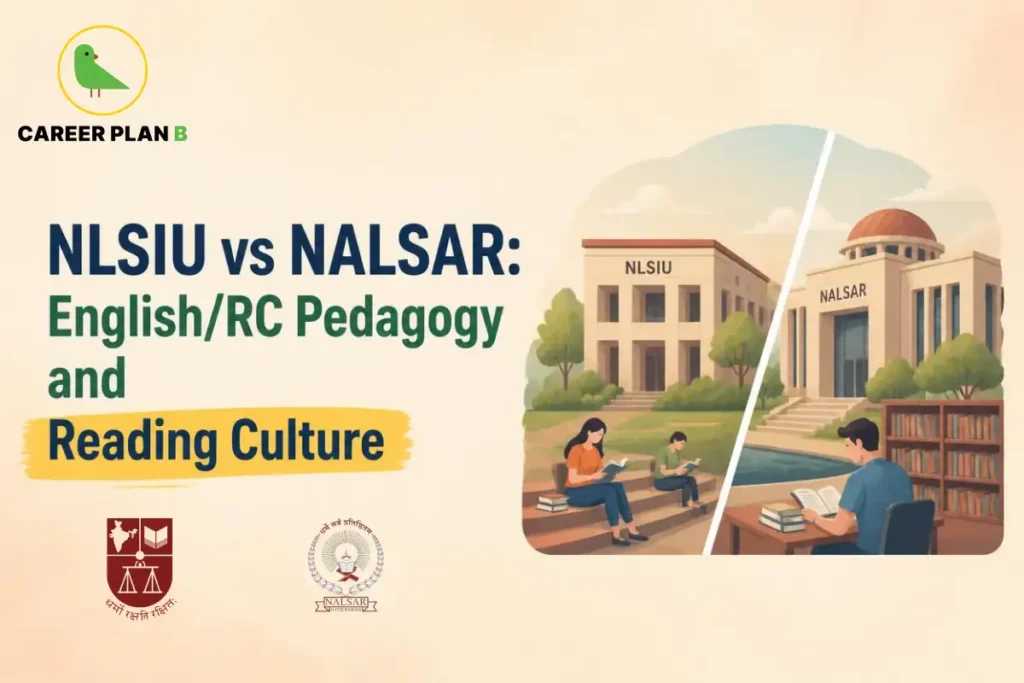
Introduction
Reading and writing are at the core of legal education, but law schools can develop these skills through very different academic structures. This makes NLSIU vs NALSAR an important comparison for CLAT aspirants considering two leading national law universities. NLSIU Bangalore, India’s first national law university, has strengthened its reading and writing culture through a dedicated Writing Centre designed to support academic reading, writing, and communication skills.
NALSAR Hyderabad, established in 1998, follows a different approach by integrating foundational English with History, Political Science, Economics, and Sociology during the first two years. Its extensive library, journals, electronic resources, and e-databases further support this interdisciplinary learning environment.
The key difference, therefore, lies in how each university structures its academic support. Does NLSIU’s dedicated, writing-focused approach provide a stronger environment for students who want structured support in reading and writing, or does NALSAR’s interdisciplinary foundation create a broader base for developing these skills? This comparison examines the pedagogy, curriculum structure, and reading culture at both institutions.
What Makes NLSIU’s Writing-Centred Pedagogy Different?
NLSIU Bangalore, established in 1987, has spent decades developing its integrated legal education model and has also extended this academic approach into its standalone BA (Hons) programme. According to the university’s official BA (Hons) programme page, the curriculum covers History, Sociology & Anthropology, Economics, and Politics, while also requiring students to develop written, oral, and digital communication skills as part of their academic training.
The Writing Centre and Reading Culture at NLSIU
A distinctive feature of NLSIU’s approach is The Writing Centre (TWC), a dedicated unit focused on developing students’ reading and writing abilities. According to the official NLSIU faculty recruitment notice, faculty associated with TWC conduct tutorials on academic reading and writing and provide individual feedback to students throughout the term.
This gives students structured support for developing academic reading and writing skills rather than leaving these abilities to emerge solely through regular coursework. The approach places explicit emphasis on helping students engage with academic material, communicate their ideas effectively, and strengthen their writing through ongoing feedback.
What Makes NALSAR’s Foundational English Approach Different?
NALSAR University of Law, founded in 1998 by an Act of the Andhra Pradesh State Legislature, structures its five-year integrated BA LLB (Hons) programme around a distinctly interdisciplinary foundation. Instead of relying on a separate writing-focused unit, NALSAR integrates English into its foundational curriculum alongside History, Political Science, Economics, and Sociology during the first two years.
This structure connects language development with broader social science learning, giving students an opportunity to engage with different disciplines as part of their early legal education.
Seminar Courses and Library Resources at NALSAR
According to the official NALSAR programmes information, foundational courses in these disciplines lead into interdisciplinary electives and seminar courses later in the degree. This gives students opportunities to explore specific areas in greater depth.
NALSAR’s library resources further support this academic structure. The university’s brochure describes a collection of books, journals, printed and electronic resources, and e-databases. These resources provide students with substantial material for research and reading, particularly as they progress toward seminar-based coursework.
Overall, NLSIU places greater structural emphasis on dedicated reading and writing support, while NALSAR integrates English and reading into a broader interdisciplinary academic foundation.
For Personalized Guidance
NLSIU vs NALSAR: A Side-by-Side Comparison
| Factor | NLSIU Bangalore | NALSAR Hyderabad |
|---|---|---|
| Reading/Writing Structure | Dedicated Writing Centre (TWC) | English embedded in foundational first two years |
| Curriculum Approach | Major-minor BA (Hons) with communication focus | Interdisciplinary foundation leading to seminar electives |
| Library Resources | University library and archives | Extensive printed/electronic journals and e-databases |
| Entrance Route | CLAT (UG and PG) | CLAT (UG and PG) |
| Founded | 1987 | 1998 |
Dedicated Writing Support or Interdisciplinary Foundation: Which Builds a Stronger Reading Culture?
This is really the heart of the NLSIU vs NALSAR comparison. If you want structured, one-on-one support for developing academic reading and writing skills, NLSIU’s Writing Centre offers something genuinely distinctive, with dedicated faculty leading tutorials and providing individual feedback throughout each term. If, on the other hand, you prefer a broader interdisciplinary foundation, where English sits alongside history, economics, sociology, and political science before flowing into specialised seminar courses, NALSAR’s structure builds reading culture more organically across multiple disciplines. Neither approach is inherently better; the right fit depends on whether you want dedicated writing mentorship or a wider, subject-integrated reading foundation.
How Seminar Courses Shape Reading Habits at Both Universities
Both institutions lean heavily on seminar-style teaching to deepen reading engagement beyond standard lectures. NALSAR’s elective and seminar courses, as detailed in its official brochure, allow students to benefit from ongoing faculty research while developing focused reading habits in specific legal areas. NLSIU’s approach, particularly through its history major-minor track, similarly emphasises research skills and critical engagement with sources, though it channels this more explicitly through its dedicated Writing Centre rather than through elective breadth alone. Therefore, students at either university should expect substantial reading loads, just structured through slightly different institutional mechanisms.
How Career Plan B Helps
Choosing between NLSIU’s structured writing support system and NALSAR’s interdisciplinary reading-based approach depends on how you learn and develop legal skills. Career Plan B helps CLAT aspirants make the right choice through personalised guidance.
Personalised Career Counselling: Helps students understand whether a writing-focused academic environment or a broader interdisciplinary legal education style matches their learning goals.
Psychometric & Career Assessment Tests: Helps identify strengths in reading, analysis, communication, and research to choose the right law school environment.
Career Roadmapping: Helps create a step-by-step plan for law school preparation, skill development, internships, and future legal career paths.
Admission & Academic Profile Guidance: Helps compare NLSIU and NALSAR based on curriculum structure, teaching approach, academic culture, and CLAT admission strategy.
Get In Touch With Us
Frequently Asked Questions
Q1. Which entrance exam applies to both NLSIU and NALSAR?
Both universities admit undergraduate and postgraduate law students through CLAT.
Q2. What is NLSIU’s Writing Centre?
The Writing Centre (TWC) is a dedicated unit at NLSIU responsible for developing course curricula, leading tutorials on academic reading and writing, and providing individual student feedback.
Q3. Does NALSAR include English as part of its core curriculum?
Yes. According to NALSAR’s official CLAT brochure, foundational courses in English are offered alongside history, political science, economics, and sociology during the first two years.
Q4. Which university is older?
NLSIU, established in 1987, is older than NALSAR, which was founded in 1998.
Q5. Where can I check official details on NLSIU’s BA (Hons) curriculum?
Refer to the official NLSIU BA (Hons) programme page.
Q6. Where can I check official details on NALSAR’s curriculum and library resources?
Refer to the official NALSAR CLAT 2025 Brochure.
Conclusion
Weighing NLSIU vs NALSAR on English pedagogy and reading culture ultimately comes down to how you want that reading foundation built. NLSIU offers a genuinely structured approach through its dedicated Writing Centre, giving students consistent, individualised support for academic reading and writing throughout their degrees. NALSAR, meanwhile, builds its reading culture more organically, embedding English within a broader interdisciplinary foundation that flows into seminar-based electives backed by extensive library resources. Both remain among India’s most competitive CLAT-admitting NLUs, so the deciding factor really comes down to whether you prefer dedicated writing mentorship or a wider, subject-integrated reading environment. Before applying, check the official curriculum pages of both universities directly, since programme structures are updated each academic cycle.
And if you’re still weighing which pedagogical approach fits your learning style, Career Plan B can help you think it through with guidance built around your own strengths.