Careerplanb · July 29, 2026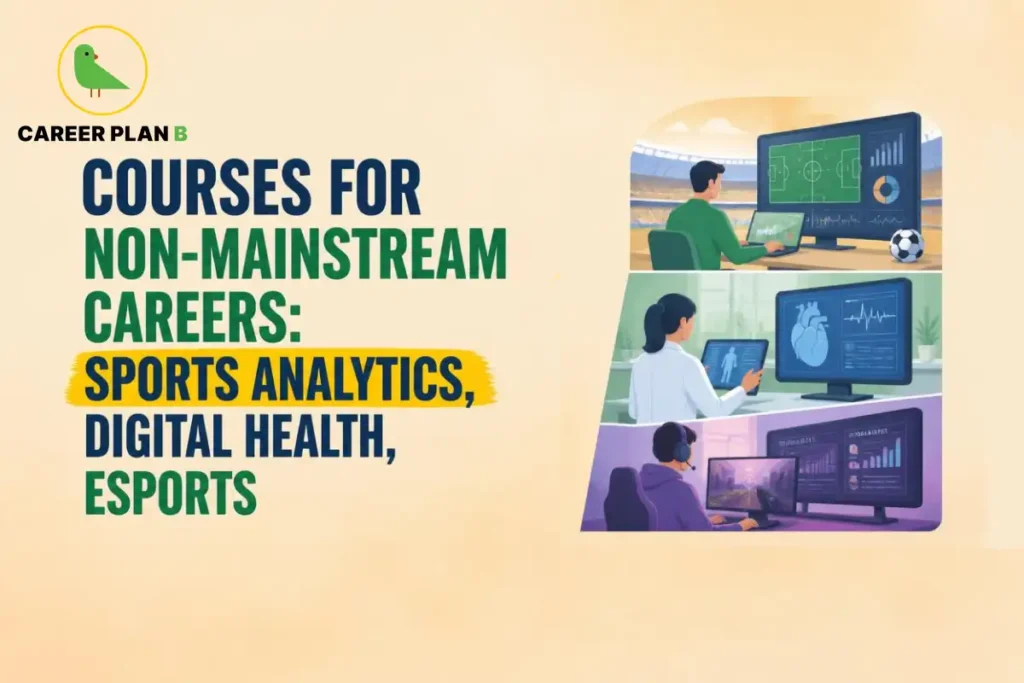
Introduction
Not every rewarding career starts with “engineer,” “doctor,” or “chartered accountant.” Non mainstream career courses are quietly building real, well-paying career tracks in spaces that barely existed a decade ago — analysing cricket data for an IPL franchise, managing digital health records for a hospital chain, or running tournament logistics for a professional esports team.
This guide looks at three of the fastest-growing non-mainstream fields in 2026 — sports analytics, digital health, and esports — covering the courses available, what these careers actually involve, and where they can take you. Whether you’re a student exploring unconventional paths, a working professional considering a pivot, or a parent trying to understand these newer fields, here’s a grounded, practical breakdown.
Why Are Non-Mainstream Careers Gaining Real Traction?
Here’s a question worth sitting with: what if the career with the best growth trajectory over the next decade isn’t the most familiar one, but the one riding an industry that’s expanding faster than traditional sectors? That’s exactly the story playing out across sports analytics, digital health, and esports right now.
The numbers back this up clearly. India’s sports market is expected to reach $130 billion by 2030, growing at a CAGR of 14% — a pace likely to outstrip many more traditional industries. Meanwhile, India’s esports market is projected to cross ₹2,000 crore by 2026, with the government having formally recognised esports under the Ministry of Youth Affairs and Sports, giving the sector real institutional legitimacy.
Sports Analytics: Courses and Career Paths
Let’s start with the field turning raw game data into strategic decisions.
What Sports Analytics Actually Involves
It’s broader than just crunching player stats. Sports professionals in this space interpret complex data sets to provide insights into player performance, game strategies, and audience preferences, while also gathering performance and health metrics from wearables, video feeds, and sensors to optimise training.
Courses to Consider
Sports analytics education in India ranges from short certificate programs to full-fledged degrees. Options include dedicated Sports Management and Analytics courses covering strategic sports management, data-driven decision making, and performance analytics, alongside university-level options like a BBA in Sports Management, which blends core business subjects with specialised sports topics.
Career Roles and What They Pay
The field offers a genuine range of entry points. Roles span Sports Data Analyst, Athlete Performance Analyst, Sports Scout/Talent Analyst, and Sports Technology Specialist, with entry-level salaries in India’s broader sports industry typically ranging from ₹3–6 LPA, rising to ₹15–25 LPA with experience.
Where the Field Is Headed
Growth isn’t limited to teams and leagues anymore. Analytics roles are expanding beyond sports teams into sports marketing, media, and healthcare, broadening career prospects considerably and colleges, betting and fantasy platforms, and youth development programs are all now active employers in this space too.
For Personalized Guidance
Digital Health: Courses and Career Paths
Next, a field sitting squarely at the intersection of healthcare and technology.
What Digital Health Careers Actually Involve
This space covers a wide technological range. Digital health encompasses electronic health records, telemedicine, wearable devices, mobile health apps, and health informatics — technologies with real potential to improve patient outcomes and reduce healthcare costs.
Courses to Consider
Multiple structured pathways now exist for entering this field. Options include a Postgraduate Diploma in Digital Health covering health policies, economics, healthcare informatics, and AI/machine learning applications in medicine, as well as dedicated Health Informatics certificate courses designed for students from computing, science, engineering, business, or healthcare backgrounds.
Notably, this field is also increasingly collaborative at an institutional level — UNICEF India, IIHMR Delhi, and IIT Bombay jointly launched a Digital Health Enterprise Planning Course aimed at equipping doctors, nurses, pharmacists, and healthcare administrators with digital transformation skills.
Career Roles and What They Pay
The role diversity here is genuinely wide. Career paths include Health Data Analyst, Telemedicine Specialist, Health Informatics Specialist, and Digital Health Product Manager, with salary ranges for health informatics specialists in India spanning roughly ₹5–10 LPA at entry level, climbing to ₹15–45 LPA at senior, specialised levels with advanced qualifications.
Why This Field Is Growing So Fast
The infrastructure driving this growth is substantial and government-backed. The Ayushman Bharat Digital Mission (ABDM) is a national initiative promoting a digital health ecosystem, including components like the ABHA Health ID and Health Facility Registry — creating sustained institutional demand for digital health professionals across the public and private sectors.
Suggested blog:- Animation, Gaming & E-Sports: Turning Passion Into a Thriving Career
Esports: Courses and Career Paths
Finally, a field most people still associate only with professional players — but the real opportunity lies elsewhere.
The Biggest Misconception About Esports Careers
This is worth stating clearly upfront. The majority of jobs in esports have nothing to do with being a professional player — for every player on a team, there is a coach, an analyst, a team manager, a tournament organiser, a broadcast team member, and a content creator, all part of a much larger workforce behind the scenes.
Real Career Roles Beyond Pro Gaming
The role diversity in Indian esports has expanded considerably. Career paths now include Coaches and Analysts, Shoutcasters and Broadcasters, Tournament/Event Managers, Content Creators, and Team Managers or Agents each representing a distinct, structured career track within the industry.
What These Roles Actually Pay
Compensation varies significantly by role and seniority, but it’s genuinely viable as a career. Data analyst roles in esports pay roughly ₹25,000–60,000 per month at semi-professional level, rising to ₹60,000–1,20,000 monthly at professional organisations figures that reflect a maturing, salaried industry rather than a hobbyist space.
How to Actually Break In
Unlike more traditional fields, esports rewards demonstrated ability over formal credentials. A coach starts by coaching, an analyst starts by posting analytical content, and a tournament manager starts by running a small tournament — showing up in the ecosystem and building visible, real work is often more valuable than any single course or certificate.
Quick Comparison Table
| Factor | VIT Bhopal (AI) | Shobhit University (IoT) |
|---|---|---|
| Core focus | Machine learning, data science, cognitive computing | Sensors, embedded systems, connected devices |
| Entrance exam | VITEEE | SUNET |
| Annual specialisation fee | Tiered by VITEEE rank, tuition portion | Approximately ₹1,80,000 per annum |
| Ideal for students who | Enjoy algorithms, data, and abstract problem solving | Enjoy hardware, networks, and tangible builds |
| Common career roles | ML engineer, AI researcher, data scientist | IoT engineer, embedded systems developer, solutions architect |
Is a Non-Mainstream Career Right for You?
With three genuinely different fields on the table, how do you know which — if any — suits you? A few honest questions can help:
- Are you drawn to data and pattern recognition? Both sports analytics and digital health reward strong analytical thinking, statistics, and data visualisation skills.
- Do you want a role rooted in healthcare, but with a tech-forward edge? Digital health specifically suits students or professionals with a healthcare or IT background who want to work at that intersection.
- Are you comfortable building a career through visible, demonstrated work rather than formal credentials alone? Esports, in particular, rewards this approach far more than traditional hiring pipelines do.
- Would you rather work within an established, structured industry or a still-forming one? Sports analytics and digital health have more institutional structure currently, while esports remains younger and more flexible, but potentially higher-risk.
How Career Plan B Helps
Deciding whether a non-mainstream career like sports analytics, digital health, or esports is right for you and which specific course or entry point actually fits your background isn’t something to figure out through guesswork. This is where Career Plan B can help by offering:
- Personalised Career Counselling: Provides expert guidance based on individual interests, skills, and career goals — helping you decide between sports analytics, digital health, esports, or a more traditional career path.
- Psychometric & Career Assessment Tests: Identifies strengths, personality traits, and suitable career opportunities, so you know whether analytical, healthcare-tech, or community-driven creative work suits you best.
- Career Roadmapping: Creates a clear step-by-step plan to achieve academic and professional goals, including which certifications or degrees genuinely matter for each of these fields.
- Admission & Academic Profile Guidance: Helps in selecting the right courses and colleges and improving academic profiles for competitive admissions into sports management, health informatics, and related emerging-field programs.
Get In Touch With Us
Frequently Asked Questions
1. Do I need an engineering or science background for sports analytics or digital health careers?
Not necessarily. Sports analytics welcomes students from Management, Commerce, Arts, or Engineering backgrounds, while digital health courses are designed for students from computing, science, business, or healthcare backgrounds alike.
2. Is esports a financially stable career, or just for hobbyists?
It’s increasingly stable for structured roles. Companies like NODWIN Gaming and Skyesports are real employers with payroll and HR departments, and non-playing roles like analysts, managers, and content creators offer defined career ladders.
3. What is the fastest way to break into sports analytics?
A formal course, like a BBA in Sports Management or a dedicated analytics certification, combined with hands-on projects and internships, tends to be the most reliable entry point, especially since employers increasingly value demonstrated project work.
4. Are digital health certifications recognised by employers in India?
Yes, particularly those from established institutions or backed by government-aligned initiatives like ABDM. Certifications in health informatics and digital health are increasingly valued by hospitals, healthcare IT companies, and telemedicine platforms.
5. Can I transition into these fields from an unrelated career?
Yes, all three fields are commonly used by working professionals as pivot points — sports analytics and digital health both explicitly welcome career-changers, while esports similarly rewards newly demonstrated skills over prior formal experience.
Conclusion
Non mainstream career courses in sports analytics, digital health, and esports represent genuine, structured alternatives to the traditional career race — each backed by real market growth, defined roles, and increasingly credible educational pathways. These aren’t fallback options; they’re fast-growing industries actively hiring for skills that didn’t have formal career tracks even a few years ago.
What matters most is choosing the field that matches your actual interests and working style, not just the appeal of doing something different from the mainstream. With the right guidance, students, professionals, and parents can approach these emerging fields with real clarity and confidence. Curious whether one of these non-mainstream paths is right for you? Talk to a Career Plan B counsellor today and build a plan around your genuine strengths and interests.