Team Career Plan B · July 18, 2026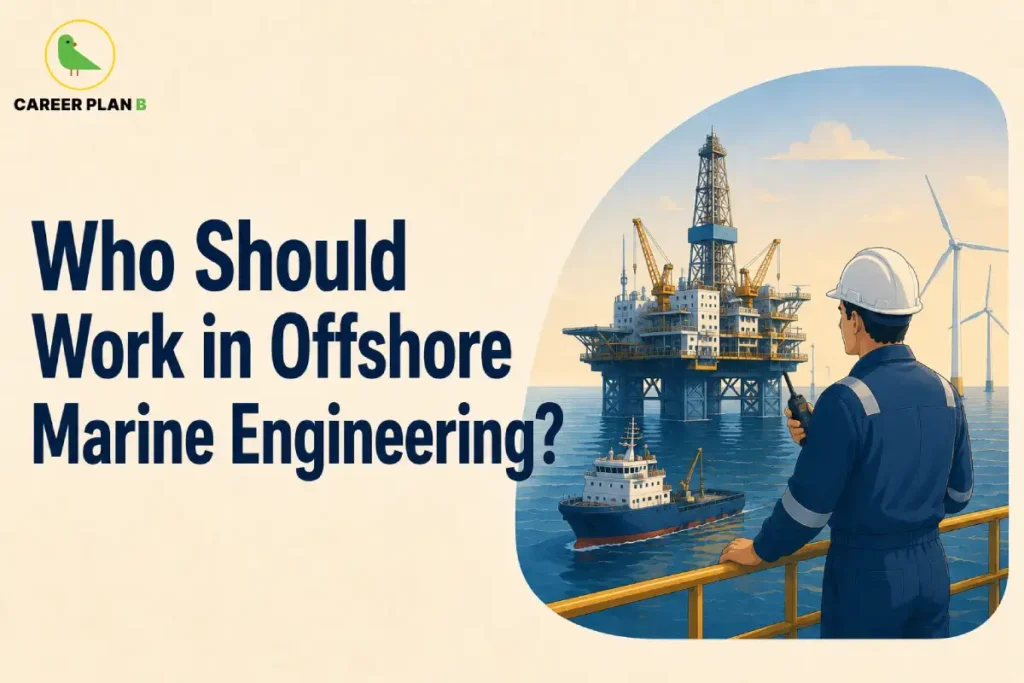
Introduction
Offshore work often gets portrayed as an adventurous, high-paying career, with images of massive platforms in the middle of the ocean and a lifestyle far removed from the ordinary nine-to-five. There’s truth to that image, but it’s only part of the story. Before deciding whether this path is right for you, it’s worth honestly asking: who should work in offshore marine engineering? This isn’t a career that suits every personality or lifestyle preference, and understanding what the work actually involves, day to day, is essential before committing to it. This blog takes a detailed, honest look at what offshore roles require, who tends to thrive in them, and how they compare to more traditional onboard marine engineering positions.
What Does Offshore Marine Engineering Actually Involve?
Offshore marine engineering typically involves working on platforms or rigs located in the middle of the sea, historically associated with oil and gas extraction, though increasingly expanding into areas like offshore renewable energy as India’s blue economy strategy develops. The work itself centres on maintaining and operating heavy machinery, power generation systems, and safety-critical equipment, often in a far more isolated and self-contained environment than a moving vessel. Unlike onboard roles where engineers travel between ports, offshore engineers typically remain stationed at a fixed location for extended periods, working alongside a relatively small, tightly knit team responsible for keeping the entire platform running safely.
Who Tends to Thrive in Offshore Roles?
Given how specific this work environment is, certain personality traits and preferences tend to predict success far more reliably than technical skill alone.
Those Comfortable with Extended Isolation
Offshore platforms are, by nature, remote and disconnected from everyday life. Engineers who genuinely don’t mind extended periods away from family, with limited internet or phone access depending on the platform’s location, tend to adapt far better than those who struggle with isolation.
People Who Handle High-Pressure, Safety-Critical Situations Well
Offshore environments involve significant safety risks, given the combination of heavy machinery, confined spaces, and remote locations where emergency response takes longer than it would onshore. Engineers who remain calm and think clearly under pressure, rather than becoming overwhelmed, are far better suited to this kind of high-stakes environment.
Individuals with Strong Physical and Mental Resilience
The physical demands of offshore work, including exposure to noise, weather conditions, and demanding shift patterns, require genuine physical stamina. Just as important is mental resilience, the ability to stay motivated and focused despite repetitive routines and the psychological weight of extended isolation.
Engineers Who Enjoy Highly Structured, Rule-Based Environments
Offshore platforms operate under strict safety protocols, checklists, and standard operating procedures, given the high-risk nature of the environment. Individuals who genuinely appreciate structure and discipline, rather than finding it stifling, tend to fit in more naturally than those who prefer loosely structured, flexible work settings.
Those Motivated by Strong Long-Term Earning Potential
Compensation in offshore roles generally reflects the demanding nature of the work and the specialized skills required, making this a genuinely appealing path for those motivated by long-term financial growth, though specific figures vary considerably by company, platform type, and experience level, so it’s best understood as a general trend rather than a guaranteed outcome.
What Is Life on an Offshore Platform Really Like?
Understanding the life on an offshore platform in practical terms helps set realistic expectations. Most offshore roles follow a rotational schedule, where engineers work for a set number of weeks on the platform, followed by an equivalent period off, allowing for extended rest and time with family between rotations. Living quarters are typically compact but functional, with shared facilities and structured daily routines built around shift patterns. Regular safety drills are a standard part of platform life, given the emphasis on emergency preparedness in such an isolated setting. Despite the isolation, teamwork tends to be unusually strong on offshore platforms, since small teams rely heavily on each other, both for operational efficiency and personal wellbeing during extended stays.
Offshore vs Onboard Marine Engineering: Key Differences
| Aspect | Offshore Marine Engineering | Onboard (Vessel) Marine Engineering |
|---|---|---|
| Work Location | Fixed platform, stationary | Moving vessel, changing ports |
| Rotation Style | Set weeks on, set weeks off | Longer sea contracts, several months at a stretch |
| Environment | Isolated, small team | Larger crew, more varied social interaction |
| Connectivity | Often limited, platform-dependent | Improving, but still variable at sea |
| Focus Areas | Power generation, safety-critical systems | Propulsion, general ship machinery, navigation-linked systems |
This comparison of offshore vs onboard marine engineering highlights those genuinely different lifestyle demands, even though both paths draw on the same foundational marine engineering training.
Skills and Eligibility Needed for Offshore Roles
Entering offshore marine engineering requires meeting the same core offshore engineer eligibility standards as other marine engineering paths, including relevant academic qualifications and passing medical fitness examinations prescribed by the Directorate General of Shipping. Beyond this baseline, offshore-specific roles often require additional safety certifications related to platform-specific emergency procedures and equipment. In terms of skills for offshore engineers, strong mechanical and electrical systems knowledge remains essential, alongside genuine composure under pressure, adaptability to isolated living conditions, and a solid understanding of safety compliance standards specific to offshore operations.
For Personalized Guidance
How India Is Growing Offshore Opportunities
India’s offshore sector is gradually expanding beyond traditional oil and gas exploration. NITI Aayog‘s research into ocean resources highlights growing interest in offshore renewable energy, including early-stage lease frameworks and pilot auctions for offshore wind projects, reflecting a broader national push to diversify the country’s blue economy. This expansion is gradually creating fresh offshore energy careers for marine engineers, particularly for those willing to build additional knowledge in renewable energy systems alongside their core mechanical training, widening the overall marine engineering career scope in India.
How Career Plan B Helps
Trying to honestly assess whether offshore work fits your personality and lifestyle preferences can be genuinely difficult without proper guidance, and that’s exactly where Career Plan B can help. Through personalised career counselling, we help you think through the realistic demands of an offshore marine engineering career, including isolation, safety-critical pressure, and rotational lifestyles, rather than relying only on its more glamorised image. Our Psycheintel and Career Assessment Tests offer deeper insight into whether you’re naturally suited to structured, high-pressure, isolated work environments. Our Admission and Academic Profile Guidance helps you understand the right entry route and certifications needed for offshore-specific roles, while our Career Roadmapping process ensures you build a realistic, well-informed plan before committing to this demanding but rewarding path.
For Latest Information
Frequently Asked Questions
- Is offshore work more dangerous than onboard vessel work?
Both involve safety risks, but offshore environments carry unique risks due to isolation and the nature of heavy machinery involved, which is why strict safety protocols and training are especially emphasized in this field.
- Can women work in offshore marine engineering roles?
Yes, while historically male-dominated, offshore roles are increasingly open to all genders, particularly as companies work to improve inclusivity and platform facilities.
- How long are typical offshore rotations?
This varies by company and platform, but rotations commonly follow patterns of several weeks on the platform followed by an equivalent period off, allowing for extended rest between assignments.
- Do I need special training beyond standard marine engineering qualifications?
Yes, offshore roles often require additional safety certifications specific to platform emergency procedures, beyond the standard qualifications required for onboard vessel roles.
- Is offshore work suitable for someone early in their marine engineering career?
It can be, though many engineers gain initial experience onboard vessels first before transitioning to offshore roles, depending on company hiring practices and individual interest.
- Is offshore renewable energy a stable career option right now?
It’s still an emerging area in India, with strong long-term potential, though currently at an earlier stage compared to more established offshore oil and gas roles.
Conclusion
Honestly answering the question of who should work in offshore marine engineering comes down to a genuine match between your personality, lifestyle preferences, and the specific demands of this environment, extended isolation, high-pressure safety responsibilities, and highly structured routines. For the right person, it offers a genuinely rewarding, well-compensated, and expanding career path. If you’re unsure whether this fits you, Career Plan B is here to help you assess it honestly and plan your next step with real clarity.