Team6 · July 14, 2026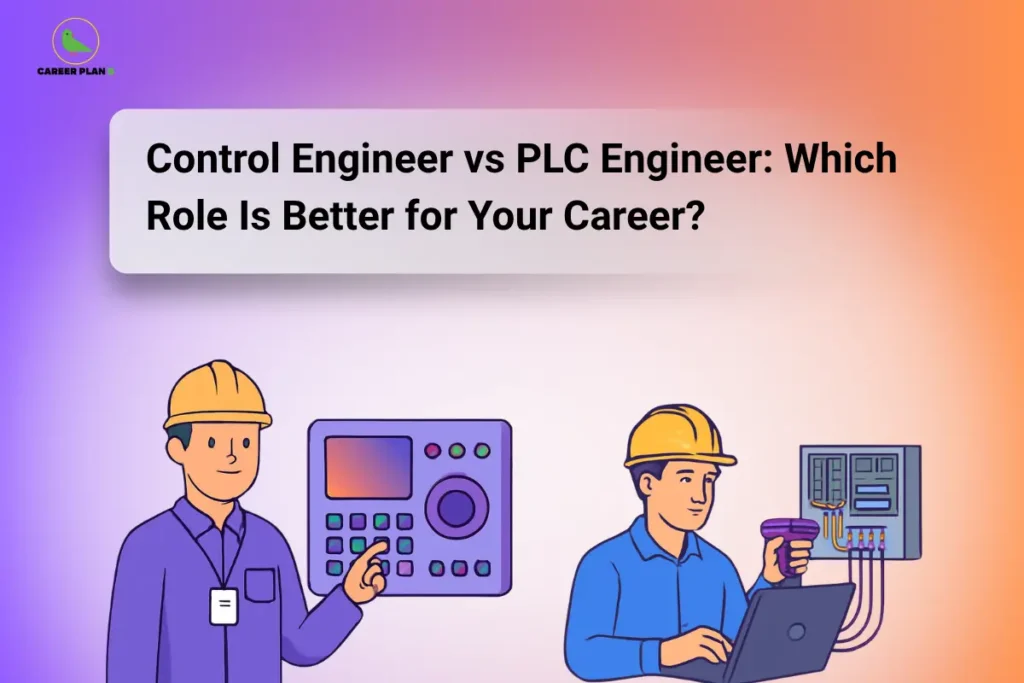
Introduction
Picture two engineers walking into the same automated factory. One heads straight to the control room, opens MATLAB Simulink, and begins analysing the stability of a feedback loop controlling a high-speed production line. The other walks onto the factory floor, connects a laptop to a Siemens PLC panel, and starts debugging a ladder logic programme that controls a robotic assembly arm.
Both are automation engineers. Both are indispensable. But they are doing very different jobs and they built very different careers to get there.
The debate around Control Engineer vs PLC Engineer is one of the most common and most misunderstood career questions in electrical, electronics, and instrumentation engineering. Students and working professionals alike often confuse the two roles, assume one is superior to the other, or most critically choose the wrong path for their actual strengths and interests.
India’s industrial automation market is growing at a CAGR of over 9% through 2027, driven by the government’s Make in India initiative, Industry 4.0 adoption, and the rapid expansion of smart manufacturing. (Source: Ministry of Commerce and Industry Make in India) Both control systems engineering career paths and PLC programming and automation roles are benefiting enormously from this growth but in different ways and across different industries.
In this blog, we will break down exactly what each role involves, compare them head to head across salary, skills, industries, and career growth and help you decide which one is genuinely the better fit for your specific profile.
Who Is a Control Engineer? Role, Scope and Responsibilities
A control engineer is a specialist in designing and analysing systems that automatically regulate the behaviour of dynamic processes. Their work is fundamentally mathematical and theoretical but with very real-world consequences.
The core function of a control engineer is to ensure that a system, whether it is a satellite maintaining its orbit, a power plant regulating its output, or an electric vehicle managing its torque, behaves predictably, stably, and accurately in the face of disturbances and uncertainties.
Core Responsibilities of a Control Engineer:
- Designing feedback control systems using classical and modern control theory
- Building mathematical models of physical systems to simulate and predict behaviour
- Performing stability analysis using techniques like Bode plots, root locus, and Nyquist criteria
- Designing and tuning PID controllers, state-space controllers, and model predictive controllers
- Simulating system performance using MATLAB Simulink, LabVIEW, or Scilab
- Validating control algorithms on hardware-in-the-loop test platforms
Industries and Employers for Control Engineers:
The control systems engineering career path spans some of the most technically prestigious industries in engineering:
- Aerospace and Defence: ISRO, DRDO, HAL, BEL for satellite guidance, launch vehicle control, and missile systems
- Electric Vehicles Motor torque control, regenerative braking, battery management algorithms
- Power Generation Automatic generation control, turbine speed governors, grid frequency regulation
- Robotics Motion planning, trajectory tracking, joint control for industrial and collaborative robots
- Chemical and Process Industries Advanced Process Control (APC) for refinery and chemical plant optimisation
ISRO’s guidance, navigation, and control teams represent the pinnacle of control engineering careers in India, designing the systems that steer India’s rockets and satellites with extraordinary precision. (Source: ISRO Official)
Who Is a PLC Engineer? Role, Scope and Responsibilities
A PLC (Programmable Logic Controller) engineer is a specialist in programming and maintaining the industrial computers that directly control automated machinery and manufacturing processes. Where control engineers work primarily in the domain of mathematics and system theory, PLC engineers work in the domain of practical machine automation on the factory floor, in control panels, and inside industrial plants.
The core function of a PLC engineer is to translate a machine’s operational requirements into a reliable, efficient program that runs continuously in real time, controlling motors, valves, conveyors, sensors, and actuators with precise timing and logic.
Core Responsibilities of a PLC Engineer:
- Writing PLC programmes in ladder logic, function block diagrams, structured text, and sequential function charts
- Designing and configuring SCADA (Supervisory Control and Data Acquisition) systems and HMI (Human Machine Interface) screens
- Commissioning automated machinery and production lines on factory floors
- Troubleshooting electrical and programming faults in live industrial systems
- Integrating PLCs with sensors, drives, robots, and industrial communication networks
- Documenting programmes, electrical schematics, and maintenance procedures
Industries and Employers for PLC Engineers:
PLC programming and automation roles are in demand across virtually every manufacturing and process industry:
- Automotive Manufacturing Robotic welding lines, paint shop automation, assembly conveyors
- Food and Beverage Processing Packaging lines, filling machines, temperature control
- Pharmaceuticals Cleanroom automation, batch processing, validation-compliant control systems
- Oil, Gas, and Petrochemicals Pipeline control, pump station automation, safety instrumented systems
- Power Generation Substation automation, turbine control panels, switchgear operation
The National Institute of Electronics and Information Technology (NIELIT) under India’s Ministry of Electronics and Information Technology offers government-recognised training programmes in industrial automation and PLC programming that are directly relevant to entering this career path. (Source: NIELIT Official)
Have Any Doubts?
Control Engineer vs PLC Engineer Head-to-Head Comparison
This is the core of the Control Engineer vs PLC Engineer debate and the comparison is more nuanced than most people expect.
Educational Background Required
Both roles typically require a degree in Electrical Engineering, Electronics and Communication Engineering, or Instrumentation Engineering. However, control engineering roles particularly in aerospace, defence, and advanced robotics more frequently require or strongly prefer postgraduate qualifications (M.Tech in Control Systems or similar). PLC engineering roles are more accessible at the diploma and undergraduate levels, making them a faster entry point into the industrial automation engineer workforce.
Day-to-Day Work and Environment
This is where the two roles differ most dramatically in lived experience:
A control engineer’s day is predominantly office and lab-based mathematical modelling, simulation, code development, testing on hardware rigs, and technical documentation. The work is intellectually intensive and often involves long periods of focused analytical problem-solving.
A PLC engineer’s day is far more dynamic, alternating between the control room and the factory floor, commissioning equipment, troubleshooting live faults, interacting with mechanical and electrical installation teams, and responding to production issues that need immediate resolution. The work is hands-on, fast-paced, and directly tied to production output.
Technical Skills and Tools
| Dimension | Control Engineer | PLC Engineer |
|---|---|---|
| Core Tools | MATLAB Simulink, LabVIEW, Scilab | Allen Bradley Studio 5000, Siemens TIA Portal, Schneider Unity Pro |
| Programming | C, C++, Python, MATLAB | Ladder Logic, FBD, ST, SFC (IEC 61131-3) |
| Key Knowledge | Control theory, state-space, frequency response | Machine sequences, interlocking logic, fieldbus protocols |
| Communication Protocols | CAN, EtherCAT, industrial Ethernet | Modbus, PROFIBUS, PROFINET, OPC-UA |
| Safety Standards | IEC 61508, ISO 26262 | IEC 61511, SIL assessment |
Industries and Employers
Control engineers find their strongest opportunities in aerospace, defence, EVs, advanced robotics, and power systems sectors, where mathematical sophistication is paramount. ISRO, DRDO, NTPC, automotive OEMs, and global technology companies are primary employers.
PLC engineers find their strongest opportunities in manufacturing, process industries, oil and gas, food processing, and pharmaceuticals sectors where reliable machine automation and fast commissioning are paramount. BHEL, Siemens, ABB, Honeywell, Rockwell Automation, and EPC contractors are among the largest employers for SCADA and DCS engineer opportunities.
Salary Comparison in India and Globally
Automation engineer skills and salary in India: figures for both roles show strong growth in 2026, but with different profiles:
| Experience Level | Control Engineer (India) | PLC Engineer (India) |
|---|---|---|
| Entry Level (0–2 years) | ₹5 – ₹9 LPA | ₹3.5 – ₹7 LPA |
| Mid Level (3–6 years) | ₹12 – ₹25 LPA | ₹8 – ₹18 LPA |
| Senior Level (7+ years) | ₹25 – ₹50+ LPA | ₹18 – ₹35 LPA |
| Top Specialisation Premium | Aerospace, EV control highest | Oil and Gas DCS, Safety Systems highest |
Control engineers generally command higher salaries at senior levels particularly in aerospace, defence, and advanced automotive domains. However, PLC engineers with DCS expertise and safety instrumented systems certification can close this gap significantly, particularly in oil and gas roles where SCADA and DCS engineer opportunities carry strong compensation premiums.
Globally, both profiles are in strong demand. Control engineers in the US earn USD 90,000–150,000 annually. Senior PLC and automation engineers in Germany, the heart of European manufacturing automation, earn EUR 65,000–100,000 annually.
Career Growth and Advancement Path
The control systems engineering career path typically progresses from junior control engineer to senior engineer, then to lead engineer, systems architect, or technical specialist, often with increasing academic depth or domain specialisation in aerospace, EVs, or advanced robotics.
The PLC programming and automation roles career path progresses from PLC programmer to automation engineer, then to lead automation engineer, project manager, or systems integrator often moving into broader Industry 4.0 and industrial IoT roles as connectivity and data analytics become integral to factory automation.
Both paths offer strong advancement opportunities but through different mechanisms. Control engineering rewards mathematical depth and research capability. PLC engineering rewards practical breadth, project delivery experience, and the ability to manage complex multi-vendor automation projects.
Which Role Suits Which Type of Engineer?
This is the most important question in the Control Engineer vs PLC Engineer debate and the honest answer is that neither role is universally better. The best role is the one that matches your specific strengths, interests, and working style.
Choose a Control Systems Engineering Career Path if you:
- Genuinely enjoy mathematics, differential equations, and analytical problem-solving
- Are fascinated by aerospace, robotics, EVs, or advanced power systems
- Prefer office- and lab-based work over factory floor environments
- Want to pursue postgraduate research or work in R&D-oriented organisations
- Are targeting prestigious organisations like ISRO, DRDO, or global technology companies
Choose PLC Programming and Automation Roles if you:
- Prefer hands-on, practical work over theoretical analysis
- Enjoy the dynamic environment of factory floors and industrial plants
- Want to enter the workforce quickly without necessarily pursuing postgraduate studies
- Are interested in manufacturing, process industries, oil and gas, or food processing
- Want a career where your work directly and visibly impacts production output
For Government and PSU Careers: Both paths are viable for government employment. GATE-qualified electrical and instrumentation engineers are recruited by BHEL, NTPC, POWERGRID, ONGC, and ISRO for roles spanning both control systems design and industrial automation. (Source: POWERGRID Official)
The International Society of Automation (ISA) provides detailed career guidance and professional development resources for both control engineers and automation engineers worldwide. (Source: ISA Official)
Have Any Doubts?
Can You Transition Between the Two Roles?
One of the most encouraging aspects of the industrial automation engineer comparison is that the two roles are not mutually exclusive, and transitioning between them is more common than most engineers realise.
From PLC Engineer to Control Engineer: A PLC engineer who develops strong mathematical foundations through postgraduate study or self-directed learning in control theory, particularly in areas like model predictive control and advanced process control, can transition into broader control systems engineering career path roles. Many senior process automation engineers in oil and gas effectively do both jobs simultaneously.
From Control Engineer to PLC Engineer: A control engineer who adds PLC programming, SCADA configuration, and industrial commissioning skills to their technical repertoire becomes an extremely valuable hybrid professional capable of both designing control algorithms and implementing them on industrial hardware. This combination is one of the most sought-after profiles in the best career in the industrial automation 2026 job market.
Hybrid Roles in Industry 4.0: The convergence of process control vs programmable logic controller disciplines is accelerating in the Industry 4.0 era. Smart factories increasingly require engineers who understand both control theory and PLC programming along with industrial IoT, OPC-UA connectivity, and cloud-based analytics. These hybrid roles represent the highest-value segment of the automation engineer skills and salary India market in 2026.
The Ministry of Heavy Industries’ National Industrial Corridor Development Programme is one of India’s largest smart manufacturing initiatives, creating demand for exactly these hybrid automation engineering profiles across India’s emerging industrial corridors. (Source: National Industrial Corridor Development Corporation)
How Career Plan B Helps
Choosing between a control systems engineering career path and PLC programming and automation roles or identifying whether a hybrid path suits you best is a genuinely complex decision that depends on your specific mathematical aptitude, working style preferences, industry interests, and long-term goals. Career Plan B offers expert career counselling, PsycheIntel-based career assessment tests, and tailored career roadmapping to help EEE, ECE, and instrumentation engineering graduates navigate the Control Engineer vs PLC Engineer decision with clarity and build a focused, personalised action plan toward the best career in industrial automation 2026 for their unique profile.
For Latest Information
Frequently Asked Questions (FAQs)
Q1. What is the core difference between a control engineer and a PLC engineer?
The core difference in the Control Engineer vs PLC Engineer comparison lies in the nature of their work. Control engineers design mathematical models and algorithms that govern how dynamic systems behave, working primarily in simulation and analysis tools like MATLAB Simulink.
Q2. Which role has better salary control: engineer or PLC engineer?
Control engineers generally command higher salaries at senior levels, particularly in aerospace, defence, and advanced EV domains due to the mathematical depth and specialisation required. However, senior PLC engineers with DCS expertise and safety instrumented systems certification in oil and gas can earn comparable packages. The automation engineer skills and salary India gap between the two roles narrows significantly with experience and specialisation. Both offer strong compensation growth in 2026.
Q3. Which industries offer the most industrial control systems job opportunities for PLC engineers?
Manufacturing, oil and gas, pharmaceuticals, food processing, and power generation are the strongest sectors for PLC programming and automation roles in India. Companies like Siemens, ABB, Honeywell, Rockwell Automation, and large EPC contractors are among the biggest employers.
Q4. Can a PLC engineer transition into a control engineering role?
Yes, with targeted upskilling. A PLC engineer who builds strong foundations in control theory, mathematical modelling, and simulation tools like MATLAB Simulink can transition into broader control systems engineering career path roles, particularly in advanced process control, model predictive control, and industrial IoT integration.
Q5. What certifications add the most value for the best career in industrial automation 2026?
For control engineers GATE qualification, ISA Certified Automation Professional (CAP), and postgraduate specialisation in control systems. For PLC engineers, ISA Certified Control Systems Technician (CCST), vendor-specific certifications from Siemens, Rockwell, or Schneider, and NIELIT automation programmes.
Conclusion
The Control Engineer vs PLC Engineer debate does not have a universal winner, and that is actually good news. It means that regardless of whether your strengths lie in mathematical analysis or hands-on practical programming, in theoretical elegance or factory floor problem-solving, or in aerospace research or manufacturing automation, there is a well-compensated, high-impact career in industrial automation waiting for you.
Control engineers build the intelligence that makes complex systems stable and precise. PLC engineers build the programmes that make factories and plants run reliably and efficiently. What matters is not which role is objectively better but which role is better for you. That comes down to your specific strengths in mathematics versus practical programming, your preference for office-based analysis versus field-based commissioning, your industry interests, and your long-term career ambitions.
Whether the control systems engineering career path or PLC programming and automation roles are the right direction for you or whether a hybrid path combining both skills represents your strongest opportunity in the best career in the industrial automation 2026 landscape, the key is making that decision deliberately, with a clear understanding of your own profile and a concrete plan to develop the right skills.
That is exactly where Career Plan B makes all the difference. With expert career counselling, comprehensive Psycheintel assessments, and tailored academic and career roadmapping, Career Plan B helps EEE, ECE, and instrumentation engineering graduates cut through the confusion of the industrial automation engineer comparison and build a clear, confident, personalised path toward a technically rich and well-rewarded career in industrial automation.