Team Career Plan B · August 12, 2026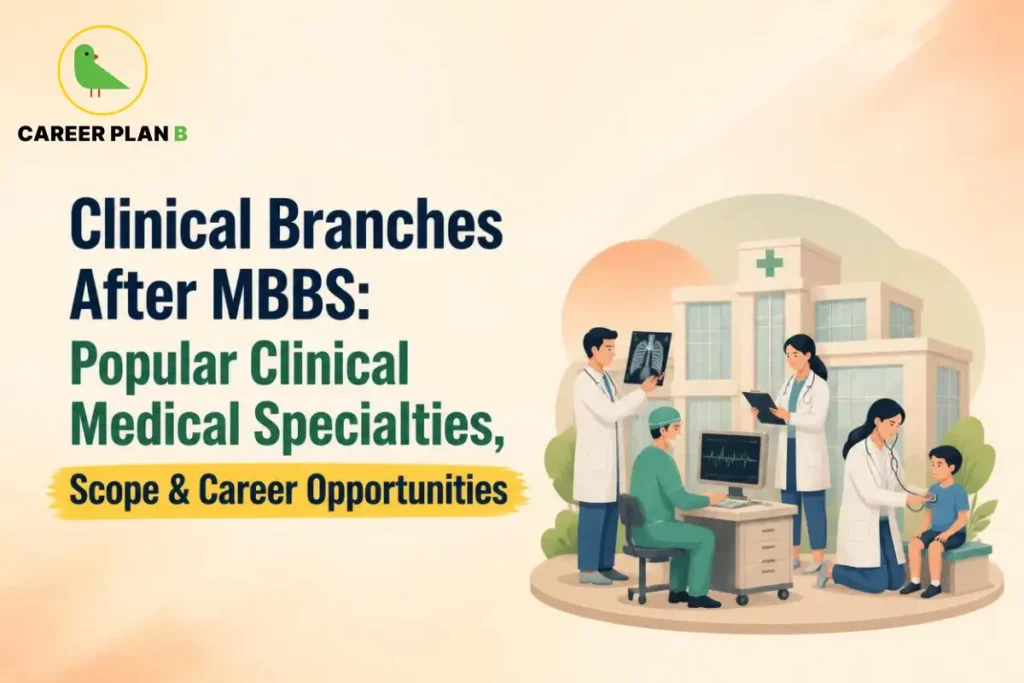
Introduction
Completing an MBBS degree and compulsory rotatory internship represents a defining milestone for every medical graduate. Choosing the right postgraduate specialization is the most critical decision in shaping your medical career. Understanding the full range of clinical branches after MBBS helps doctors select the ideal branch for their long-term professional goals.
Postgraduates in clinical medical specialties India gain hands-on expertise in direct patient care, procedural interventions, and diagnostic decision-making. These branches span non-surgical specialties like General Medicine and Dermatology alongside surgical disciplines like General Surgery and Orthopedics.
This comprehensive guide details the popular clinical medical specialties, clinical specialty training workflows, salary benchmarks, and career pathways. By assessing these options early, medical postgraduates can build a confident preference list during centralized allotment rounds.
Types of Clinical Specialties in India
Understanding the broad classification of clinical branches in medicine helps candidates categorize their options based on clinical interest and lifestyle tolerances.
Non-Surgical Clinical Specialties (MD / DNB)
Non-surgical clinical specialties focus on diagnostic reasoning, pharmacology, non-invasive therapies, and chronic disease management. Postgraduates analyze systemic pathologies, manage acute medical emergencies, and direct intensive care protocols.
These specialties generally offer structured hospital consulting hours and lower physical strain inside operation theatres. Candidates evaluating branch allotments can review our companion guide on top MD/MS specializations after NEET PG for cutoff rank trends.
Surgical Clinical Specialties (MS / DNB)
Surgical clinical specialties center on invasive operative procedures, trauma management, and complex anatomical reconstructions. This postgraduates spend extensive hours in operating rooms mastering intricate operative techniques and post-operative critical care.
Surgical disciplines demand high physical stamina, rapid emergency decision-making, and extended call schedules. Returning foreign medical graduates preparing for parallel screening cycles can also check our FMGE strategy guide for document verification rules.
Popular Clinical Specialties After MBBS
Evaluating popular clinical specialties after MBBS requires matching your individual clinical interests with emergency call tolerances and fellowship scope.
MD General Medicine
MD General Medicine remains the most coveted clinical specialization among top merit rankers in national counselling. Physicians diagnose complex multi-system disorders, manage ICU protocols, and serve as primary hospital consultants across tertiary networks.
The specialty offers an exceptional foundation for super-specialization fellowships in Cardiology, Gastroenterology, Nephrology, or Endocrinology. Fresh General Medicine postgraduates command strong starting packages in corporate healthcare.
MD Radio-Diagnosis
MD Radio-Diagnosis experiences intense candidate demand due to its technological integration and regular lifestyle. Radiologists interpret MRI scans, CT imaging, ultrasound studies, and perform image-guided interventional procedures.
The branch provides predictable working hours with minimal emergency night calls, making it ideal for maintaining work-life balance. High diagnostic reliance across corporate hospital networks ensures exceptional career growth for diagnostic specialists.
MD Dermatology, Venereology & Leprosy (DVL)
MD Dermatology is renowned for offering top-tier financial returns alongside an outstanding outpatient lifestyle. Dermatologists treat skin pathologies, perform aesthetic laser therapies, execute hair transplant surgeries, and manage cosmetic clinics.
Because most cosmetic procedures are elective and outpatient-based, emergency night calls are extremely rare. High consumer demand for aesthetic procedures elevates Dermatology into the premier tier of types of clinical specialties.
MD Pediatrics
MD Pediatrics focuses on neonatal care, childhood growth monitoring, developmental disorders, and pediatric infectious diseases. Pediatricians manage specialized Neonatal Intensive Care Units (NICU) and Pediatric Intensive Care Units (PICU) in tertiary care hospitals.
The branch requires deep diagnostic patience and clear communication when counseling anxious parents. Pediatricians enjoy high patient volume and rapid independent clinic setup opportunities across urban centers.
MS General Surgery
MS General Surgery serves as the foundational gateway to high-volume operative procedures and emergency trauma management. Surgeons perform laparoscopic procedures, emergency abdominal surgeries, oncological resections, and vascular repairs.
Completing MS General Surgery opens direct pathways toward elite MCh super-specialty fellowships in Surgical Gastroenterology, Urology, or Neurosurgery. Candidates evaluating compensation benchmarks can check our report on highest paying MD/MS specializations for salary tiers.
MS Obstetrics & Gynecology (OB-GYN)
MS Obstetrics & Gynecology combines high-volume surgical delivery procedures with comprehensive female reproductive healthcare. OB-GYN specialists perform cesarean sections, gynecological laparoscopic resections, infertility treatments, and maternal-fetal monitoring.
The specialty demands constant readiness for emergency delivery calls, resulting in an intense work schedule. High patient volume and surgical procedure fees ensure OB-GYN offers exceptional financial security.
MS Orthopedics
MS Orthopedics specializes in bone fracture fixations, joint replacement surgeries, arthroscopic sports medicine, and spinal corrections. Orthopedic surgeons utilize advanced biomechanical implants, power tools, and image-guided surgical systems.
High trauma volumes and joint replacement demand drive exceptional earning capacity across private corporate hospitals. Orthopedics consistently ranks among the most coveted surgical clinical specialties after MBBS in India.
MS Ophthalmology
MS Ophthalmology focuses on delicate microsurgical procedures involving the eye, including cataract phacoemulsification, LASIK, and retinal surgeries. Ophthalmologists utilize high-precision operating microscopes and specialized laser delivery systems.
The specialty offers an ideal blend of delicate surgical practice and predictable outpatient clinic hours. Low emergency call frequencies allow eye surgeons to maintain a balanced personal lifestyle.
Scope of Clinical Branches After MBBS in India
Analyzing the scope of clinical branches after MBBS demonstrates why clinical postgraduates secure immediate professional demand nationwide.
- Corporate Hospital Appointments: Tertiary care hospital networks actively recruit postgraduates for full-time consultant positions, ICU coverage, and department leadership roles.
- Independent Private Practice: Broad specialty postgraduates easily establish independent outpatient clinics, maternity nursing homes, or diagnostic centers in Tier 2 and Tier 3 cities.
- Academic Faculty Positions: Medical colleges governed under rules from the National Medical Commission (NMC) hire clinical postgraduates as Assistant Professors and Senior Residents.
- Super-Specialization (DM / MCh): Broad specialty clinical degrees serve as mandatory eligibility criteria for entering 3-year DM or MCh super-specialty training programs.
Candidates tracking central counselling joining deadlines can refer to our detailed NEET PG counselling schedule for round-wise joining windows.
To read more about career practices after MBBS click on this link.
Clinical Specialty Training and Residency Workflow
Understanding roles and training clinical specialties mandates reviewing the 3-year postgraduate residency curriculum established by official boards.
Residency guidelines authorized by the National Board of Examinations in Medical Sciences (NBEMS) require postgraduates to complete continuous ward rotations, emergency duty calls, and surgical assistance logs. Residents participate in weekly clinical grand rounds, journal clubs, inter-departmental mortality meets, and mandatory thesis research submission.
Fulfilling logbook requirements and passing practical clinical case examinations at the end of 3 years confirms clinical competence. Candidates preparing for initial seat allotment can review our step-by-step NEET PG counselling registration guide to lock choices safely.
For Personalized Guidance
Matrix of Popular Clinical Medical Specialties
The following matrix compares operational parameters across major clinical specialty opportunities in India.
| Specialization / Branch | Degree Type | Residency Duration | Call Intensity & Stress | Primary Career Opportunities |
|---|---|---|---|---|
| General Medicine | MD Degree | 3 Years | High / ICU Emergency | Hospital Consultant, ICU Lead, DM Fellowships |
| Radio-Diagnosis | MD Degree | 3 Years | Low / Predictable | Imaging Center Lead, Interventional Radiologist |
| Dermatology (DVL) | MD Degree | 3 Years | Very Low / Outpatient | Aesthetic Clinic Owner, Cosmetologist |
| Pediatrics | MD Degree | 3 Years | Moderate to High | NICU / PICU Lead, Private Practitioner |
| General Surgery | MS Degree | 3 Years | High / Operative | Trauma Surgeon, MCh Fellowships |
| Obstetrics & Gynec. | MS Degree | 3 Years | Very High / Night Calls | Maternity Home Owner, Gynec Surgeon |
| Orthopedics | MS Degree | 3 Years | High / Physical | Joint Replacement Lead, Trauma Surgeon |
| Ophthalmology | MS Degree | 3 Years | Low / Predictable | Eye Hospital Consultant, LASIK Specialist |
(Source: Operational parameters compiled in alignment with public notices published under the Ministry of Health and Family Welfare).
How Career Plan B Helps
Evaluating best clinical branches after MBBS, analyzing allotment ranks, and optimizing preference lists requires data-driven strategic planning. Career Plan B supports medical postgraduates through:
- Personalised Career Counselling: Evaluating your expected All India Rank, clinical specialization preferences, and seat allotment probabilities across state and central quotas.
- Psycheintel & Career Assessments: Scientific evaluations confirming whether clinical residency, surgical tracks, or diagnostic specialties fit your natural strengths best.
- Customized Admission Guidance: Support navigating centralized Medical Counselling Committee (MCC) counselling, state quota registrations, and stray vacancy rounds smoothly.
- Career Roadmapping: Strategic planning extending beyond residency toward super-specialization, hospital consulting, and global licensing.
Get In Touch With Us
Frequently Asked Questions
Q1. Which are the best clinical branches after MBBS in India?
General Medicine, Radio-Diagnosis, Dermatology, General Surgery, Pediatrics, and Orthopedics represent the most sought-after clinical branches based on candidate merit ranks.
Q2. What is the scope of clinical branches after MBBS compared to non-clinical branches?
Clinical branches offer direct patient interaction, higher earning ceilings, independent practice opportunities, and diverse corporate hospital consulting roles compared to non-clinical disciplines.
Q3. How long does clinical specialty training take for MD and MS degrees?
Postgraduate clinical specialty training takes exactly 3 years of full-time hospital residency following MBBS completion and entrance qualification.
Q4. Can I start an independent clinic immediately after MD Dermatology or MD Pediatrics?
Yes. Postgraduates in Dermatology and Pediatrics can establish independent outpatient clinics immediately after residency without mandatory super-specialty fellowships.
Q5. Are DNB clinical seats fully equivalent to MD and MS degrees in India?
Yes. Guidelines established by the National Medical Commission (NMC) treat DNB qualifications as fully equivalent to MD and MS degrees for clinical practice and academic appointments.
Conclusion
Analyzing competitive preparation trends proves why thoroughly evaluating clinical branches after MBBS is essential for every medical graduate. By assessing emergency tolerances, outpatient preferences, and super-specialization scope early, you turn post-result downtime into a decisive professional advantage.
Remember that reviewing historical opening and closing ranks authorized by official counselling boards protects your academic attempt. Staying disciplined, building multi-tier choice lists, and analyzing specialty workflows ensures a smooth transition into residency.
Developing a clear post-allotment strategy ensures you lock choices confidently on official allotment portals. Connect with Career Plan B today to build a personalized medical career roadmap tailored to your long-term goals.