Team Career Plan B · July 22, 2026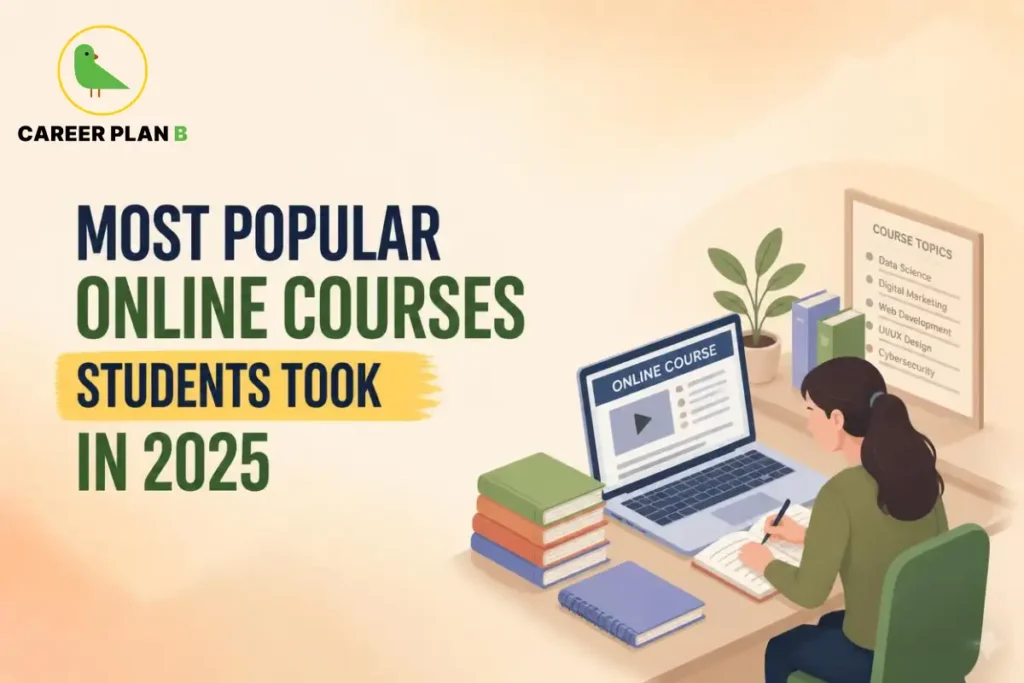
Introduction
2025 was the year online learning stopped being a backup option and became a default part of how students built their profiles. Alongside a degree, most students now treat at least one online course or certification as a given, not an extra.
What stood out wasn’t just the volume of courses taken. It was the shift in what students chose to study, which were some popular online courses . Interest moved noticeably toward practical, tool-based skills and government-backed certifications, alongside continued strength in the usual favourites like programming, design, and digital marketing.
This guide looks back at the subjects and platforms that saw the strongest student interest in 2025, what made them popular, and what that pattern suggests about where student priorities are headed in 2026.
Why Was 2025 Different?
A few things shaped what students studied online in 2025.
First, AI tools moved from a niche interest to something almost every field now touches, which pushed students across streams, not just computer science, toward AI-adjacent courses.
Second, government platforms expanded their course catalogues and improved their delivery, making free, credit-eligible learning a genuinely competitive option next to paid platforms.
Third, hiring conversations shifted further toward skills and portfolios over degrees alone, which pushed students to treat certifications as a resume requirement rather than an optional add-on.
The Popular Online Courses Students Gravitated Toward in 2025
1. AI and Machine Learning Fundamentals
This was the single biggest shift in student interest in 2025. Courses covering AI fundamentals, prompt engineering, and applied machine learning saw a surge in enrollment, and notably, this interest wasn’t limited to engineering or computer science students. Commerce, arts, and science students increasingly took introductory AI courses to stay relevant in their own fields, from AI in finance to AI in content and design.
2. Data Analytics and Visualisation
Python, SQL, Power BI, and Tableau remained consistently popular through 2025, driven by strong hiring demand for business analyst and data analyst roles across IT services, fintech, and e-commerce. These courses appealed particularly to commerce and BBA students looking to add a technical layer to a business background.
3. Digital Marketing
Digital marketing courses, particularly Google’s certifications in the space, held steady popularity through 2025. The appeal stayed consistent: practical, verifiable skills that apply directly to freelance work, small business roles, and marketing-adjacent careers, with a lower barrier to entry than more technical fields.
4. Programming and Web Development
Web development and app development courses stayed in strong demand, particularly among BCA, B.Sc Computer Science, and engineering students looking to build a portfolio alongside their degree. Full-stack development courses that combined frontend and backend skills in one structured path were especially popular.
5. Government-Recognised IT and Digital Skill Certifications
NIELIT’s IT and digital skill certifications saw continued interest through 2025, particularly among students targeting government and PSU roles where a government-recognised credential carries more weight than a private platform certificate.
6. Design and Creative Tools
Graphic design, UI/UX design, and video editing courses grew steadily through 2025, supported by rising freelance demand in these areas and by growing institutional support for creative-tech careers, including new government infrastructure for the animation, gaming, and design sector.
7. Finance and Investment Literacy
Courses covering personal finance, stock market basics, and introductory securities knowledge saw rising interest, particularly among commerce students. Some of this interest fed directly into formal certification paths like NISM modules, which several students used introductory finance courses to prepare for.
Which Platforms Saw the Most Activity
SWAYAM, India’s national online education platform under the Ministry of Education, continued to see strong enrollment through 2025, particularly for courses that offered credit transfer eligibility under a student’s degree program. Its free-to-audit model made it a common starting point before students moved to a paid platform for more specialised or advanced content.
NPTEL, the IIT-led platform under the same government umbrella, remained the preferred choice for engineering and technical students specifically, given its AICTE-approved status and strong faculty credentials.
Private platforms like Coursera and Udemy continued to see high enrollment for tool-specific and industry-certified courses, particularly where a course was developed in partnership with a globally recognised university or company, since this combination carried more weight with employers than a generic provider course.
Google’s Career Certificates, covering digital marketing, IT support, data analytics, and project management, remained popular through 2025 for their direct employer recognition and lower cost relative to longer paid programs.
What This Pattern Tells Students Heading Into 2026?
The clearest signal from 2025 is that students are no longer treating online courses as a single, one-time addition to their resume. They are building a layered profile: a free, credit-eligible course from a government platform for academic reinforcement, a paid or free certification from a recognised platform for a specific technical skill, and where relevant, a statutory or government-recognised certification for regulatory or government job eligibility.
This layering matters because employers increasingly look for a combination, not just one credential in isolation. A single certificate alone rarely moves a resume forward the way it once did; what stands out now is a coherent set of skills that clearly supports a specific career direction.
Have Any Doubts?
Advantages and Considerations for 2026
| What Worked in 2025 | What to Watch For in 2026 |
|---|---|
| Free government platforms (SWAYAM, NPTEL) for core academic and technical reinforcement | Not every SWAYAM course transfers credit; confirm with your institution before assuming it will |
| AI and data-related courses for cross-stream relevance | Pick courses that teach applied skills, not just conceptual AI awareness, for real employability |
| Government-recognised certifications (NIELIT, NISM) for regulatory or government-role eligibility | These often carry registration fees and exam requirements; budget time for proper preparation |
| Paid platform courses from recognised universities or companies | Avoid generic, unbranded courses on paid platforms; they carry little weight with employers |
How Career Plan B Helps
Choosing which online courses actually fit your degree, your target career, and your budget takes more than following what’s trending. Career Plan B helps you build that clarity through:
- Personalised Career Counselling to identify which skill layers genuinely support your specific career direction.
- Psycheintel Career Assessment Tests to understand which subjects and course formats suit your strengths and learning style.
- Admission and Academic Profile Guidance to help you choose courses that pair well with your current degree and credit transfer policies.
- Structured Career Roadmapping to sequence your course choices so your profile builds with direction, not just a scattered list of certificates.
For Latest Information
Frequently Asked Questions
Q1. Are free government courses like SWAYAM as valuable as paid courses for a resume?
Yes, particularly when paired with a paid or specialised course for depth. SWAYAM courses carry academic credibility and, in some cases, credit transfer value that paid platforms don’t offer, though paid or globally recognised courses often add stronger employer-facing weight for specific technical skills.
Q2. Should I focus on AI courses even if I’m not in a tech field?
It’s worth taking an introductory AI course regardless of your field, since AI literacy is increasingly relevant across finance, marketing, HR, and other non-technical roles. You don’t need deep technical AI skills unless you’re pursuing a tech-specific career.
Q3. How many online courses should I realistically complete alongside my degree?
There’s no fixed number, but quality and coherence matter more than quantity. A focused set of two to four courses that build toward a clear direction is generally more valuable than a long, scattered list of unrelated certificates.
Q4. Do employers actually check which platform a certificate came from?
Often, yes, especially for private platform certificates. Employers tend to weigh courses from recognised universities or companies more heavily than generic, unbranded provider courses on the same platform.
Q5. Is it too late to start building a course-based profile if I haven’t started yet?
No. Most of these courses are self-paced and can be completed within weeks to a few months. Starting now with a focused plan is far more useful than waiting for a “better” starting point.
Q6. Which subject area saw the fastest growth in interest during 2025?
AI and machine learning fundamentals saw the fastest growth in interest, driven by rising cross-stream relevance rather than demand from computer science students alone.
Conclusion
2025 showed a clear shift in how students approached popular online courses : less about collecting individual certificates, more about building a coherent, layered skill profile that supports a specific career direction. AI literacy, data skills, and government-recognised certifications moved to the centre of that shift, alongside steady demand for design, programming, and digital marketing.
Heading into 2026, the pattern to follow isn’t which course is trending. It’s which combination of courses actually builds toward the career you’re working towards.
Not sure which online courses fit your degree and career goals? Career counselling at Career Plan B can help you build a course plan with clarity and direction.