Careerplanb · July 29, 2026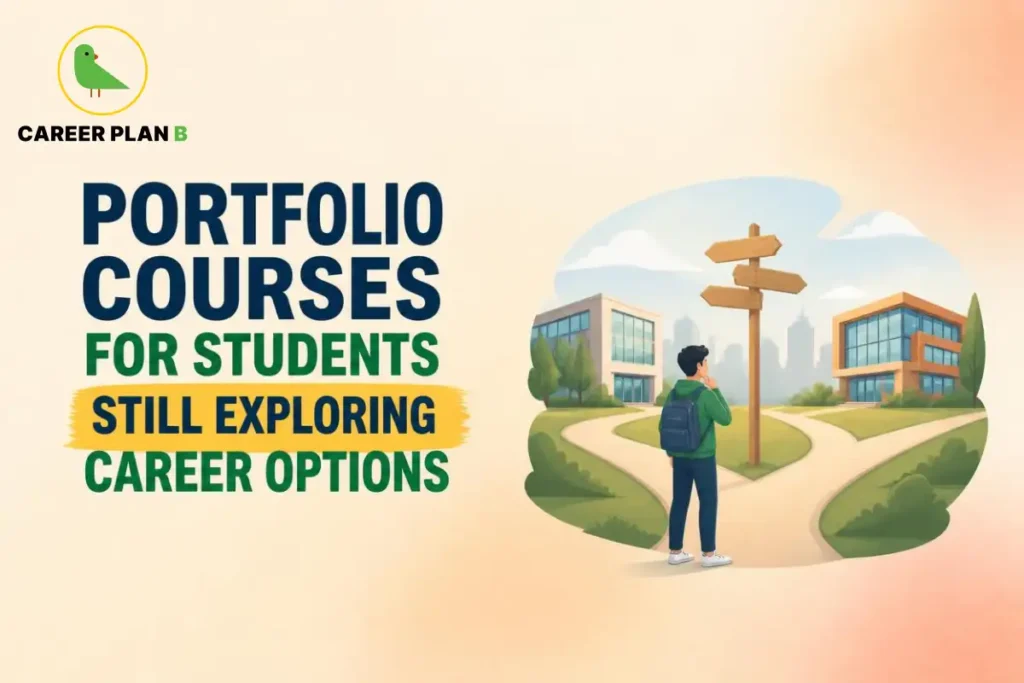
Introduction
Not every seventeen year old knows what they want to be. Some feel pulled toward biology one week and business the next, and that is completely normal. Portfolio courses exist exactly for students like this, letting them combine subjects, test interests, and build skills without locking into one narrow path too early. Instead of forcing a decision at eighteen, these programs let students grow into their choice.
As Indian universities embrace more flexible, multidisciplinary structures, portfolio courses are quickly becoming a smart option for undecided students and cautious parents alike. This blog explains what these courses actually look like, how they work under India’s current education policy, and how to choose one that keeps genuine doors open.
What Exactly Is a Portfolio Course?
Think of a portfolio course like a shopping basket instead of a fixed thali. Rather than committing to one rigid degree, students pick a mix of subjects, electives, minors, and skill-based modules that reflect their evolving interests. A student might study economics as a major, add a data science minor, and pick up a design elective, all inside one flexible degree structure.
This is different from a traditional single-subject degree, where the curriculum is fixed from day one. these courses are built around the idea that career clarity often comes through exposure, not through guesswork made at the admission stage.
Why Now? The NEP 2020 Connection
India’s National Education Policy 2020 has been a major driver behind this shift. Under NEP 2020, students can pursue general degrees in three years or honours programmes in four years, with flexible exit options and multidisciplinary subject combinations built directly into the structure. This policy shift is exactly what has made flexible degree programs realistic at scale, rather than a boutique offering at a handful of expensive universities.
Confused about your next steps? Get a personalized roadmap tailored to your career goals.
What Does a Portfolio Course Actually Include?
No two portfolios look identical, but most share a similar underlying structure. Here is a simple way to understand the building blocks:
| Component | Purpose | Example |
|---|---|---|
| Core Major | Provides depth in one primary discipline | Mathematics, Economics, Psychology |
| Minor Specialisation | Adds a secondary skill area for future-ready skills | Data Science, AI, Design |
| Skill Electives | Builds practical, job-ready capability | Communication, Coding Basics, Financial Literacy |
| Exploratory Modules | Lets students sample unfamiliar subjects | Museology, Behavioural Design, Public Policy |
Universities across India are already experimenting with this model. Several institutions now offer mathematics degrees with data science and AI as built-in minor specialisations, alongside newer, less conventional undergraduate options such as museology and heritage management. This kind of variety is exactly what makes multidisciplinary learning valuable for a student who has not yet found their one true interest.
How Is This Different From Just Taking Random Electives?
A common misconception is that these courses are simply degrees with extra electives thrown in. The real difference lies in intent. A well-designed portfolio course is structured so that each addition builds a coherent, employable profile, not a scattered mix of unrelated credits. Skill and industry-relevant courses in AI, data analytics, and design are increasingly built directly into science and arts degrees, rather than offered as disconnected add-ons.
Do Employers Actually Value This Kind of Flexible Background?
This is the question parents ask most often, and the honest answer is yes, but with a condition. Employers are not impressed by flexibility for its own sake, they are impressed by demonstrated skill and initiative. A recent industry survey found that a majority of hiring managers in digital and tech roles said they would choose a candidate with a strong project portfolio and skill certification over a more traditionally qualified candidate with no practical experience. This is precisely why portfolio courses work best when students actively build projects and real outputs, not just collect subject credits.
A Simple Way to Think About It
Picture two graduates. One has a single-subject degree and no projects to show. The other has a core major, a relevant minor, and two or three real projects built during college. In interviews, the second candidate has stories to tell and proof to show. That is the real advantage of a portfolio approach, it is not the flexibility itself, it is what a student does with that flexibility.
How Should Students Choose the Right Portfolio Mix?
Picking subjects just because they sound interesting is not enough. Here is a more structured approach for career exploration courses:
- Start with a genuine interest area, even if it feels vague, and use the first year to test it through electives
- Pick one minor that adds tangible, in-demand skill, such as data analysis, design, or applied AI
- Prioritise programs with real project work, not just theory-heavy electives with no output
- Check exit and credit transfer flexibility, in case interests shift again after year one or two
- Track placement and outcome data for students who followed similar subject combinations, not just the overall university average
A Word of Caution for Parents
Flexibility can feel risky if it is mistaken for a lack of direction. The goal of a portfolio course is not indecision, it is structured exploration with a clear plan to convert into a strong, employable profile by graduation. Before enrolling, always verify a program’s credit structure and recognition status directly through the UGC portal, and review official curriculum details on the university’s own website.
How Career Plan B Helps
Choosing between a flexible, multidisciplinary path and a traditional single-subject degree is exactly the kind of decision that benefits from expert input. This is where Career Plan B can help by offering:
- Personalised Career Counselling: Provides expert guidance based on individual interests, skills, and career goals, helping undecided students figure out which subject combinations genuinely suit them.
- Psychometric & Career Assessment Tests: Identifies strengths, personality traits, and suitable career opportunities, useful for narrowing down a meaningful core major before adding minors and electives.
- Career Roadmapping: Creates a clear step-by-step plan to achieve academic and professional goals, including how to sequence electives and skill modules for maximum career impact.
- Admission & Academic Profile Guidance: Helps in selecting the right courses and colleges and improving academic profiles, so students choose portfolio courses with credible structure and strong outcomes.
Get In Touch With Us
Frequently Asked Questions
1. Do these courses take longer to complete than a regular degree?
Not usually. Under NEP 2020’s flexible structure, most portfolio-style degrees still fit within the standard three or four year timeline, with built-in exit options along the way.
2. Will employers take a multidisciplinary degree seriously?
Yes, especially when paired with real project work and a relevant minor. Employers increasingly value demonstrated skill and initiative over a narrowly defined single-subject degree.
3. Can I switch my minor or electives after starting the program?
Many universities allow this within the first year or two, depending on credit structure, so it is worth confirming exit and switch policies before enrolling.
4. How do I know if a portfolio course is credible and well-structured?
Check UGC recognition, review the official curriculum on the university’s website, and ask specifically about placement outcomes for students who followed a similar subject combination.
Conclusion
Not knowing exactly what you want to become at eighteen is not a failure, it is simply where many students genuinely are. Portfolio courses give them room to explore without falling behind, turning uncertainty into a structured, skill-building journey. For students and parents navigating this stage, flexibility paired with the right plan can be a real advantage rather than a risk.
If you or your child is still exploring career direction, the right guidance can turn that openness into a focused, confident path forward. Clarity often comes from structured exploration, not from rushing a decision. Talk to a Career Plan B counsellor today to build a portfolio course plan that fits your goals.