Team6 · July 21, 2026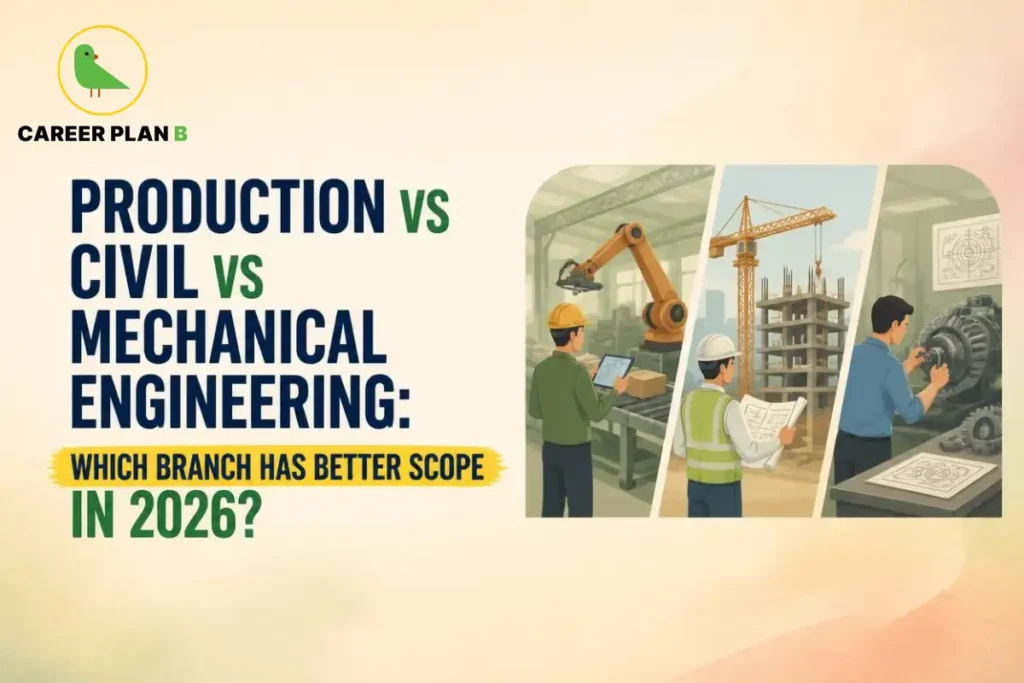
Introduction
India produces around 16 lakh engineering graduates every year, and these three core branches remain among the most commonly chosen paths within that pool. Naturally, this raises a genuinely practical question for students filling out entrance exam forms: Production vs Civil vs Mechanical: Which Has Better Scope? Students often compare these three branches superficially, going purely by reputation or family suggestion, without checking real government job data, sector growth drivers, or actual placement realities. This blog breaks down all three honestly, covering their core focus, GATE-PSU routes, and salary in genuine depth, so you can choose with real clarity rather than assumption.
What Each Branch Actually Focuses On in the Real World
Mechanical Engineering: The Broadest, Most Diversified Branch
Mechanical engineering branches into thermal systems, fluid mechanics, materials science, design, and production, giving it an unusually wide industrial footprint. This breadth means mechanical engineers work across ISRO, DRDO, BHEL, Indian Railways, and Indian Oil, alongside private sector giants in automotive, aerospace, and energy. Consequently, this mechanical engineering scope doesn’t lock you into one industry; it opens doors across a dozen sectors, many of which continue receiving sustained government funding.
Civil Engineering: India’s Infrastructure Backbone
Civil engineering, meanwhile, anchors India’s infrastructure growth directly, spanning roads, bridges, metro systems, smart cities, and water management projects. This branch benefits enormously from sustained public investment through the National Infrastructure Pipeline, PMAY, and ongoing metro rail expansion across major cities. Therefore, civil engineering scope tends to grow in close step with government infrastructure spending, making it a genuinely stable, long-term career anchor.
Production Engineering: A Focused Manufacturing Specialization
Production engineering, by contrast, narrows in specifically on manufacturing processes, quality control, and production management within factories. Rather than spanning multiple industries the way mechanical engineering does, this branch develops deep, focused expertise in converting raw materials into finished goods efficiently at scale. Consequently, production engineering career paths in India tend to concentrate around automotive, electronics, and industrial goods manufacturing specifically, rather than the broader access mechanical engineering enjoys.
Which of These Three Branches Actually Suits Your Interests?
So how do you actually decide among these three, given how much they can overlap on paper? If you want maximum industry flexibility and the option to pivot across automotive, aerospace, defence, or energy sectors later, mechanical engineering’s breadth genuinely serves that goal best. If you’re drawn to large-scale, visible infrastructure projects and enjoy fieldwork tied to public works, civil engineering is likely your stronger fit. And if you specifically want deep, focused expertise in manufacturing efficiency and quality systems from day one, production engineering offers exactly that concentrated path. Each branch rewards a genuinely different kind of thinker, so it’s worth being honest about which working style resonates with you.
Government Job Scope: Production vs Civil vs Mechanical Through GATE
Why Civil Engineering Leads in Total Government Vacancies
Civil engineering currently holds the highest total government job vacancies among all engineering branches in India, spanning SSC JE, RRB JE, PWD, CPWD, NHAI, State PWDs, and municipal corporations, which all recruit civil engineers in genuinely massive numbers every year. This sheer volume of government demand makes civil engineering an especially strong choice for students prioritizing long-term government job stability above all else.
Mechanical’s Broader PSU and Defence Access
Mechanical engineering follows closely behind, holding the highest number of vacancies across major government technical recruitment exams, with organizations like ONGC, BHEL, HAL, and NTPC recruiting mechanical engineers in large numbers through GATE. Additionally, mechanical engineering benefits from India’s defence budget, which crossed ₹6.21 lakh crore in 2024-25, creating openings at HAL, BEL, and DRDO under the government’s Atmanirbhar Bharat push.
Where Production Engineering Fits Into This Picture
Production engineering, being a narrower, more specialized branch, sees comparatively fewer dedicated GATE-PSU vacancies than mechanical or civil engineering. However, this also means candidates from this branch typically face less competition per available seat, since fewer colleges offer this specialization compared to the much larger applicant pools in mechanical and civil engineering. Programmes across all three branches require approval from the All India Council for Technical Education (AICTE), the Government of India’s apex technical education regulator, and you can verify official GATE exam details through the GATE official website, maintained by the IIT hosting the exam that year.
Have Any Doubts?
Which Sectors Are Actually Driving Growth for Each Branch Right Now?
Civil engineers benefit directly from India’s massive infrastructure push, including the National Infrastructure Pipeline, PMAY housing schemes, and expanding smart city and metro rail projects nationwide. Mechanical engineers, meanwhile, benefit from India’s broader manufacturing growth story, driven by Make in India, PLI schemes, and the accelerating EV push, with companies like Ola Electric and Tata Motors actively hiring fresh graduates with manufacturing fundamentals. Production engineers sit closely aligned with this same manufacturing growth, since the National Manufacturing Mission, targeting a rise in manufacturing’s GDP share to 25 per cent by 2035, depends directly on the systematic process expertise this branch specifically provides.
Salary Comparison: Production vs Civil vs Mechanical Engineering
| Career Stage | Production Engineering | Civil Engineering | Mechanical Engineering |
|---|---|---|---|
| Entry-Level (Private) | INR 3 – 6 lakh | INR 3 – 4.5 lakh | INR 3 – 5 lakh |
| Entry-Level (PSU/GATE) | INR 5 – 14 lakh | INR 12 – 18 lakh (GET roles) | INR 9.25 – 14 lakh |
| Mid-Level | INR 7 – 12 lakh | INR 8 – 14 lakh | INR 6 – 12 lakh |
| Senior-Level | INR 12 – 20+ lakh | INR 15 – 35+ lakh | INR 20 – 60+ lakh (PSU/MNC) |
Interestingly, mechanical engineering shows the widest senior-level ceiling overall, largely due to its access to high-paying aerospace, defence, and MNC R&D roles that neither civil nor production engineering typically reach at the same scale.
Career Roles and Growth Path
| Career Stage | Production Engineer | Civil Engineer | Mechanical Engineer |
|---|---|---|---|
| Entry-Level | Junior Production Engineer | Site Engineer / GET | Design/Production Engineer Trainee |
| Mid-Level | Manufacturing Engineer / Process Engineer | Project Engineer / Manager | Senior Design Engineer / Project Lead |
| Senior-Level | Plant Manager / Quality Head | Senior Project Manager / Chief Engineer | Engineering Manager / R&D Lead |
How Career Plan B Helps
Career Plan B helps students and professionals make informed career decisions by providing personalized guidance, assessments, and structured career planning for choosing the right engineering specialization.
Personalized Career Counselling: Provides expert guidance based on individual interests, skills, career goals, and understanding of different engineering fields such as mechanical, civil, and production engineering. It helps students identify which career path aligns best with their strengths and future aspirations.
Psychometric & Career Assessment Tests: Identify personality traits, aptitude, problem-solving abilities, and professional interests to help students evaluate whether they are better suited for manufacturing, infrastructure, design, operations, or other engineering career paths.
Career Roadmapping: Creates a clear step-by-step plan covering academic choices, skill development, certifications, entrance exam preparation, and career strategies needed to succeed in fields like GATE PSU recruitment, manufacturing engineering, infrastructure projects, and industrial roles.
Admission & Academic Profile Guidance: Helps students select the right engineering branch, courses, and colleges while improving their academic profile to prepare for long-term opportunities in mechanical engineering, civil engineering, production engineering, and India’s growing industrial sectors.
Get In Touch With Us
Frequently Asked Questions
1. Which of these three branches has better government job scope?
Civil engineering currently holds the highest total government vacancies, though mechanical engineering follows closely with strong PSU and defence sector access.
2. Which branch pays more at the entry level?
Civil engineering PSU roles through GATE often show the strongest entry-level pay, though private-sector fresher pay is broadly comparable across all three branches.
3. Which branch is growing fastest right now in India?
Mechanical engineering is seeing particularly strong growth through EV manufacturing and defence production, while production engineering grows alongside the broader National Manufacturing Mission push.
4. Is production engineering a subset of mechanical engineering?
Yes, at most institutes, production engineering is technically classified as a specialization within the broader mechanical engineering discipline.
5. Which branch should I choose if I’m unsure of my interests?
Mechanical engineering’s broad industry access makes it a flexible default choice, giving you room to specialize in production, design, or other directions later.
Conclusion
Answering Production vs Civil vs Mechanical: Which Has Better Scope? ultimately depends on what you value most: mechanical engineering offers the broadest industry flexibility and highest senior-level pay ceiling, civil engineering leads in total government job volume and infrastructure-driven stability, and production engineering provides focused, steady growth within India’s expanding manufacturing base. Rather than choosing based on which branch sounds more traditional or prestigious, it’s worth reflecting honestly on whether you want broad flexibility, infrastructure-focused fieldwork, or deep manufacturing specialization.
If you’re still unsure which path fits you best, a conversation with a Career Plan B counsellor can help you weigh your genuine interests and aptitude clearly before you finalize your entrance exam choices.