Team6 · July 21, 2026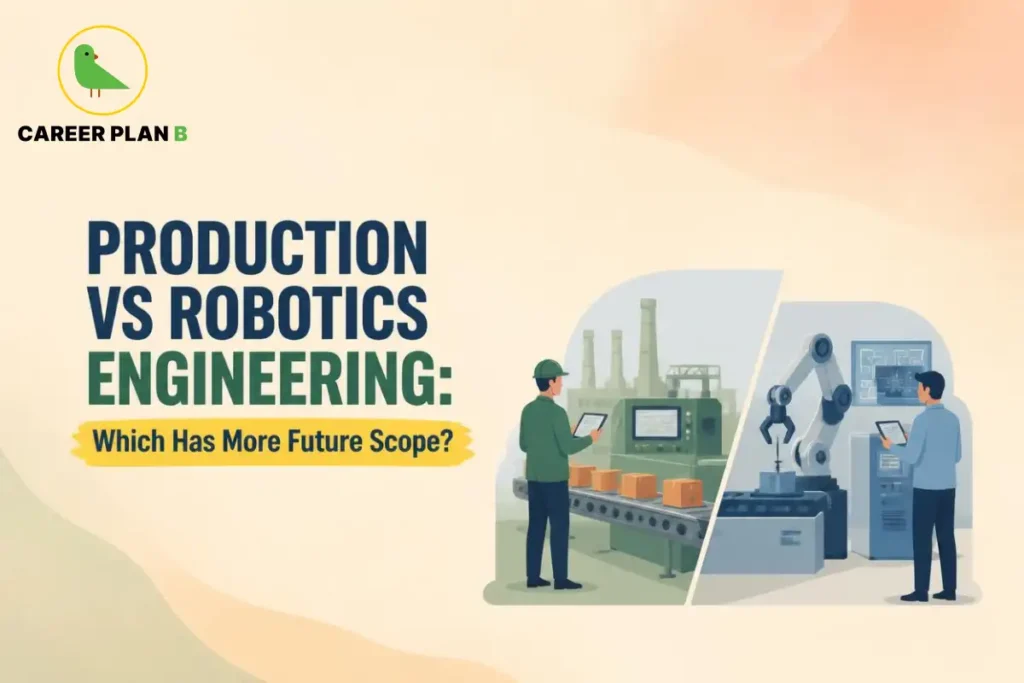
Introduction
As factories become more automated, a natural question comes up. Do you want to build the systems that run production, or the robots that increasingly run it for you? Comparing production vs robotics engineering’s future scope helps answer that question with real data rather than assumptions.
As established in earlier posts, “production engineer” maps most closely to the U.S. Department of Labour’s official “Industrial Engineers” occupational code (O*NET OnLine Industrial Engineers). Robotics engineering, meanwhile, falls under its own distinct O*NET classification (O*NET OnLine Robotics Engineers). Let’s compare what the official numbers actually show.
Why These Two Fields Keep Getting Confused
Both roles work closely with manufacturing systems, and both increasingly overlap on the same factory floors. However, this robotics vs. industrial engineering comparison reveals two genuinely different specializations once you look past the surface similarity.
What Does the Future Actually Hold for Production Engineering?
Production engineering remains a well-established, steadily growing field with strong underlying demand.
Where This Field Is Headed
According to the U.S. Bureau of Labour Statistics, industrial engineers held about 351,100 jobs in 2024, with a median annual wage of $101,140 (BLS Industrial Engineers). This field is projected to grow 11% from 2024 to 2034, among the fastest-growing engineering disciplines tracked, adding roughly 38,500 jobs (BLS Economics Daily, Engineering Employment Projections). This strong production engineering future scope reflects consistent, broad-based demand across nearly every manufacturing sector, supporting genuinely solid production engineering careers.
What Does the Future Actually Hold for Robotics Engineering?
Robotics engineering, by contrast, tells a more surprising story once you look closely at the official numbers.
Where This Field Is Headed
According to O*NET, robotics engineers fall under the broader “Engineers, All Other” category, which held 158,800 jobs in 2024, with a median annual wage of $122,930 (O*NET OnLine Engineers, All Other). However, this category is projected to grow only 1% to 2% through 2034, classified as slower than average, with about 9,300 openings projected each year. This robotics engineer job outlook may surprise people who assume robotics is universally fast-growing; in practice, this specific occupational category shows notably slower growth than production-focused engineering roles.
Automation Engineering Jobs: Where the Two Fields Overlap
Despite these differences, the two fields increasingly work together rather than in competition. Automation engineering jobs frequently blend both skill sets, since modern production floors depend on robotics systems working within larger process designs. O*NET data shows that robotics engineers commonly integrate robotics with peripherals like welders and controllers, work that directly supports the broader manufacturing systems production engineers design and oversee (O*NET OnLine Robotics Engineers). Consequently, many production engineers today need working robotics knowledge, even without holding the robotics engineer title themselves.
Have Any Doubts?
Side-by-Side: Jobs, Pay, and Growth Compared
Looking at the numbers together highlights a genuinely counterintuitive result.
| Metric | Production/Industrial Engineers | Robotics Engineers |
|---|---|---|
| Jobs Held (2024) | ~351,100 | ~158,800 |
| Median Annual Wage | $101,140 | $122,930 |
| Projected Growth (2024–2034) | 11% | 1–2% |
| Growth Classification | Much faster than average | Slower than average |
This table draws from BLS data on industrial engineers (BLS Industrial Engineers) and O*NET data on robotics engineers (O*NET OnLine Engineers, All Other). Interestingly, the future of robotics careers shows higher current pay but notably slower projected growth, while production engineering offers broader, faster-growing opportunities overall.
How Career Plan B Helps
Career Plan B helps students and professionals make informed career decisions through personalized guidance, assessments, and structured career planning to choose the right career path based on their interests, skills, and future goals.
Personalized Career Counselling: Provides expert guidance to help students understand the differences between production engineering and robotics engineering, evaluate career opportunities, and choose a path aligned with their interests and professional aspirations.
Psychometric & Career Assessment Tests: Identify individual strengths, personality traits, technical interests, and problem-solving abilities to determine whether a career in production engineering, robotics, automation, or related fields matches their capabilities.
Career Roadmapping: Creates a step-by-step career plan covering required skills, certifications, and learning pathways, including areas like robotics, automation systems, industrial engineering, programming, and advanced manufacturing technologies.
Admission & Academic Profile Guidance: Helps students select suitable engineering branches, courses, and colleges while improving their academic profile to build a strong foundation for careers in production engineering, robotics, and automation industries.
Get In Touch With Us
Frequently Asked Questions
1. Will robotics engineering eventually replace production engineering roles?
Unlikely. The two fields increasingly work together, with production engineers overseeing broader systems that robotics engineers help automate.
2. Which field has better long-term job security?
Based on current BLS projections, production/industrial engineering shows notably stronger and faster projected growth than the robotics-specific category.
3. Do production engineers need robotics skills going forward?
Increasingly, yes. As automation expands, working knowledge of robotics systems is becoming a valuable addition to traditional production engineering skills.
4. Which field pays more?
Robotics engineers, under the “Engineers, All Other” category, show a somewhat higher median wage, though this category is broad and includes several specialized roles.
5. Can you transition from production engineering into robotics?
Yes, particularly with additional training in robotics programming and systems integration, since the two fields already overlap significantly in practice.
Conclusion
Comparing production vs robotics engineering future scope reveals a genuinely surprising result: production engineering currently offers broader, faster-growing opportunities, while robotics engineering offers higher pay but slower official growth. In practice, though, these fields increasingly overlap rather than compete.
If you’re still weighing which path fits your interests and strengths, Career Plan B can help you explore both directions and build a realistic plan to get there. Whichever you choose, both fields offer genuine, evolving opportunity as manufacturing continues to modernize.