Team Career Plan B · October 13, 2026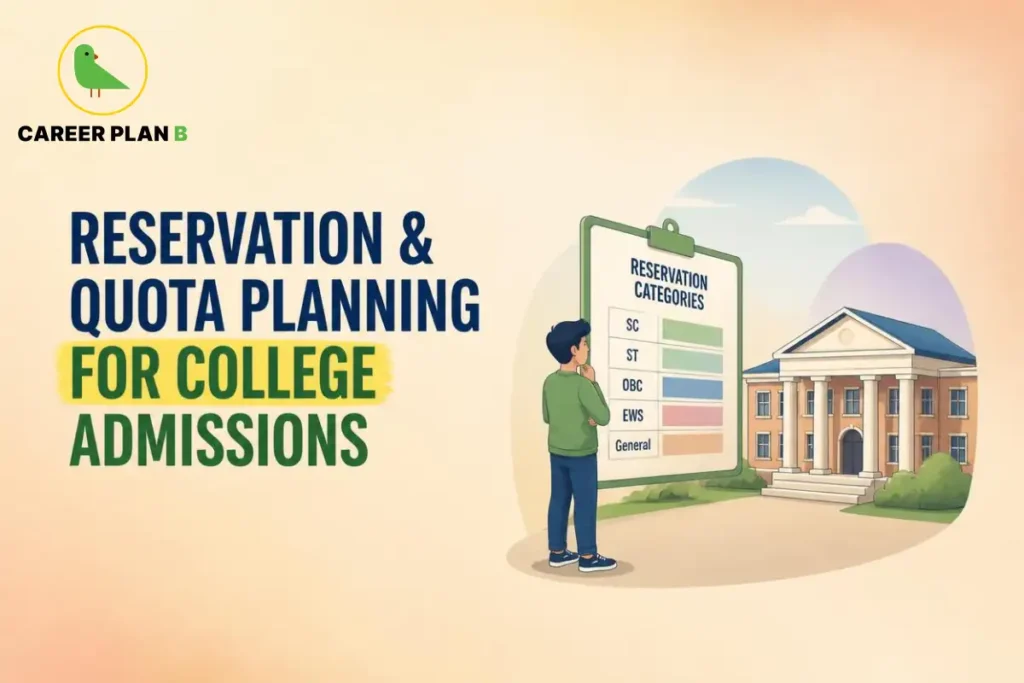
Introduction
Every year, thousands of students sit with their mark sheets in hand, wondering if they did “enough” to get into their dream college. What many don’t realise is that getting into a good college isn’t just about marks — it’s also about knowing the system. Reservation planning for college admissions is one of the most misunderstood, and most powerful, tools a student can use to their advantage. Yet, most families only discover it after the admission window has already closed.
If you’re a student planning for CUET 2027 or gearing up for central or state university admissions, this blog is your roadmap. We’ll walk you through how India’s reservation system actually works, who qualifies for what, what documents you need, and how to plan smartly — so you don’t leave any opportunity on the table.
What Is the Reservation System, and Why Does It Matter for You?
Think of India’s college admission process like a race but one where different runners start from different points, based on historical and social context. The reservation system exists to level that playing field. It’s not charity; it’s a constitutional commitment.
Under Article 15(4) and Article 16(4) of the Indian Constitution, the government is empowered to make special provisions for socially and educationally backward classes. This translates directly into reserved seats in central universities, IITs, NITs, and state colleges across India.
Here’s the standard national breakdown of reservations in central institutions:
| Category | Reservation Percentage |
|---|---|
| Scheduled Caste (SC) | 15% |
| Scheduled Tribe (ST) | 7.5% |
| Other Backward Classes (OBC-NCL) | 27% |
| Economically Weaker Section (EWS) | 10% |
| Unreserved/General | 40.5% |
So if a college has 100 seats, around 49.5 seats are reserved for various categories. That’s significant. And if you belong to any of these categories but haven’t planned around it, you may be missing seats that are rightfully accessible to you.
Who Qualifies? Breaking Down Each Category
SC and ST Reservations
Students belonging to Scheduled Castes and Scheduled Tribes get 15% and 7.5% reservation respectively in centrally funded institutions. The list of recognised SC/ST communities is notified by the central government and varies by state.
To claim this, you need a caste certificate issued by a competent state government authority — typically a Sub-Divisional Magistrate (SDM) or Tehsildar. This document is non-negotiable during admission.
You can verify recognised SC/ST communities through the Ministry of Social Justice and Empowerment and Ministry of Tribal Affairs.
OBC-NCL Reservations
OBC stands for Other Backward Classes, and the NCL part — Non-Creamy Layer is what trips most students up. Even if your community is listed as OBC, your family’s income must fall below ₹8 lakh per annum for you to qualify under OBC-NCL for central institutions.
This income limit was revised, and it’s important to verify the current threshold on the National Commission for Backward Classes (NCBC) website before applying.
Your OBC-NCL certificate must be issued in the current financial year for most central university admissions. An outdated certificate is one of the most common reasons students lose their reserved seats. Don’t let paperwork cost you a seat.
EWS Reservation
Introduced in 2019, the Economically Weaker Section (EWS) reservation gives 10% seats to students from general category families earning less than ₹8 lakh annually — provided they don’t own significant agricultural land or property beyond defined limits.
This is a relatively new category and many students from general-category families don’t realise they may qualify. Check the eligibility criteria on the Ministry of Personnel, Public Grievances and Pensions or your state government’s official portal.
Persons with Disabilities (PwD)
A horizontal reservation of 5% is provided for Persons with Disabilities (PwD) across all categories in central institutions, as per the Rights of Persons with Disabilities Act, 2016. Details are available on the Department of Empowerment of Persons with Disabilities portal.
CUET 2027: Why Reservation Planning Starts Today, Not Later
Here’s something students often say: “I’ll figure out the reservation stuff when the form comes.” That’s like packing your bags after the train has left.
CUET 2027 is your gateway to over 250 central and participating universities, including Delhi University, JNU, BHU, and Jamia Millia Islamia. The National Testing Agency (NTA) conducts CUET, and you can track all official updates on NTA’s official website and CUET’s portal.
Here’s why you need to plan your category documents right now, if CUET 2027 is your target:
- Caste and category certificates often take weeks to months to process at government offices
- OBC-NCL certificates need to be from the current financial year — timing matters
- Some states require fresh verification or affidavits for central university admissions
- EWS certificates need income verification from a gazetted officer, which has its own timeline
Planning for CUET 2027 isn’t just about studying for the exam. It’s about making sure your paperwork, your category, and your college shortlist are all aligned before the admission cycle begins.
How to Shortlist Colleges Based on Your Category
Most students make a list of colleges based on cut-offs from the general category and then feel discouraged. But here’s the thing: category-wise cut-offs are significantly different.
For example, at the University of Delhi, the cut-off difference between General and SC/ST categories can be anywhere from 10 to 20 percentage points depending on the course. This means a student who might not qualify under the general category could comfortably secure a seat under their reserved category.
Here’s how to approach college shortlisting smartly:
- Identify your category — SC, ST, OBC-NCL, EWS, or General
- Look at previous years’ category-wise cut-offs on official university websites.
- Check seat matrices — how many seats are reserved in each programme at each institution
- Note domicile rules — some state universities prioritise state residents in reserved categories
- Cross-check with CUET subject requirements — your subject combination in Class 12 must align with the programme’s CUET paper requirements
For Personalized Guidance
Documents You Cannot Afford to Miss
Getting your documents wrong is one of the most heartbreaking parts of the admission season. Students lose confirmed seats every year because of expired certificates, wrong issuing authorities, or mismatched names.
Here’s a checklist to keep handy:
For SC/ST students:
- Caste certificate from competent state authority
- Community verification document (in some states)
For OBC-NCL students:
- OBC-NCL certificate (current financial year)
- Community listed in the Central OBC List (verify at NCBC)
Also For EWS students:
- EWS income and asset certificate (issued by Tehsildar or SDM)
- Must be from the current financial year
For PwD students:
- Disability certificate from a government medical board
- UDID card (Unique Disability ID), available through UDID Portal
General documents (all students):
- Class 10 and 12 mark sheets and certificates
- Domicile certificate (if applying under state quota)
- Aadhaar card
- Passport-size photographs
State Quota vs. Central Quota: Know the Difference
Here’s something that surprises many families: reservation rules are different for state and central institutions. Central universities follow the central government’s reservation policy. State universities follow state government policies and these can vary quite a bit. For example:
- Some states have reservation percentages higher than the central norm (Tamil Nadu has 69% reservation under state law)
- Domicile reservations are common in state universities — students from outside the state may not be eligible for reserved category seats
- Some states have additional sub-categories within OBC, such as MBC (Most Backward Classes)
Always check the official website of the specific university or state government for the most accurate and updated reservation breakdown.
How Career Plan B Helps
Career Plan B helps students navigate CUET 2027 planning with structured guidance, ensuring that admission decisions, academic planning, and career choices are approached with clarity and confidence:
- Personalized Career Counselling: Helps students understand their academic goals, evaluate available pathways, and make informed decisions about courses, colleges, and future opportunities.
- Psycheintel & Career Assessment Tests: Provides data-backed insights into aptitude, personality traits, interests, and learning styles, helping students identify subject choices and career paths that genuinely match their strengths.
- Admission & Academic Profile Guidance: Supports students in strengthening their academic profile, understanding admission requirements, keeping track of important documents and timelines, and preparing strategically for applications.
- Subject & College Alignment: Helps students connect subject selections with university eligibility, preferred courses, and long-term career aspirations, ensuring academic choices support future goals.
- Career Roadmapping: Creates a structured, step-by-step plan that links Class 12 preparation, CUET 2027, university admissions, and long-term career objectives into one clear direction.
- End-to-End Guidance: Assists students throughout the process so they can make informed decisions with greater confidence and avoid unnecessary confusion during the admission journey.
For Latest Information
Frequently Asked Questions (FAQs)
Q1. Can I apply under both OBC-NCL and EWS categories?
No. These are separate categories. OBC-NCL is for communities listed as Other Backward Classes with income below the creamy layer limit. EWS is only for students from the General category whose family income is below ₹8 lakh per annum. You can only apply under one category.
Q2. My OBC certificate is from last year. Can I still use it for CUET 2027 admissions?
Most central universities require an OBC-NCL certificate issued in the current financial year. An old certificate is typically not accepted. Start the renewal process early, ideally a few months before the admission cycle.
Q3. Does reservation apply to CUET scores or only to seat allotment?
Reservation applies at the seat allotment stage, not the CUET exam itself. All students write the same exam. Category-wise merit lists are prepared separately during university admissions.
Q4. I belong to an SC community in one state but am studying in another. Which state’s certificate do I need?
You need a caste certificate issued by the state where your community is officially notified as SC. SC/ST lists are state-specific. A certificate from a different state where your community is not notified as SC will not be accepted.
Q5. Is there reservation for sports or NCC/NSS quotas?
Yes. Many central and state universities offer supernumerary seats for outstanding sports persons, NCC cadets, and NSS volunteers. These are separate from the standard reservation categories. Check individual university prospectuses on their official websites for details.
Conclusion
Reservation planning for college admissions isn’t something to figure out at the last minute — it’s a strategy, and like all good strategies, it works best when you start early. Whether you’re aiming for a central university through CUET 2027 or targeting a state institution, understanding your category, gathering the right documents, and aligning your college list accordingly can genuinely change your outcome.
You’ve worked hard in school. You deserve to walk into the admission process fully prepared, not scrambling at the last minute because of a missing certificate or an expired document. Your category is not just a box to tick on a form; it’s a door that’s already open for you. The only question is whether you know how to walk through it.