Team Career Plan B · October 3, 2026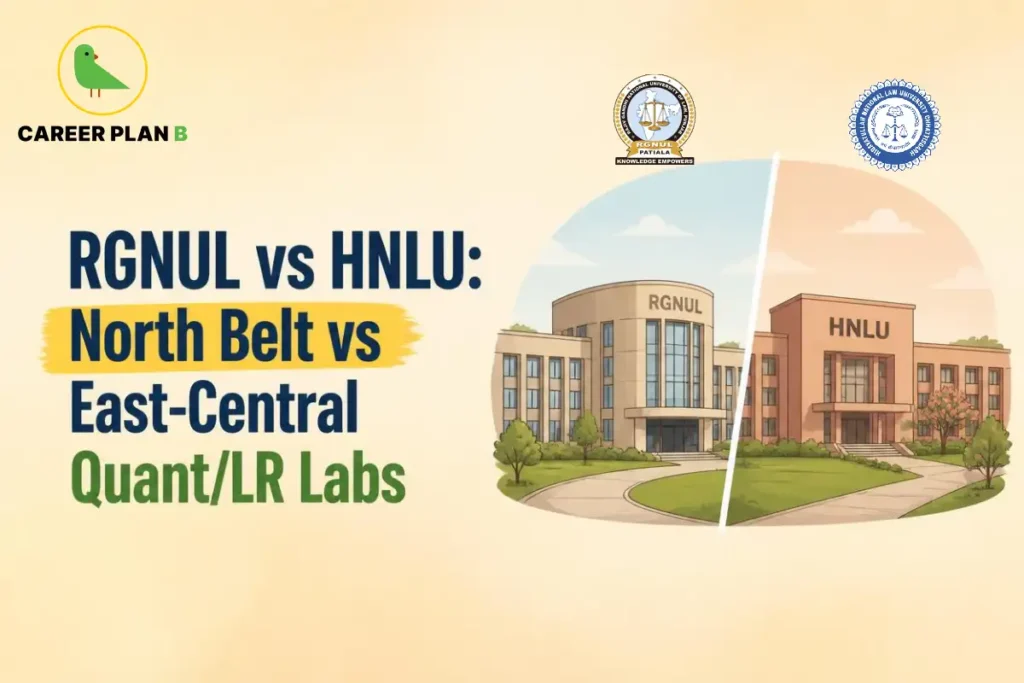
Introduction
Data-driven research and courtroom reasoning represent two different training grounds, and this exact split defines RGNUL vs HNLU. RGNUL Patiala, based in Punjab’s northern belt, has built genuine technical infrastructure through its digital forensics laboratory and Law and Tech Times research team. HNLU Raipur, meanwhile, based in Chhattisgarh’s east-central region, channels student development through five state-of-the-art moot court halls, backed by a dedicated annual funding commitment. Consequently, CLAT aspirants weighing these two institutions should consider whether tech-driven, data-heavy research or funded, reasoning-intensive mooting suits them better. This blog compares infrastructure, research centres, and reasoning culture at both universities.
What Makes RGNUL Patiala’s Quant-Orientated Infrastructure Different?
RGNUL, established in 2006 under Punjab Act No. 12, operates from a 50-acre campus in Sidhuwal. Moreover, the university has invested specifically in data-and-technology-linked research infrastructure, distinguishing it from many peer institutions.
Digital Forensics and Law-and-Technology Research at RGNUL
According to official reporting confirmed through RGNUL’s own channels, the university established a digital forensics laboratory in collaboration with the National Forensic Sciences University, under the NFSU-RGNUL Advanced Center for Research in Forensic Justice. Furthermore, according to the official RGNUL Law and Tech Times, a dedicated student research team focuses specifically on blockchain, artificial intelligence, data storage, and data protection law. Additionally, the official RGNUL-CADR publication confirms the university’s Centre for Alternate Dispute Resolution has operated since 2018, publishing its own review series. Therefore, RGNUL students build genuinely quant-adjacent, data-literate reasoning skills through technology-focused research.
What Makes HNLU Raipur’s Reasoning-Intensive Moot Culture Different?
HNLU Raipur, established in 2003, has instead built its academic identity around heavily funded, structured courtroom reasoning. According to the official HNLU, the university follows a Hub-and-Spoke Research Architecture (R-HaS), comprising 25 research centres organised under five schools of excellence.
Funded Moot Court Infrastructure at HNLU
Furthermore, according to the official HNLU Facilities, the university maintains five state-of-the-art Moot Court Halls, carefully designed to match the standards of the Supreme Court and High Courts. Notably, HNLU spends Rs. 1 crore annually to support student participation in moot court competitions, seminars, and conferences at national and international levels. Consequently, HNLU positions itself as the only law school in the country offering fully funded participation in international moots, including Jessup, Vis Vienna, and the Oxford Price Media Law competitions.
RGNUL vs HNLU: A Side-by-Side Comparison
| Factor | RGNUL Patiala | HNLU Raipur |
|---|---|---|
| Established | 2006 | 2003 |
| Core Orientation | Data, forensics, and technology-linked research | Funded, reasoning-intensive moot court culture |
| Distinctive Infrastructure | Digital Forensics Laboratory (with NFSU) | Five state-of-the-art Moot Court Halls |
| Research Structure | Law and Tech Times, RGNUL-CADR | Hub-and-Spoke Architecture: 25 research centres |
| Annual Moot Funding | Not separately publicised | Rs. 1 crore annually for competitions |
Tech-Driven Data Labs or Funded Reasoning Practice: Which Suits You?
This question sits at the centre of the RGNUL vs HNLU decision. If you’re drawn toward data analysis, forensic science, and emerging technology law, RGNUL’s digital forensics laboratory and dedicated tech research team offer genuinely applied, quant-adjacent training. However, if you value sustained, heavily funded exposure to competitive courtroom reasoning, HNLU’s five dedicated Moot Court Halls and Rs. 1 crore annual budget give students unmatched practical advocacy opportunities. Neither approach is inherently superior; instead, the right fit depends on whether data-driven research or funded reasoning practice appeals to you more.
For Personalized Guidance
How Institutional Investment Shapes Student Skill Development
RGNUL’s investment in forensic and technology infrastructure signals a deliberate push toward interdisciplinary, data-literate legal training, positioning graduates for careers touching cyber law and digital evidence. HNLU’s substantial moot funding, meanwhile, reflects an equally deliberate commitment to producing confident, competition-ready advocates through repeated national and international exposure. Therefore, both universities invest heavily, just toward genuinely different skill outcomes.
Research Depth Beyond the Headline Infrastructure
RGNUL supplements its tech-focused labs with a broader network of centres for advanced study, including criminal law, consumer protection, and international humanitarian law. HNLU similarly runs 25 research centres under its hub-and-spoke architecture, spanning constitutional law, digital governance, and climate justice. Additionally, both universities layer this research depth on top of their signature strengths, giving students well-rounded academic support regardless of specialisation.
How Career Plan B Helps
Choosing between RGNUL’s technology-driven research infrastructure and HNLU’s funded, moot-court-focused reasoning environment depends on understanding your interests, learning approach, and future legal career direction. Career Plan B helps CLAT aspirants evaluate these differences through structured guidance and personalised planning.
Personalised Career Counselling: Helps students identify whether RGNUL’s data-driven, technology-orientated research ecosystem or HNLU’s advocacy-focused moot culture better matches their interests, strengths, and preferred method of learning law.
Psychometric & Career Assessment Tests: Helps analyse individual abilities such as analytical reasoning, technology aptitude, research inclination, communication skills, and argument-building skills to understand which academic environment suits the student better.
Career Roadmapping: Helps students create a practical roadmap by connecting their university choice with future goals such as cyber law, digital evidence, forensic legal research, litigation, arbitration, moot advocacy, or policy-orientated legal careers.
Admission & Academic Profile Guidance: Helps aspirants compare RGNUL Patiala and HNLU Raipur based on CLAT admission, research infrastructure, moot court opportunities, academic culture, and career pathways to make a well-informed law school decision.
Get In Touch With Us
Frequently Asked Questions
Q1. Which entrance exam applies to both RGNUL and HNLU?
Both universities admit undergraduate law students through CLAT-UG, conducted by the Consortium of National Law Universities.
Q2. What is RGNUL’s digital forensics laboratory?
It is a joint initiative with the National Forensic Sciences University, established under the NFSU-RGNUL Advanced Center for Research in Forensic Justice.
Q3. How much does HNLU spend annually on moot court funding?
According to HNLU’s official facilities page, the university spends Rs. 1 crore every year supporting student participation in moot competitions and conferences.
Q4. What is HNLU’s Hub-and-Spoke Research Architecture?
It is a research structure comprising 25 research centres organised under five Schools of Excellence, covering areas from digital governance to climate justice.
Q5. Where can I check official details on RGNUL’s technology research team?
Refer to the official RGNUL Law and Tech Times page.
Q6. Where can I check official details on HNLU’s moot court infrastructure?
Refer to the official HNLU Facilities page.
Conclusion
Weighing RGNUL vs HNLU ultimately comes down to whether tech-driven research or funded reasoning practice matters more to you. RGNUL Patiala offers genuinely applied infrastructure through its digital forensics laboratory and dedicated law-and-technology research team. HNLU Raipur, meanwhile, offers unmatched, heavily funded moot court infrastructure, backed by five dedicated halls and a Rs. 1 crore annual commitment. Both universities admit through CLAT and support broader research through extensive centre networks. Before applying, check the official infrastructure and research pages of both institutions directly, since facilities and funding commitments are updated regularly.
And if you’re still weighing data-driven research against funded reasoning practice, Career Plan B can help you think it through with guidance built around your own interests.