Team6 · August 12, 2026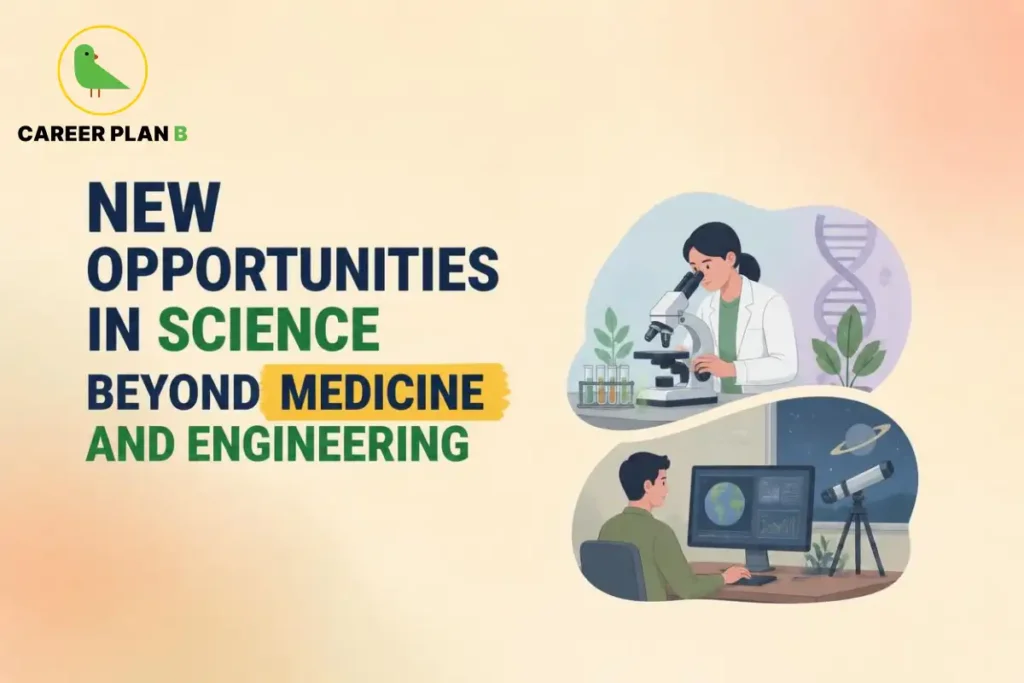
Introduction
Ask a science student what they’re planning to do, and the answer usually falls into one of two buckets: medicine or engineering. It’s an understandable default. Both fields are visible, well-understood, and heavily discussed at home and in school.
They’re also not the only real options. India’s science ecosystem includes research institutions, space agencies, environmental bodies, and biotechnology programs that offer genuine, well-supported careers, often with less competition than the two most obvious paths.
This guide covers real New Opportunities in Science beyond medicine and engineering. It looks at what each path involves, which government bodies support it, and how to start building toward it.
Why These Paths Get Overlooked
A few reasons explain why students rarely consider these options seriously, even when they fit a student’s interests well.
Visibility is uneven
Medicine and engineering dominate career conversations at home, in coaching centres, and in school counselling, simply because they’re familiar and well-trodden. Other science paths get far less airtime, not because they’re weaker, but because they’re less discussed.
The path looks less linear
Medicine has a clear sequence: study, clear an entrance exam, get a degree, practise. Many other science careers require more active planning, since the path isn’t as standardised or as widely explained.
Families default to known options
When a career isn’t well understood, it’s harder for parents to feel confident supporting it, even when the underlying opportunity is genuinely strong.
Path One: Research Careers in Core Sciences
India’s research ecosystem runs through a network of institutions that actively fund and train young scientists, well beyond university faculties alone.
The Council of Scientific and Industrial Research runs a large network of national laboratories across physics, chemistry, biology, and materials science. Students with a strong BSc or MSc background can pursue research fellowships here, often leading into PhD programs and long-term research careers. The Department of Science and Technology also funds research programs and fellowships specifically aimed at bringing young scientists into structured research roles early.
What this path looks like: a BSc in a core science subject, followed by an MSc, and entry into a funded research fellowship or PhD program at a recognised institute.
Path Two: Space Science and Related Technical Roles
India’s space program has expanded well beyond a small, specialist field, and it now offers real, structured career entry points for science graduates.
The Indian Space Research Organisation recruits scientists and engineers across physics, mathematics, materials science, and remote sensing, not just aerospace engineering specifically. Beyond direct ISRO roles, a growing ecosystem of private space-tech startups has emerged around satellite technology, remote sensing analytics, and space data applications, creating additional entry points beyond the government agency itself.
What this path looks like: a strong science or engineering background, often with a postgraduate specialisation in areas like remote sensing, astrophysics, or applied mathematics, followed by ISRO recruitment exams or private space-tech roles.
Path Three: Environmental and Climate Science
Environmental science has moved from a niche academic interest to an active, funded area of government work, particularly as climate policy has become a bigger national priority.
Government bodies and research institutes work on climate modelling, pollution monitoring, biodiversity research, and disaster prediction, often in partnership with international science bodies. This field increasingly overlaps with data science too, since much environmental work now involves analysing large datasets from satellites, sensors, and monitoring stations.
What this path looks like: a BSc or MSc in environmental science, ecology, or a related field, paired with data analysis skills, leading into research institutes, government environmental agencies, or increasingly, private climate-tech startups.
Path Four: Biotechnology and Life Sciences Research
Biotechnology sits at the intersection of biology, chemistry, and increasingly, computational science, and it has grown into a genuinely well-funded government priority area.
The Department of Biotechnology and its associated funding body support research across genomics, drug discovery, agricultural biotechnology, and synthetic biology, often through structured fellowships and funded lab positions for young researchers. This field also connects closely with the growing use of AI and machine learning in biological research, creating hybrid roles for students who combine a life sciences background with computational skills.
What this path looks like: a BSc or MSc in biotechnology, microbiology, or a related life science, followed by a funded research position, a PhD, or an entry-level role at a biotech company doing applied research.
Path Five: Science Communication and Policy
Not every science career requires working in a laboratory. Science communication and science policy offer exciting opportunities to use scientific knowledge in different ways. These fields remain relatively underexplored despite growing demand.
Science communicators explain complex research to the public through media, educational organisations, and research institutions. Science policy professionals work with government bodies, think tanks, and funding agencies to shape research priorities and science-related policies.
What this path looks like: Complete a science degree, then strengthen your profile with strong writing, communication, or analytical skills. A short course in science communication or public policy can further improve your prospects. Career opportunities are available in research institutions, media organisations, government departments, and policy think tanks.
Path Six: Forensic Science
Forensic science applies scientific methods to criminal investigations. It is a specialised field that offers structured, government-supported career opportunities beyond medicine and engineering.
State forensic science laboratories and central forensic institutions recruit science graduates trained in forensic techniques. Career opportunities include DNA analysis, toxicology, fingerprint examination, and digital forensics. The rapid growth of cybercrime has also increased demand for professionals with expertise in digital investigations.
What this path looks like: Complete a BSc, followed by a specialised Diploma or MSc in Forensic Science. Graduates can build careers in state or central forensic laboratories, forensic research centres, or digital forensics and cybercrime investigation units.
Have Any Doubts?
A Quick Comparison of These Paths
| Path | Core Background Needed | Key Government Bodies Involved |
|---|---|---|
| Core science research | BSc/MSc in Physics, Chemistry, Biology | CSIR, DST |
| Space science | BSc/MSc in Physics, Math | ISRO, private space-tech |
| Env. & climate science | BSc/MSc in Env. Science, data skills | Govt environmental bodies |
| Biotech research | BSc/MSc in Biotech/Life sciences | Dept of Biotechnology |
| Science comm & policy | Science degree + writing/analysis | Research inst., think tanks |
| Forensic science | BSc + Forensic diploma/MSc | State/Central forensic labs |
How to Start Exploring These New Opportunities in Science
If one of these career paths interests you, take a few practical steps before making a long-term commitment.
Connect with a professor or researcher working in your chosen field and ask about project or internship opportunities. Explore whether your university offers electives, workshops, or short courses related to that area, even if it isn’t your core major.
Also, research the entrance exams, fellowships, or recruitment processes for your chosen career. Every science field follows a different pathway, so understanding the requirements early will help you plan with confidence.
How Career Plan B Helps
Exploring science careers beyond the two most obvious paths takes real research and, often, reassurance for both students and families. Career Plan B helps you build that clarity through:
- Personalised Career Counselling to help you and your family understand a less familiar science path with confidence.
- Psycheintel Career Assessment Tests to check whether research, communication, policy, or a technical specialisation genuinely fits your strengths.
- Admission and Academic Profile Guidance to help you identify the right postgraduate programs, fellowships, or entrance exams for your chosen path.
- Structured Career Roadmapping to build a clear, staged plan from your current science background toward one of these specific careers.
For Latest Information
Frequently Asked Questions
1. Are these science careers as financially stable as medicine or engineering?
Many are, particularly government research and policy roles, which offer structured pay scales and job security. Private biotech, space-tech, and climate-tech roles vary more, similar to other private sector fields, but often pay competitively for specialised skills.
2. Do I need a PhD to have a real career in research?
Not always. Some research support roles, technical positions, and industry-based research jobs are accessible with a strong MSc. A PhD matters more for independent research leadership or academic faculty positions specifically.
3. Can I switch into one of these paths from an engineering background?
Often, yes, particularly for space science, environmental data work, and biotech-adjacent computational roles, since these fields increasingly value technical and analytical skill alongside a pure science background.
4. How do I convince my family that a less familiar science path is a good idea?
Bring concrete information: which government bodies support the field, what the entry path actually looks like, and what real career outcomes exist. Vague enthusiasm is harder to support than a clear, researched plan.
5. Is science communication a real, paying career, or more of a hobby?
It’s a real, paying career, particularly within research institutions, science media outlets, and government communication roles. It does require deliberately building writing or communication skills alongside your science background, though.
Conclusion
Medicine and engineering are well-known career paths, but they are not the only options for science students. New opportunities in research, space science, environmental science, biotechnology, science communication, and forensic science offer strong, government-supported career pathways. Many of these fields also have less competition and greater scope to build a unique professional profile.
You don’t have to give up your interest in science to explore these careers. Instead, look beyond the traditional choices and discover fields that match your interests and strengths.
Not sure which science career is right for you? Career counselling can help you explore your options and make an informed decision with confidence.