Team Career Plan B · August 12, 2026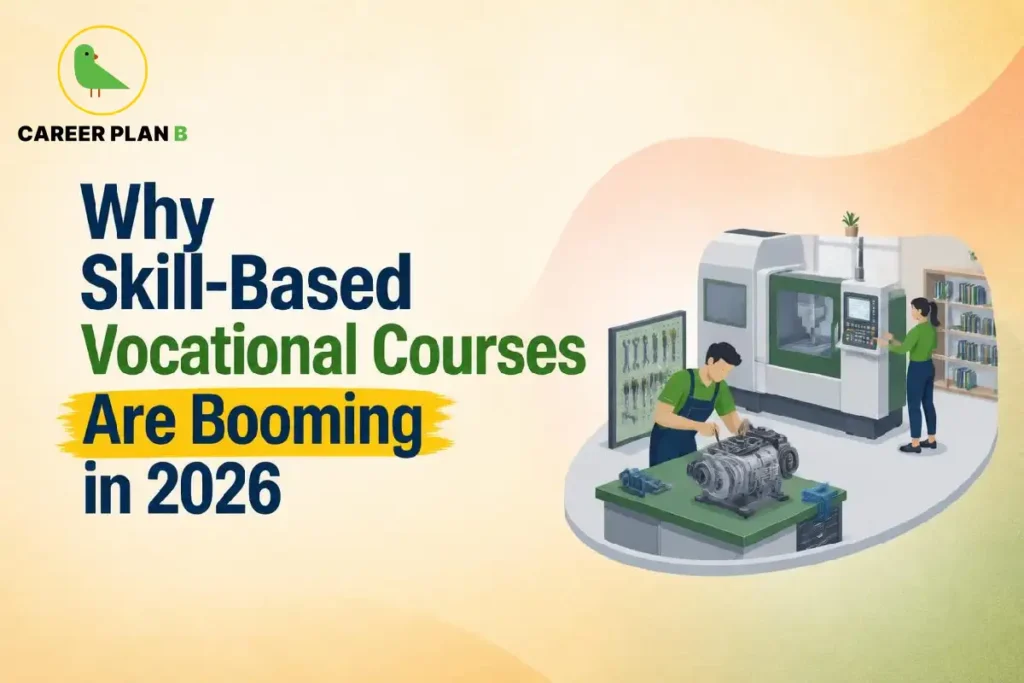
Introduction
Why are millions of Indian students now actively choosing vocational courses over traditional degrees?
This is not a passing trend. Real policy investment and verified enrolment data confirm that skill-based vocational courses are genuinely booming in 2026. This guide covers the key reasons behind this growth. You will also learn which official programmes are driving it and how you can benefit.
What Is Driving the Boom in Vocational Courses?
The growth of vocational education in 2026 comes from several forces working together.
Government Investment at Scale
India’s government has committed sustained, large-scale funding to vocational skilling through multiple schemes. This investment is not aspirational. It is showing up in verified enrolment and training numbers year on year.
Changing Employer Preferences
Employers across sectors are increasingly valuing demonstrable, practical skills alongside, or even instead of, a traditional degree. This shift has made certified vocational training more relevant than it was even five years ago.
The NSQF Equivalence Framework
The National Skills Qualifications Framework (NSQF) is overseen by the National Council for Vocational Education and Training. It now formally maps vocational qualifications alongside academic degrees on a single, comparable scale. This structural change has raised the credibility of vocational certification considerably.
The Numbers That Confirm the Boom
Verified data from government sources leaves little doubt about the scale of this shift.
PMKVY 4.0 Training Numbers
The Pradhan Mantri Kaushal Vikas Yojana (PMKVY) is India’s flagship short-term skilling scheme. It has trained over 27.08 lakh candidates under its fourth phase alone. This covers 38 sectors across 36 states and 732 districts.
Total Training Under PMKVY
Across its full run over the last five years, PMKVY has trained more than 53 lakh candidates nationally. A Parliamentary reply from the Ministry of Skill Development and Entrepreneurship confirmed this figure in December 2025.
Placement Rate Among Trained Candidates
The same Ministry response noted that around 70.5 per cent of surveyed PMKVY candidates received placement in their desired skill sectors. This shifts vocational training from a welfare programme into a genuine career pathway.
ITI Expansion
Between 2014 and 2025, the number of Industrial Training Institutes grew from around 9,977 to over 14,682, with more than 4,600 new ITIs established nationally. Enrolments have also risen from about 9.5 lakh to over 14 lakh trainees in the same period.
Why Vocational Courses Are More Attractive in 2026 Specifically
Several factors make 2026 a particularly strong year for vocational education.
Degree Inflation Is Making Employers Look Elsewhere
As more candidates hold general undergraduate degrees, employers in many sectors are looking for specific, demonstrable skills. A vocational certificate with verified practical training often stands out against a general degree without applied experience.
Shorter Timelines to Employment
Most vocational courses and ITI programmes complete in months, not years. For students who need to enter the workforce quickly, this timeline advantage is significant.
Recognition of Prior Learning
PMKVY’s Recognition of Prior Learning (RPL) component allows people with existing practical skills to gain formal certification through assessment alone. This formalises skills that were previously unrecognised, opening access to better roles.
Key Official Programmes Supporting This Boom
Several government programmes are actively sustaining this growth.
PMKVY 4.0
PMKVY 4.0 runs under the Ministry of Skill Development and Entrepreneurship. It covers sectors from IT-ITeS to aerospace, agriculture, rubber, leather, and hospitality. It is a demand-driven scheme, with training centres established based on state government and industry proposals.
National Apprenticeship Promotion Scheme (NAPS)
The National Apprenticeship Promotion Scheme has engaged over 41.95 lakh apprentices since its inception. This sits alongside PMKVY as a structured, income-generating route into skilled employment.
Skill India Digital Hub
The Skill India Digital Hub extends access to vocational and skilling programmes through a digital platform. This makes verified training accessible to students without a nearby physical training centre.
What This Means for Students Today
The vocational boom is not just a policy story. It has direct, practical implications for students choosing their education path.
Vocational Is No Longer a Fallback Option
The data confirms that vocational training, when taken through a recognised, government-approved programme, leads to real employment outcomes. This changes the perception of vocational courses from a fallback into a deliberate first choice.
The Best Entry Point Is Through Verified Programmes
Not all vocational courses carry the same credibility. Programmes under PMKVY, ITI, and NSQF-aligned institutions carry government backing. Unverified private courses without these markers offer no such assurance.
Portfolio of Skills Matters More Than Ever
Employers increasingly want evidence of what you can actually do. A vocational certificate from a recognised programme, paired with practical project work, builds this portfolio faster. A general academic degree alone rarely matches this advantage.
For Personalized Guidance
Benefits, Challenges, and What the Data Says
The benefits of this boom are well-documented. PMKVY data confirms scale, sectoral diversity, and genuine placement outcomes. NSQF provides structural legitimacy. NAPS provides income alongside training.
However, challenges remain. Parliamentary data from December 2025 noted low enrolment at some PMKK (Kaushal Kendra) training centres during the first half of FY 2025-26. This shows that execution gaps still exist despite strong overall numbers.
Students should verify the specific programme and centre they enrol in. Approvals, active status, and sector coverage should all be checked directly through official portals before committing.
The Outlook for Vocational Education Beyond 2026
PMKVY 4.0 runs until 2026 and is expected to be followed by continued government skilling investment. ITI numbers and enrolments are both growing steadily. NSQF adoption is expected to keep expanding across more employers and institutes.
This points toward vocational education becoming a mainstream, well-respected pathway by the end of this decade. It will no longer be seen as an alternative route.
How Career Plan B Helps
Understanding which vocational programme genuinely fits your goals can feel overwhelming without guidance. Career Plan B simplifies this through:
- Personalised Career Counselling: identifying which vocational stream aligns with your specific interests and career goals
- Psycheintel Career Assessment Tests: confirming whether skill-based, hands-on work suits your genuine strengths
- Admission and Academic Profile Guidance: verifying PMKVY, ITI, and NSQF-aligned programmes relevant to your field
- Structured Career Roadmapping: a clear plan from vocational enrolment to your first certified career role
Get In Touch With Us
Frequently Asked Questions
Q1. Why are vocational courses growing so fast in India in 2026?
Government investment through PMKVY, ITI expansion, and NSQF recognition has made vocational training more credible and accessible than before.
Q2. How many people have been trained under PMKVY?
More than 53 lakh candidates were trained under PMKVY in the last five years, as confirmed by a December 2025 Parliamentary reply.
Q3. What placement rate does PMKVY report?
Around 70.5 per cent of surveyed PMKVY candidates received placement in their desired skill sectors. This was confirmed by the Ministry of Skill Development and Entrepreneurship.
Q4. How do I know if a vocational programme is genuinely recognised?
Check the programme’s PMKVY, ITI, or NSQF alignment directly through the official MSDE or NCVET portals before enrolling.
Q5. Is vocational training only for those who could not get into college?
No. The 2026 data shows vocational training is increasingly a deliberate first choice. Students seeking faster, practical career entry are driving this shift.
Q6. What is the difference between PMKVY and ITI training?
PMKVY offers shorter, sector-specific short-term training. ITI offers longer, more structured technical training over one to two years, with broader trade coverage.
Conclusion
Skill-based vocational courses are booming in 2026 for reasons backed by real, verified data.
Over 53 lakh candidates trained under PMKVY, a 70.5% placement rate, and 14,682 ITIs across India confirm this is a structural shift. It is not a surface trend. The NSQF framework has elevated vocational qualifications to formal, comparable standing alongside academic degrees.
Start by identifying your area of interest, then explore PMKVY, ITI, or NSQF-aligned programmes through official portals.
Ready to explore which vocational course genuinely fits your goals? Talk to a Career Plan B counsellor and get a personalised roadmap today.