Team Career Plan B · October 8, 2026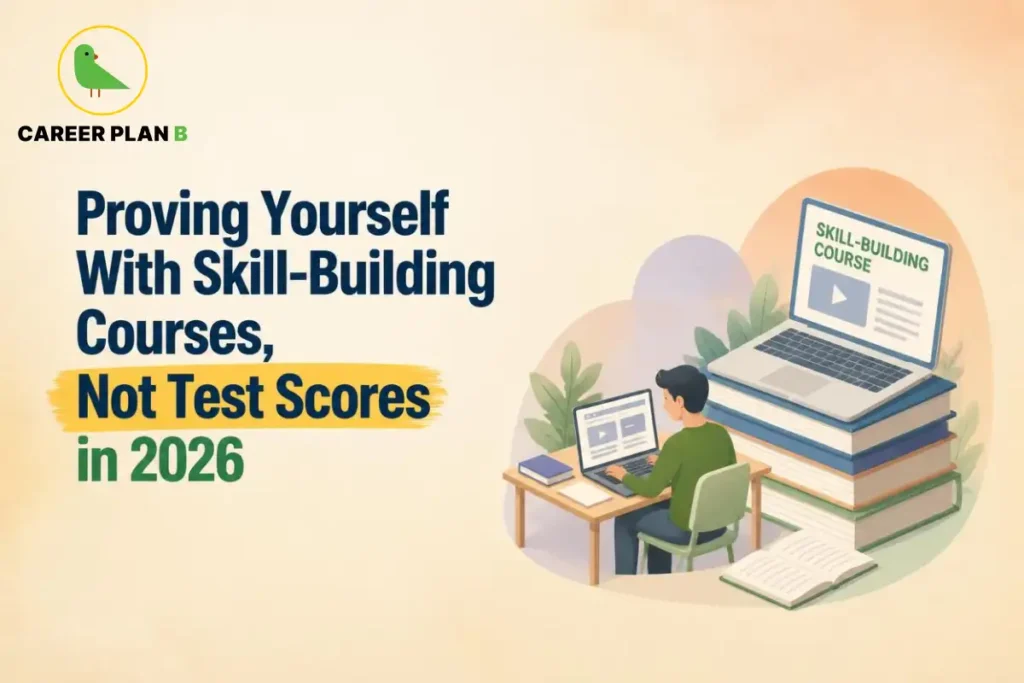
Introduction
Some students light up in a classroom during a written exam. Others come alive with a tool, a screen, or a real problem to solve. If you’re the second kind, you may feel the Indian education system wasn’t built for you.
Skill-Building Courses exist for students like this. Instead of asking you to prove yourself through one high-pressure test, they focus on what you can actually do. You can build, fix, design, sell, communicate, or create. In 2026, this is no longer a fringe alternative. It’s a growing, government-backed part of India’s education and employment ecosystem.
If marks have never fully captured your abilities, this blog is for you. We’ll explain what skill-based courses are, how they’re officially recognized, and how you can use them to build a real career on your own terms.
Skill-Based Career Courses: What They Actually Are
Skill-Based Career Courses are training programmes built around demonstrable competence rather than exam performance. Instead of relying on one three-hour paper, they assess practical tasks, projects, and hands-on skills linked to a specific job role.
In India, this isn’t an informal or unregulated space. It operates through a structured government framework:
- NCVET (National Council for Vocational Education and Training) is the regulatory body for vocational education and training. It recognizes and standardizes training providers, awarding bodies, and assessment agencies across the country.
- Sector Skill Councils, set up under the National Skill Development Corporation (NSDC), define job roles and the skills required for them. They cover sectors from IT and retail to media, healthcare, and manufacturing.
- The National Skills Qualification Framework (NSQF) organizes these qualifications by competency level. It allows learners to move between vocational, school, and higher education systems.
This means Skill-Based Career Courses aren’t just “shortcuts.” They’re a formally recognized parallel track to traditional degree-and-exam education. They also have established oversight and quality checks.
Courses Without Entrance Exams
One of the biggest relief points for many students is realizing how many career paths exist as Courses Without Entrance Exams. Here’s what that typically looks like:
- Skill certification programmes – These align with National Occupational Standards for specific job roles. They usually last a few months to a year and focus on hands-on capability.
- ITI (Industrial Training Institute) courses – This long-standing government vocational network trains students in technical trades without requiring a competitive entrance exam. India’s ITI ecosystem has expanded significantly. The number grew from around 9,977 institutes in 2014 to over 14,682 today. Enrolments also rose from about 9.5 lakh to over 14 lakh trainees.
- Sector-specific vocational diplomas – These cover fields such as digital marketing, retail operations, hospitality service, and technical trades. Admission usually depends on Class 10 or 12 completion rather than a rank.
- Apprenticeships – These combine paid, on-the-job training with structured learning. They let you build real work experience alongside your certification.
Admission into these programmes generally depends on eligibility, such as your educational stage. Some may also include a basic aptitude check. They don’t usually require a nationally ranked, high-stakes exam.
Read more :- Why Good Marks Don’t Guarantee Career Success
Skills Over Test Scores: Why This Shift Matters
The idea of Skills Over Test Scores isn’t just a feel-good phrase. It reflects a real and deliberate policy direction in India.
The Ministry of Skill Development and Entrepreneurship’s review shows the scale of this shift. Under the Pradhan Mantri Kaushal Vikas Yojana (PMKVY) 4.0 alone, more than 28.17 lakh candidates were trained across 36 sectors in 36 states by June 2026. The programme also introduced 68 customised courses and 189 future-skill job roles. The government has also developed more than 600 new job roles in emerging areas. These include semiconductors, AI, cybersecurity, and renewable energy.
This tells us something straightforward: India’s skilling infrastructure isn’t a backup plan for students who “couldn’t make it” academically. It’s being built as a primary employment pathway alongside traditional degree education.
For students who struggle with exam pressure but thrive with hands-on work, this shift matters. Your strengths can now have a formally recognized and supported route to a real career.
For Personalized Guidance
Career-Focused Certification Courses Worth Exploring
If you’re ready to explore specific options, here are categories of Career-Focused Certification Courses to look into based on your interests:
| Interest Area | Type of Certification to Explore |
|---|---|
| Technical trades (electrical, fitting, welding) | ITI diploma courses |
| Digital & IT skills | NSDC-aligned IT/ITES sector courses |
| Retail & sales | Retail sector skill certifications (NSQF-aligned) |
| Hospitality service roles | Vocational hospitality certifications |
| Creative & media | Media & entertainment sector skill courses |
| Renewable energy & green jobs | New-age job role certifications under MSDE’s emerging sector missions |
When researching any of these, always check whether the certifying body is NCVET-recognized or aligned with a legitimate Sector Skill Council under NSDC. This is the simplest way to separate a credible skill-building course from an unverified private training claim.
Skill-Building Courses 2026: Getting Started the Right Way
If you’re planning to pursue Skill-Building Courses 2026, here’s a practical starting checklist:
- Identify your genuine interest area first — don’t just chase whatever sounds trendy. Skill-building only works if you actually enjoy doing the work.
- Check NCVET recognition or NSQF alignment for any course or institute you’re considering — this is your quality assurance marker.
- Look at the specific job role, not just the course title. Qualification packs are tied to defined job roles, so understand exactly what you’ll be trained and assessed for.
- Consider combining certification with practical exposure — apprenticeships or internships alongside your course dramatically strengthen your readiness for real work.
- Don’t assume skill-based means “lesser.” These pathways are formally recognized within India’s education framework and can lead to solid, respectable careers, often faster than a traditional degree track.
How Career Plan B Helps
If test scores have never told the full story of your abilities, Career Plan B helps you build a career path around what you can actually do.
- Personalized Career Counselling: We help you identify skill-based paths that align with your genuine strengths, not just academic performance.
- Psychometric & Career Assessment Tests: Our assessments highlight practical, hands-on aptitudes that traditional exams often miss.
- Career Roadmapping: We map out a clear route through recognized skill-building courses and certifications tailored to your interests.
- Admission & Academic Profile Guidance: We help you verify which courses and institutes are genuinely NCVET-recognized or NSDC-aligned before you commit.
Get In Touch With Us
Frequently Asked Questions
Q1. Are skill-building courses officially recognized in India?
Yes. The National Council for Vocational Education and Training (NCVET) regulates and recognizes vocational training providers, awarding bodies, and assessment agencies across India.
Q2. Do skill-based courses require an entrance exam?
Most don’t. Admission is typically based on your educational stage (Class 10 or 12 completion) and sometimes a basic aptitude check, rather than a competitive national exam.
Q3. Are ITIs a good option for students who don’t want to write competitive exams?
Yes. Industrial Training Institutes (ITIs) are a long-standing government vocational education network, and they’ve expanded significantly in recent years, with rising enrolments nationwide.
Q4. How do I know if a certification course is legitimate?
Check whether it’s recognized by NCVET or aligned with a Sector Skill Council under NSDC. This confirms the course meets government-set quality standards.
Q5. Can a skill-based certification lead to a real, stable career?
Yes. These certifications are tied to defined job roles developed with industry input, and government skilling missions have trained lakhs of candidates across dozens of sectors in recent years.
Conclusion
Not everyone proves their ability best through a written exam, and that’s completely okay. Skill-building courses offer a legitimate, government-recognized way to demonstrate what you’re truly capable of, without your future hinging on a single test score.
Whether it’s a technical trade, a creative field, or an emerging sector like renewable energy or AI, India’s skilling ecosystem is actively expanding to make room for hands-on talent. If you’re ready to explore a path that values your real abilities, reach out to Career Plan B and let’s build a career plan around your strengths, not just your marks.